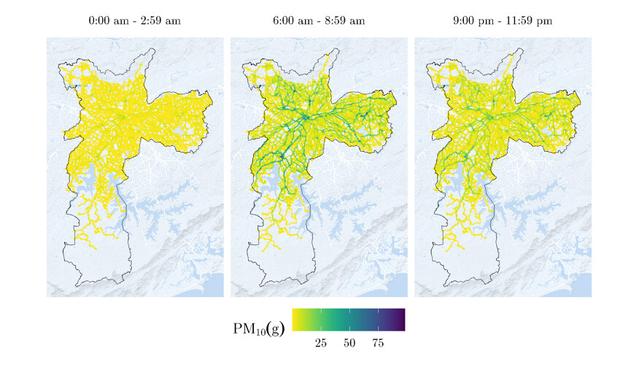
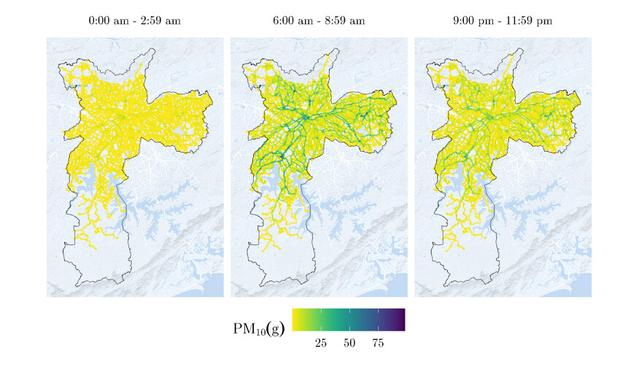
2. We're now using #gtfs2gps to estimate public transport emissions with the new #gtfs2emis package in #rstats.
📦Package: https://ipeagit.github.io/gtfs2emis/
🔖Paper preprint: https://osf.io/8m2cy/
🌐Blog post: https://transportpolicymatters.org/2022/12/12/measuring-public-transport-emissions/

What applications could gtfs2gps help you with?

Estimating Public Transport Emissions from General Transit Feed Specification (GTFS) Data

A bottom up model to estimate the emission levels of public transport systems based on General Transit Feed Specification (GTFS) data. The package requires two main inputs: i) Public transport data in the GTFS standard format; and ii) Some basic information on fleet characteristics such as fleet age, technology, fuel and Euro stage. As it stands, the package estimates several pollutants at high spatial and temporal resolutions. Pollution levels can be calculated for specific transport routes, trips, time of the day or for the transport system as a whole. The output with emission estimates can be extracted in different formats, supporting analysis on how emission levels vary across space, time and by fleet characteristics. A full description of the methods used in the gtfs2emis model is presented in Vieira, J. P. B.; Pereira, R. H. M.; Andrade, P. R. (2022) <doi:10.31219/osf.io/8m2cy>.

How clean is our public transport? Introducing a new tool to measure&nbsp;emissions

Transport Policy Matters
Very glad to share #gtfs2emis, a new model to estimate the environmental emissions of public transport systems using #GTFS data. Co-eveloped with @joaopbazzo & P. Andrade (@dsrinpe).
📦Package in #rstats: https://ipeagit.github.io/gtfs2emis/
🔖Preprint with method: https://osf.io/8m2cy/
Estimating Public Transport Emissions from General Transit Feed Specification (GTFS) Data

A bottom up model to estimate the emission levels of public transport systems based on General Transit Feed Specification (GTFS) data. The package requires two main inputs: i) Public transport data in the GTFS standard format; and ii) Some basic information on fleet characteristics such as fleet age, technology, fuel and Euro stage. As it stands, the package estimates several pollutants at high spatial and temporal resolutions. Pollution levels can be calculated for specific transport routes, trips, time of the day or for the transport system as a whole. The output with emission estimates can be extracted in different formats, supporting analysis on how emission levels vary across space, time and by fleet characteristics. A full description of the methods used in the gtfs2emis model is presented in Vieira, J. P. B.; Pereira, R. H. M.; Andrade, P. R. (2022) <doi:10.31219/osf.io/8m2cy>.

#gtfs2emis is a bottom-up model that allows one to estimate the emissions of each public transport vehicle at high spatial and temporal resolutions with little data requirements. More info on this 🧵by @joaopbazzo
---
RT @joaopbazzo
📦gtfs2emis is finally on CRAN!
An R package to estimate the emission levels of public transport vehicles based on General Transit Feed Specification (GTFS) data.
Quick thread of our new pre-print, by @Urban…
https://twitter.com/joaopbazzo/status/1593260736603598848
Joao Bazzo on Twitter

“📦gtfs2emis is finally on CRAN! An R package to estimate the emission levels of public transport vehicles based on General Transit Feed Specification (GTFS) data. Quick thread of our new pre-print, by @UrbanDemog, Pedro Andrade (INPE), and me. 🔗 https://t.co/4zR75axSyt”

Twitter
This is the result of over 2 years of collaboration with @joaopbazzo and Pedro Andrade (INPE). The real work is just starting now. #gtfs2emis #transportemissions #publictransport #sustainablemobility