Our paper “Exploring the time geography of public transport networks with the gtfs2gps package” came out published in
@JGeoSys
a couple weeks ago. Quick thread:
Paper🔖 https://link.springer.com/article/10.1007/s10109-022-00400-x
🔓PDF https://urbandemographics.org/publication/2022_jgs_time_geography_gtfs2gps/
R package📦 https://ipeagit.github.io/gtfs2gps/
Exploring the time geography of public transport networks with the gtfs2gps package - Journal of Geographical Systems

The creation of the General Transit Feed Specification (GTFS) in the mid-2000s provided a new data format for cities to organize and share digital information on their public transport systems. GTFS feeds store geolocated data on public transport networks, including information on routes, stops, timetables, and service levels. The GTFS standard is now widely adopted by thousands of transport authorities and a wide variety of software applications for different purposes, including trip planning, timetable creation and accessibility analysis. Yet, there is still a lack of tools to parse GTFS data when the objective is to analyze the complex spatial and temporal patterns of public transport systems. This paper presents {gtfs2gps}, a new general-purpose computational tool to easily process static GTFS data that allows one to analyze the space–time trajectories of public transport vehicles at fine spatial and temporal resolutions. {gtfs2gps} is an open-source R package that employs parallel computing to convert GTFS feeds from relational text files into a trajectory data table, similar to GPS records, with the timestamps of vehicles in every trip. This paper explains the package functionalities and demonstrates how {gtfs2gps} can be used to articulate key concepts in time geography to explore and visualize the spatial and temporal patterns of public transport networks. We also present a case study looking at how {gtfs2gps} can be used to examine socioeconomic and spatial–temporal inequalities in access to public transport, providing key information to monitor cities’ progress toward the Sustainable Development Goals. The paper is accompanied by a computational notebook in R Markdown to support reproducibility of the results in this paper and to replicate the analysis for other contexts where GTFS data are available. Given the widespread use of GTFS, {gtfs2gps} opens new possibilities for researchers to examine the time geography of public transport systems in urban areas across the globe.
SpringerLink
In this paper,
@joaopbazzo
, P.Andrade (
@dsrinpe
) and I introduce #gtfs2gps, an #rstats package that converts public transport data in #GTFS format to a trajectory data table format, similar to GPS records showing the timestamps of vehicles in every trip +
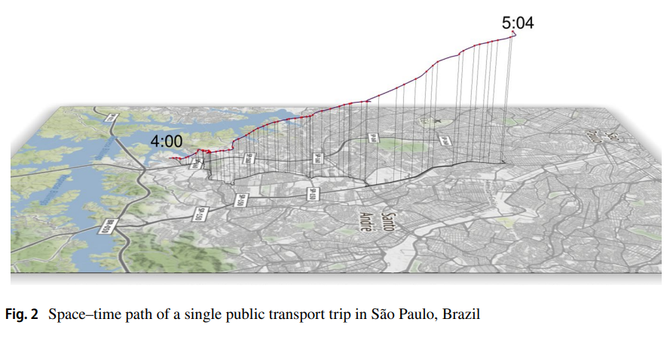
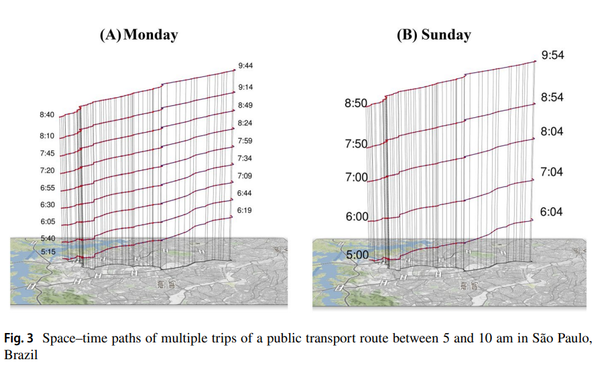
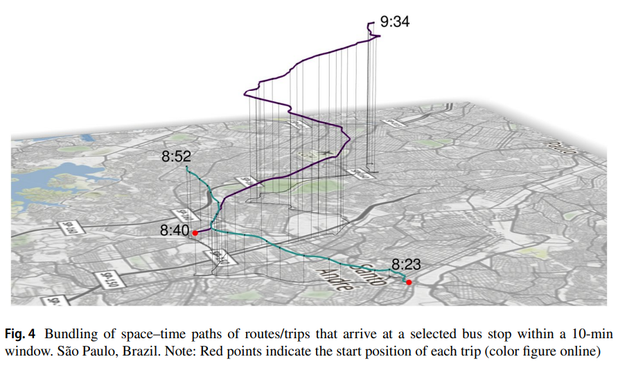
#gtfs2gps reports the space-time trajectories of public transport vehicles at fine spatial & temporal resolutions, which could be useful for several applications. We demonstrate the package in the paper in two ways:
First, we explain the package methods and demonstrate how #gtfs2gps can be used to articulate key concepts in #TimeGeography to explore and visualize the spatial and temporal patterns of public transport networks. Figures show the space-time paths and Bundling of trips #rayshader
Second, we present a case study in São Paulo to show how {gtfs2gps} can be used to examine socioeconomic and spatial–temporal inequalities in access to public transport, providing key information to monitor cities’ progress toward the Sustainable Development Goals #SDG11 #gtfs
Key message: #gtfs2gps outputs general purpose trajectory data that can be used for several applications:
1. Lewis Lehe et al have used #gtfs2gps to analyze bus stop spacings in the US, which can importantly influence service coverage & accessibility https://findingspress.org/article/27373-distributions-of-bus-stop-spacings-in-the-united-states

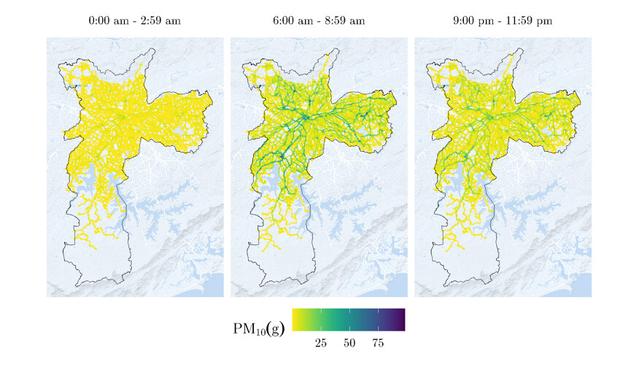
2. We're now using #gtfs2gps to estimate public transport emissions with the new #gtfs2emis package in #rstats.
📦Package: https://ipeagit.github.io/gtfs2emis/
🔖Paper preprint: https://osf.io/8m2cy/
🌐Blog post: https://transportpolicymatters.org/2022/12/12/measuring-public-transport-emissions/

What applications could gtfs2gps help you with?

Estimating Public Transport Emissions from General Transit Feed Specification (GTFS) Data

A bottom up model to estimate the emission levels of public transport systems based on General Transit Feed Specification (GTFS) data. The package requires two main inputs: i) Public transport data in the GTFS standard format; and ii) Some basic information on fleet characteristics such as fleet age, technology, fuel and Euro stage. As it stands, the package estimates several pollutants at high spatial and temporal resolutions. Pollution levels can be calculated for specific transport routes, trips, time of the day or for the transport system as a whole. The output with emission estimates can be extracted in different formats, supporting analysis on how emission levels vary across space, time and by fleet characteristics. A full description of the methods used in the gtfs2emis model is presented in Vieira, J. P. B.; Pereira, R. H. M.; Andrade, P. R. (2022) <doi:10.31219/osf.io/8m2cy>.

The paper is part of a special issue on Time Geography in @JGeoSys. Keep an eye on the other papers. Huge thanks to @paezha for playing an amazing editor role helping us improve the study.

Paper🔖 https://link.springer.com/article/10.1007/s10109-022-00400-x
Ungated 🔓PDF https://urbandemographics.org/publication/2022_jgs_time_geography_gtfs2gps/
R package📦 https://ipeagit.github.io/gtfs2gps/

Exploring the time geography of public transport networks with the gtfs2gps package - Journal of Geographical Systems

The creation of the General Transit Feed Specification (GTFS) in the mid-2000s provided a new data format for cities to organize and share digital information on their public transport systems. GTFS feeds store geolocated data on public transport networks, including information on routes, stops, timetables, and service levels. The GTFS standard is now widely adopted by thousands of transport authorities and a wide variety of software applications for different purposes, including trip planning, timetable creation and accessibility analysis. Yet, there is still a lack of tools to parse GTFS data when the objective is to analyze the complex spatial and temporal patterns of public transport systems. This paper presents {gtfs2gps}, a new general-purpose computational tool to easily process static GTFS data that allows one to analyze the space–time trajectories of public transport vehicles at fine spatial and temporal resolutions. {gtfs2gps} is an open-source R package that employs parallel computing to convert GTFS feeds from relational text files into a trajectory data table, similar to GPS records, with the timestamps of vehicles in every trip. This paper explains the package functionalities and demonstrates how {gtfs2gps} can be used to articulate key concepts in time geography to explore and visualize the spatial and temporal patterns of public transport networks. We also present a case study looking at how {gtfs2gps} can be used to examine socioeconomic and spatial–temporal inequalities in access to public transport, providing key information to monitor cities’ progress toward the Sustainable Development Goals. The paper is accompanied by a computational notebook in R Markdown to support reproducibility of the results in this paper and to replicate the analysis for other contexts where GTFS data are available. Given the widespread use of GTFS, {gtfs2gps} opens new possibilities for researchers to examine the time geography of public transport systems in urban areas across the globe.
SpringerLink