NGC 2392

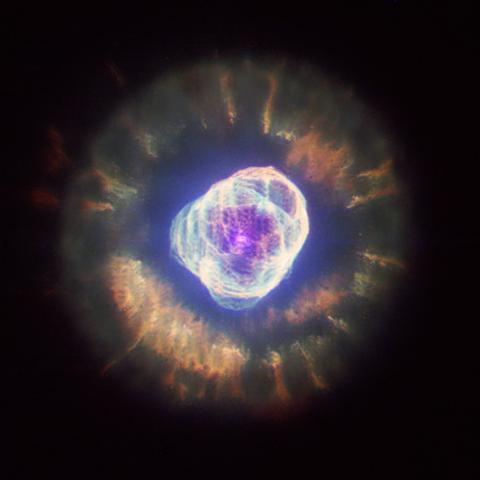
My interpretation of Hubble Space Telescope data on NGC 2392. It combines UV with visible light.

This planetary nebula is about 6500 light-years away and consists of gases ejected by the O-type star in its center. When comparing this image from 2006/2007 with a previous image from 1999 (see e.g., Wikipedia), one can see slight changes in the filaments of the nebula as it expands.

Telescope: HST/WFPC2/PC
Proposal ID: 10822/11122
Release date: 25.09.2006/21.09.2007
Filters: F185W (blue), F502N (blue), F656N (green), F658N (red)
Processing: #Siril, #GIMP, #GMIC, #GraXpert

#NGC2392 #HST #Hubble #WFPC2 #PlanetaryNebula #Nebula #SpaceTelescope #astrophotography #DeepSky #DigiKam
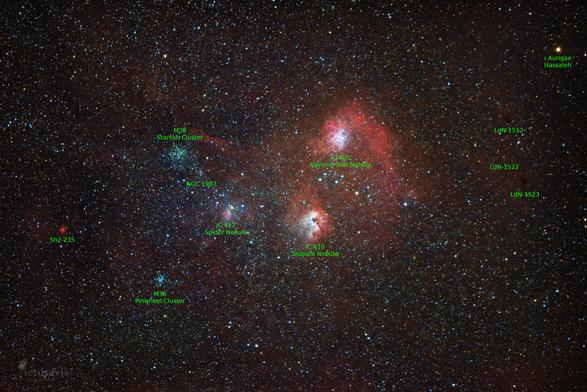
Around the Flaming Star

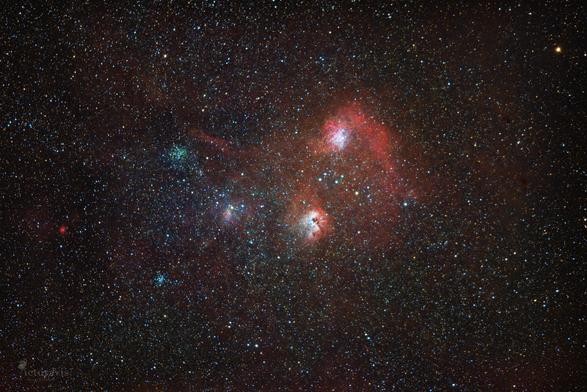
This image depicts a region in the Auriga constellation, including multiple deep-sky objects. I aimed for the Flaming Star Nebula (IC 405) and the Tadpole Nebula (IC 410), but the wider framing of the lens includes the star clusters M36, M38, and NGC 1907, as well as the nebulae IC 417, Sh2-235, LdN-1512, LdN-1522, and LdN-1523.

As with my previous DSO images, this image was taken without a tracker but with sporadic manual tracking with a standard DSLR setup with a 105 mm macro lens. This time I used 1360 × 2 s frames, resulting in 45 m 20 s exposure time.

This relatively short integration time is near the limit of what is possible for me, as the large number of frames requires a lot of storage during processing (>700 GB in this case). Details of the nebulae are not obtainable with this method, but the general shape can be seen. It also only works well with larger objects, as the relatively wide tele, noise, and resolution limits do not allow capturing details of smaller DSOs.

Despite the limitations, it is fun to experiment without a tracker and see what is possible.

The workflow included #Siril, #GraXpert, #StarNet, and #GIMP.

Nikon D500, Sigma 105mm EX DG OS HSM, 105 mm, f/2.8, 1360x2 s, ISO 3200, tripod, no tracker
#Nebulae #StarCluster #astrophotography #photography #germany #digikam

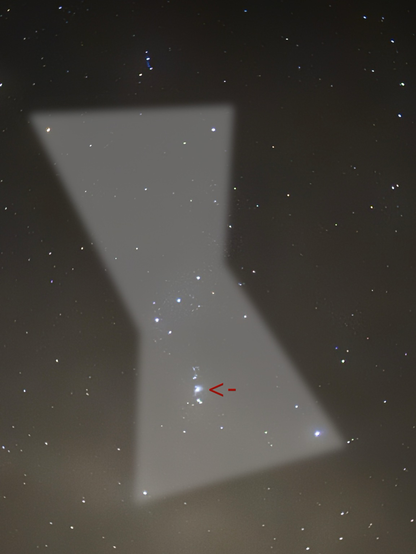
M 42 „Orionnebel“ mit M 43 „De Mairans Nebel“.

Ca. 700 Aufnahmen mit unterschiedlichen Einstellungen. Nachbearbeitet in #siril mit #graxpert und #cosmicclarity.

(Das 2. Bild soll der Orientierung dienen)

#astronomy #astrophotography #dwarf3

Orion

Orion photographed under suboptimal conditions. It was relatively low over the horizon, there was haze, thin clouds, and light pollution. But I like the glow it gave the bright stars. The Orion Nebula (M42 and M43), the Running Man Nebula (S279) the Flame Nebula (NGC 2024) and the Horsehead Nebula (B33 and IC 434) are visible. Especially the latter surprised me, although there is just a long red blob with a small black blob visible.

I chose too long an exposure time for pixel peeping, so please ignore the oblong stars.

Image created from 99x10s exposures (16 minutes, 30 seconds) with #Siril, #GraXpert and #GIMP.

Nikon Z50, Nikkor 17-28/2.8, 28 mm, f/2.8, 99×10 s, ISO 3200, tripod, no tracker
#constellation #orion #nebulae #stars #photography #astrophotography #digikam
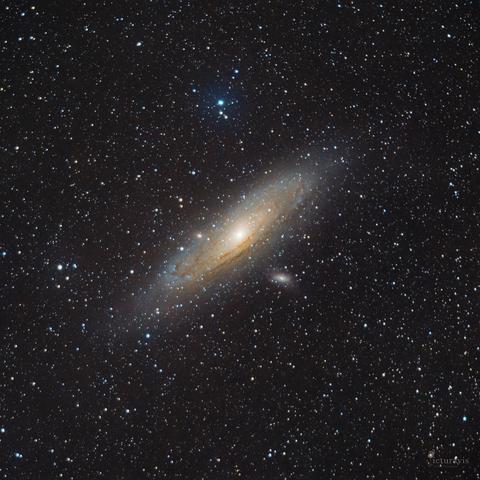
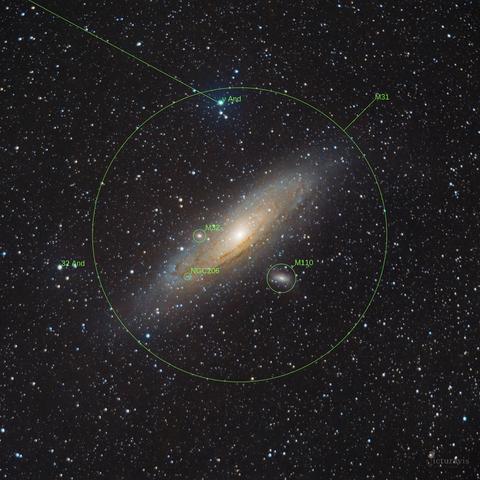
M31 Andromeda

I went outside for the Aurora party, and all I got was this lousy Andromeda Galaxy.

Since I was a day late for the aurora, but the sky was relatively clear, I decided to try the Andromeda Galaxy (M31) again, this time with more integration time. This was in a Bortle class 4–5 area with occasional thin clouds (you can see the shine around the bright stars), but at least the moon rose late. It (again) worked out better than expected. M32 and M110 are clearly visible, and even finer details and colors of the galaxy can be seen.

This time, I used 868 frames with a total exposure time of 28 minutes and 56 seconds, with sporadic manual tracking. The FITS sequence file of the registered images was over 200 GB… and the standard processing script failed, because today I learned 400 GB is apparently not enough free space for processing astro images.

Post-processing was done in #Siril with #GraXpert and #StarNet, and then #GIMP including #GMIC. The annotation in the second image was also done in Siril.

Without a tracker, the larger field of view of the 158 mm (effective) lens is good, as I did not have to adjust the camera as often. But the need to crop out less-exposed outer areas reduces the available final resolution. Additionally, the maximum limit of 2 s exposures (any more and the Earth rotates too fast) requires many images (and data).

Nikon D500, Sigma 105mm EX DG OS HSM, 105 mm, f/2.8, 868x2 s, ISO 3200, tripod, no tracker
#Andromeda #Galaxy #astrophotography #photography #germany #digikam

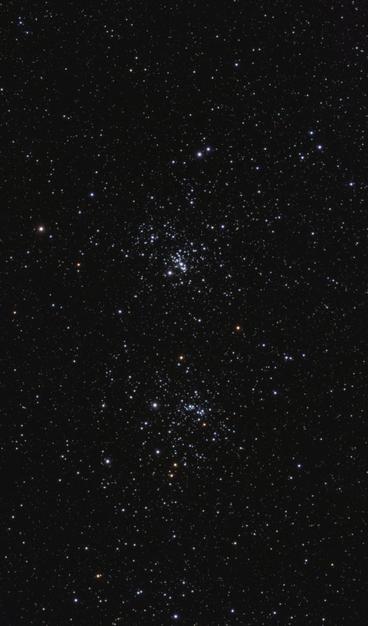
And here's the two clusters on their own, from the #Seestar. This one was stacked with #Siril, denoised with #GraXpert and edited in #GIMP

#Astrodon #StarClusters

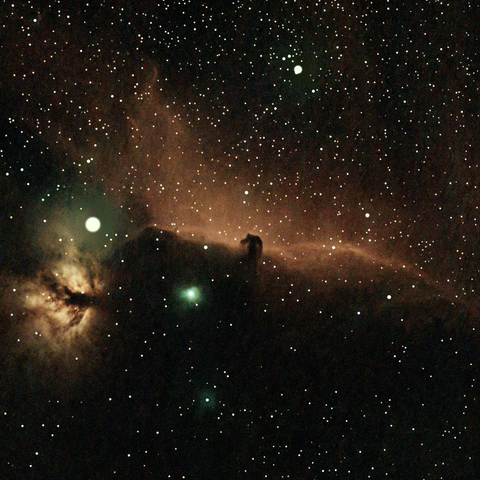
In meiner Kindheit faszinierte mich das Foto des Pferdekopfnebels in einem „Was ist Was“ Buch. Jetzt konnte ich ihn das erste Mal selbst aufnehmen. Trotz 98% Mond, Dunst und leichten Wolken.
Von knapp 500 Aufnahmen je 60s konnte ich nur 112 gebrauchen - aber ich werde noch mehr Aufnahmen machen und bin dann auch feinfühliger bei der Nachbearbeitung in #siril und #graxpert
#astronomy #astrophotography #dwarf3
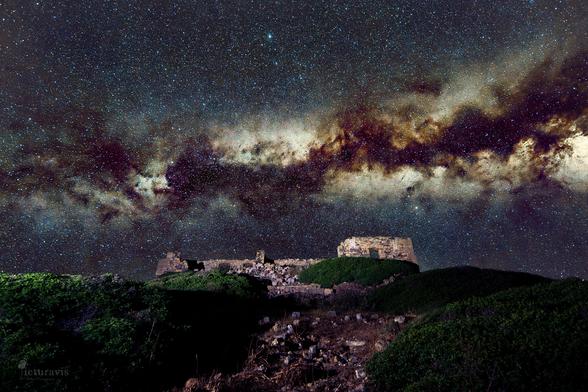
Look into the past 2.0

Ruins of the ancient cretan city of Itanos ( Ίτανος) in front of the Milky Way.

This is a second attempt at photos taken in 2022.

The Milky Way was photographed with an integration time of 38 x 8s = 5m 4s and processed with #Siril, #GraXpert, #StarNet and #GIMP. The ruins were taken with 30s exposure and light painted with a flashlight, then processed with #RawTherapee and GIMP. Final composition was done in GIMP.

Milky Way: Nikon D500, Tokina AT-X 11-20 f2.8 PRO DX, 11 mm, f2.8, 38x8s, ISO 3200, tripod
Ruins: Nikon D500, Tokina AT-X 11-20 f2.8 PRO DX, 11 mm, f2.8, 30s, ISO 800, tripod, light painted
#astrophotography #ruins #nightscape #milkyway #photography #greece
The Pleiades 2.0

This is a second attempt at post-processing the Pleiades star cluster (M45). This time, I took more time to learn #Siril and added #GraXpert for background extraction and denoising.

The data are the same as in the previous attempt, so you can see how important post-processing is in astrophotography. Fine details are not visible, as the data do not contain enough information, but to my taste, this version is much improved.

I am still very impressed with what is achievable with a standard DSLR, a fast lens, and a standard tripod.

Nikon D500, Sigma 105mm EX DG OS HSM, 105 mm, f/2.8, 177x2 s, ISO 3200, tripod
#pleiades #astrophotography #photography #germany #digiKam #StarNet #GIMP

C 27 - „Crescent Nebula“ oder Sichelnebel.

Das bleibt übrig, wenn ein Stern in einer Supernova explodiert. Die Schockwelle wird aber das weitere Gas in der Umgebung komprimieren, woraus neue Sterne entstehen können. Recycling.

Aufgenommen mit meinem #dwarf3 - ca 4 Stunden mit jeweils 30s Belichtungszeit. Nachbearbeitet mit #siril und #graxpert

#astronomy #astrophotography