 Phillip Medhurst [Unofficial]
Bowyer Bible Gospels: The Resurrection
https://fed.brid.gy/r/https://phillipmedhurst.com/2026/06/27/bowyer-bible-gospels-the-resurrection/

Bowyer Bible Gospels: The Resurrection
https://fed.brid.gy/r/https://phillipmedhurst.com/2026/06/27/bowyer-bible-gospels-the-resurrection/
Bowyer Bible John’s Gospel: Noli me tangere. John 20:14-17


Cenotaph
A Tale of Love Beyond the Tomb
I went each evening to the tomb because the dead had no one else.
It stood beyond the last lamps of the village, where the road narrowed into a path and the path, in time, surrendered itself to nettles, thorns, and the pale roots of ancient trees. There the hill rose like the back of some buried beast, and in its side, half-swallowed by ivy and weather, was the stone door behind which my beloved lay.
No name remained upon the lintel. The rain had taken it. Or the years. Or perhaps those who had carved it had done so lightly, as if afraid that naming the dead too deeply would make death more permanent. But I knew the place. I knew the stone. I knew the silence that gathered before it like a servant waiting for orders.
I had seen the black carriage pass beneath the sycamores. I had heard the bell. I had stood among the mourners while the wind pressed their coats against their bodies and made their veils tremble like wings. I had watched the door sealed with mortar. I had watched the priest lower his head. I had watched the others turn away.
Afterward, when they returned to their bread, their fires, their sleep, I remained.
Then I came the next evening.
And the next.
And in this way the years began.
I brought what the seasons allowed. In spring, violets. In summer, white roses stolen from the wall of the abandoned rectory. In autumn, red leaves that looked already wounded. In winter, when the earth refused all tenderness, I brought my breath cupped in my hands, warming nothing.
I never came armed.
This was often remarked upon in the village, though never to my face. The road was lonely. Wolves had once been seen in the upper wood. Worse than wolves, it was said, were the men who slept in the ruined mill and came out at dusk with knives beneath their coats. But I carried no pistol, no blade, no staff. I carried only the small candle I lit upon the lowest step.
I do not know why I refused protection. Perhaps because grief itself had rendered me defenseless. Perhaps because one does not visit the beloved as though entering battle. Perhaps because I believed, with a conviction I never spoke aloud, that no evil thing would dare approach a tomb already so well attended.
At the stone door I always said the same words.
“I have come.”
Nothing more.
It seemed enough.
In the beginning I wept. Later I spoke. Later still I sat in silence until the candle guttered and the darkness of the wood became one with the darkness of the tomb. There were evenings when I told small things: that the baker’s daughter had married the cooper’s son; that lightning had struck the church spire but spared the bell; that the old dog who used to follow the funeral processions had died beneath the market table; that the village had forgotten certain songs.
There were other evenings when I confessed what I dared not tell the living: that I had grown envious of those whose dead were buried in the churchyard, near bells, near footsteps, near the innocent disturbances of children; that I sometimes feared the face within the tomb had altered beyond recognition; that I could no longer remember the exact sound of the voice I had loved, only the wound it left by ceasing.
Still I came.
The villagers first pitied me. Then they avoided me. Finally they made of my devotion a superstition.
Mothers frightened their children with me. Do not linger after dusk, they said, or you will see the mourner on the hill. Young men, drunk on harvest ale, dared one another to follow me, but none came farther than the black pond where the reeds whispered without wind. Once I found a crude figure made of straw hanging from a branch near the path. It wore a scrap of mourning cloth. I took it down, carried it to the tomb, and burned it in my candle flame.
The smoke drifted beneath the door.
That was the first time I thought I heard movement within.
It was faint. So faint that a sensible mind would have named it settling stone, or a root shifting in the earth, or the sigh of air through cracks. But grief does not possess a sensible mind. Grief has ears everywhere. Grief hears the dead turning over beneath the world.
I placed my palm against the door.
The stone was cold.
“I have come,” I whispered.
From within there came nothing.
Yet after that night, the tomb seemed changed.
Not opened. Not visibly disturbed. But alert. The ivy appeared to have loosened its grip around the lintel. The candle flame bent toward the door though no wind touched it. The flowers I laid upon the step vanished by morning, though no animal tracks marked the earth.
At first I thought the villagers had stolen them to mock me. But who among them would climb that path before dawn? Who would dare lay fingers upon offerings given to the dead? No. Something received them.
This knowledge, if knowledge it was, neither comforted nor terrified me. It merely deepened the ritual. I brought better flowers. I trimmed the candle wick. I brushed dead leaves from the threshold. I spoke less and listened more.
Years passed.
The village altered as villages do, by slow betrayals. The mill collapsed inward. The inn changed hands. Children became adults and looked at me with the same uneasy curiosity their parents once had. The priest died and was replaced by a younger man with pale eyes and clean hands. He once stopped me near the church gate and asked, gently, whether I thought my nightly pilgrimage was good for my soul.
“For my soul?” I asked.
“Yes.”
I looked past him to the churchyard, where the dead lay safely labeled beneath crosses and stones, each one accounted for, each one furnished with a place among the living.
“My soul,” I said, “is not buried here.”
He did not trouble me again.
There were nights when I almost believed the tomb loved me in return.
In rain, the threshold remained strangely dry. In winter, no snow gathered against the door. Once, when fever shook me so violently that I could scarcely climb the hill, I found the stone warm beneath my hand. Another night, upon arriving late, I discovered my candle already lit.
I knelt before it a long while.
I told no one.
For who could have understood? Those who have never loved the silent dead think silence is empty. They do not know how crowded it is. They do not know the multitude that gathers in one withheld word, one vanished face, one unopened door.
My body failed before my devotion did.
First the breath. Then the knees. Then the hands, which trembled so badly that I spilled wax upon the stone. I began to leave earlier each evening and return later, for the path grew longer though the hill did not move. Some nights I slept beside the tomb, waking before dawn with frost in my hair and my cheek against the step.
It was then that the dreams began.
I dreamed I stood inside the tomb. Not outside, not kneeling at the threshold, but within. The chamber was larger than it could possibly be, descending far beneath the hill by corridors of black stone. Niches lined the walls, and in each niche lay something I had lost: a child’s shoe; a broken instrument; a letter never sent; a lock of hair; a bowl of soup cooling beside an empty chair; a song I had once intended to write; a prayer abandoned halfway through because no answer came.
At the end of the corridor was a door.
Behind it, someone breathed.
I would wake with soil beneath my fingernails.
The last evening came in November.
All day the sky had lowered until it seemed the world was trapped beneath a lid of iron. Crows gathered on the church roof. The air smelled of rain and extinguished lamps. Villagers later said they watched me pass and knew something final moved beside me, though I walked alone.
I carried no flowers. None remained. I carried no candle either, for my hands could no longer shield the flame.
I climbed slowly.
The black pond gave back no reflection. The trees did not stir. Even the brambles seemed to withdraw from the path, as though making way for what had already been decided.
When I reached the tomb, the door stood open.
Not wide. Only a little. Enough for the dark to show itself.
I was not afraid.
Or if I was, fear had become indistinguishable from longing.
For many years I had spoken through stone. Now the stone had answered.
I pressed my shoulder to the door. It yielded with a sound like a breath being taken after long restraint. The darkness inside was complete, yet not hostile. It surrounded me with the intimacy of closed eyes.
I stepped in.
The chamber was smaller than my dreams. Bare walls. Low ceiling. A shelf cut into the rock. Earth beneath my feet. The air held no corruption, no sweetness of decay, no ancient bitterness of sealed flesh. It was cold and pure.
I reached toward the shelf.
My hand found nothing.
I searched the chamber wall to wall. My fingers swept stone, dust, root, emptiness. There was no coffin. No shroud. No bone. No ring. No remnant of the beloved body to which I had given my years.
Nothing.
Only then did I understand what the word meant.
Not tomb.
Not grave.
Cenotaph.
The realization did not strike like lightning. It opened beneath me like a floor giving way.
All those evenings. All those flowers. All those whispered reports from the world. All the candles. All the kneeling. All the weather endured. All the love poured through stone into a chamber that had never held the dead.
I laughed then.
The sound horrified me.
It rose from my chest like something winged and wounded. I laughed until I could not breathe, and then the laughter broke apart and became weeping. I lowered myself to the floor and pressed my forehead to the dust.
“Not here,” I said.
The words seemed to pass through the chamber and into some deeper hollow beneath the hill.
“Not here.”
And then, after a long while, I felt beneath my hands what I had never felt outside the door.
Warmth.
It came not from the shelf, nor from the walls, nor from any body hidden there. It came from the earth itself, faint but living, as though all the years of attendance had gathered under the stone and kindled there.
My eyes adjusted.
Upon the empty shelf lay the flowers.
All of them.
The violets. The roses. The cedar. The red leaves. The pitiful winter twigs. The offerings of every season lay in a heap of impossible preservation, neither dead nor alive, neither fresh nor withered. Each retained the form of the day I had brought it. Each remembered my hand.
The tomb had been empty.
But it had not been indifferent.
I understood then—not with the mind, which is always late to mercy, but with the ruined heart—that I had not kept vigil over bones. I had kept vigil over faithfulness itself. I had honored the absent. I had loved without proof. I had returned to the place that could not answer until the returning became its own reply.
The beloved was not there.
Yet love had been there.
And perhaps love, having nowhere else to lay its head, had made of that emptiness a dwelling.
At dawn they found the tomb open.
They found the flowers.
They found my coat folded on the threshold and my shoes placed neatly beside the stone, as though I had entered some house where footwear was not permitted.
They did not find me.
Some said I had wandered into the wood and died beneath leaves. Some said I had thrown myself into the black pond, though the pond gave up nothing. Some said the devil had taken me, for the villagers preferred damnation to mystery.
But the young priest, older by then and less certain, stood a long while before the open chamber. He saw the flowers. He saw the two dark impressions in the dust where knees had rested. He touched the stone shelf and drew back his hand.
It was warm.
After that, the path changed.
Not all at once. Gothic mercies do not hurry. But the brambles loosened. The pond cleared. In spring, flowers grew thick around the tomb, though none had ever rooted there before. Those who grieved without graves began to come: mothers whose sons were lost at sea; wives whose husbands vanished in war; children who remembered faces no one else would name; old men mourning the selves they had outlived.
They came ashamed at first.
Then less so.
Each stood before the empty chamber and whispered into it what I had whispered for years.
“I have come.”
And though no corpse rested there, and though no voice replied, many left with lighter steps.
For the tomb held no body.
It held attendance.
It held the honor of loving what could not be recovered.
It held the terrible mercy of absence made holy by return.
And beneath the stone, where no beloved had ever lain, something like a heart continued to keep warm.

The Root Beneath the Stone
I thought the stone was final.
I thought the name carved there
was the last word
the earth would allow.
I thought absence
had a kind of authority,
as if an empty place
could speak with the voice of God
and say,
No farther.
But last night,
beneath the monument,
something moved.
Not the dead.
Not the lost.
Not the boy exactly,
nor the song,
nor the face before sorrow
taught it its new expression.
Something thinner than memory,
but stronger than grief.
A root.
Pale as a finger
beneath the dark soil,
blindly seeking
what the heart had forgotten
how to want.
It did not knock.
It did not rise
with trumpets or thunder.
It did not roll the stone away.
It only pressed
against the underside
of what I had mistaken
for an ending.
All these years
I had been kneeling
before emptiness,
bringing flowers
to a place
that could not receive them.
But perhaps the flowers knew
what I did not.
Perhaps their stems,
cut and dying,
were still fluent
in the old language of return.
Perhaps every grief
I laid down there
became compost.
Perhaps every tear
sank farther
than my prayers.
Perhaps the thing I mourned
was not buried elsewhere
after all,
but traveling underground,
passing through houses
that no longer stand,
fields grown over
with strange weeds,
the silence after a voice
has vanished.
I wanted resurrection
to arrive upright,
whole,
recognizable.
I wanted the former self
to come walking back
wearing the same face,
carrying the same bright belief,
singing the song
exactly as it was
before the world interrupted.
But roots do not return
as branches.
Seeds do not rise
as seeds.
What comes back
comes changed,
darkened by earth,
fed by what has fallen,
tender where it once was proud.
So I will come again
to the cenotaph.
I will bring flowers.
I will kneel.
But I will listen now
not for the dead
inside the stone,
not for the old name
to answer me,
but for the small green pressure
beneath everything,
the mercy
working in secret,
the hidden life
that does not ask
whether the grave was marked correctly,
only whether there is still
somewhere in me
a little soil
left open.
The Cenotaph Triad
#absence #Cenotaph #CreativeWriting #DarkArt #DarkPoetry #EmptyTomb #ExistentialPoetry #faithAndDoubt #FormerSelves #gothicIllustration #gothicPoetry #grief #HauntingBeauty #Healing #innerLandscape #LostJoy #Melancholy #memory #Mercy #Mourning #poeticReflection #resurrectionImagery #roots #SpiritualReflection #symbolicArt #TheRootBeneathTheStone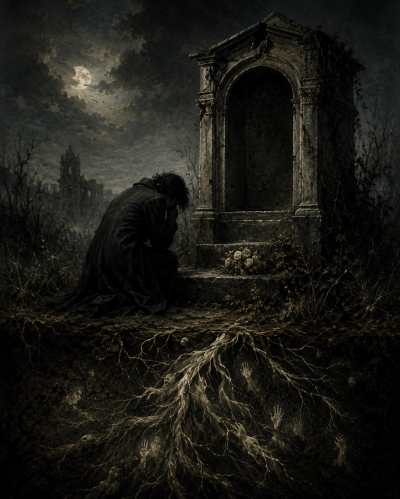
The Cenotaph
There are places in me
where I go to mourn
what is not there.
An empty stone,
a name without a body,
a date without a doorway.
The precious thing is buried elsewhere—
in a house that no longer stands,
in a field grown over strange weeds,
in a voice I cannot quite recover,
in the face of someone
before disappointment taught them
how to look away.
I bring flowers
to the wrong place.
Still, I come.
Because memory does not always know
where the dead are buried.
Sometimes, it only knows
where to kneel.
And perhaps that is what I am:
a cenotaph of my former selves,
a monument raised far from the grave,
a body still walking
with epitaphs hidden under the skin.
Here lies the boy who believed.
Here lies the song unsung.
Here lies the photo with the blurred face.
Here lies the joy that went ahead of me
and never came back.
But the mausoleum is empty.
That is the terror.
That is the mercy.
For what is not here
may not be wholly lost.
What is buried far away
may still be sending roots beneath the earth,
their ghostly fingers stretching toward me.
The Cenotaph Triad
#buriedMemories #Cenotaph #distance #EmptyTomb #grief #GriefAndHope #Healing #innerLandscape #longing #lostInnocence #lostSelf #Melancholy #memorial #memory #minimalIllustration #Nostalgia #personalReflection #prosePoetry #reflectiveArt #remembrance #sacredAbsence #shadowWork #Solitude #soulWork #spiritualExile #symbolicArt #visualMetaphor #woundedSelf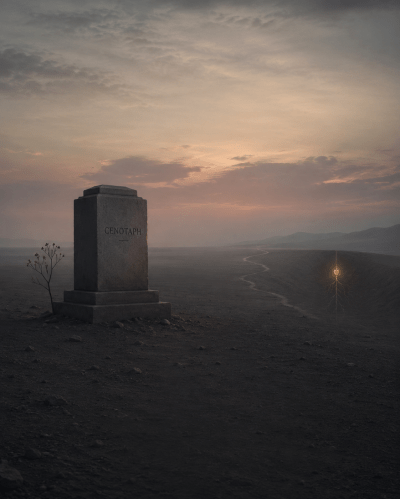
The Verdict Reversed: The Day Death Lost Its Case
2,442 words, 13 minutes read time.
The Hostile Takeover of the Grave
Easter is not a victory lap; it is a hostile takeover. For three days, the universe sat in the suffocating shadow of a “Guilty” verdict that had been handed down to the human race since the Garden. The Grave was the ultimate high-security prison, a vault with a 100% retention rate and a legal mandate to hold every man who ever breathed. But on the third day, the structural integrity of Death’s authority suffered a total, catastrophic failure. When Jesus of Nazareth walked out of that rock-hewn tomb, He didn’t just perform a miracle; He served an eviction notice to the enemy and proved that the debt of Friday had been cleared by the court of the Almighty. This was the day the verdict was reversed, the keys were seized, and the “Game Over” of the grave was revealed to be a temporary lie for the man who stands in Christ.
The environment of that weekend was not one of quiet reflection; it was a battlefield where the physical laws of the universe were being rewritten in real-time. When the Substitute drew His last breath on Friday, the sun went black at high noon—a celestial blackout that signaled the Father turning His back as the Son absorbed the concentrated radiation of every murder, every lie, and every secret filth you’ve ever committed. The earth itself buckled in a localized seismic tantrum, a groan from the very bedrock of creation as its Maker’s blood hit the dirt. In the Temple, the massive, four-inch-thick curtain—the “Keep Out” sign between a Holy God and a dead man—was ripped in half from the top down. This wasn’t the work of men; it was the legal declaration that the barrier was destroyed, not because we got better, but because the Barrier-Breaker had arrived.
But the most gut-punching detail of this divine insurrection? The graves didn’t just open—they emptied. The Bible records that when the earth shook, the tombs of the holy ones were thrown wide. After Jesus rose, these men—men who had been dead and buried for years—straightened their backs, walked into the holy city, and stood face-to-face with the living.
This wasn’t a ghost story or a private vision; it was a public, physical security breach. People recognized them. They saw faces they had wept over at funerals, men with names and histories, now walking the town square and breathing the morning air. When the God-Man hit the floor of the Grave, the locks didn’t just turn; they exploded. The “retention center” of death suffered a systemic malfunction because its King had been overmatched.
The Mechanics of the Reversal
The Structural Failure of Death’s Authority
To understand the Resurrection, you have to understand the legal standing of Death. It wasn’t just a biological end; it was a jurisdictional boundary. Death had a legitimate “claim” on us because of the unpaid debt of our treason. In the court of Divine Justice, the wage of sin is death—not as a suggestion, but as an absolute, forensic requirement. We were prisoners of war held in a legal cage. However, when Jesus—the only Man in history who owed nothing to the Law—voluntarily entered that vault, He broke the system from the inside out.
As an observer of the Divine Law, I see the Empty Tomb as the ultimate forensic receipt. If the Cross was the payment, the Resurrection is the proof that the check cleared the bank of Heaven. If Jesus had stayed in the dirt, the Cross would have been a tragic failure, a noble but useless sacrifice. But because He rose, the “Finished Work” of Friday became the “Current Power” of Sunday. The Resurrection proves that the Father was satisfied with the Son’s payment. It means the verdict of “Death” has been legally vacated for every man who accepts the Substitute’s victory. You aren’t just “off the hook”; you are a man whose case has been dismissed with prejudice.
The End of Spiritual Probation
This reversal means that the Grave no longer has the power to subpoena your past. Most men walk through life as if they are on a permanent spiritual probation, waiting for the other shoe to drop, constantly looking over their shoulder to see if their secret shames are catching up to them. They think that by “maning up” and doing enough good deeds, they can keep the Warden at bay. But Easter proves that the prison has been demolished. The Resurrection was the Father’s “Amen” to the Son’s “It is finished.”
It was the public declaration that the Law had no more demands to make and the Grave had no more rights to enforce. When the stone moved, it wasn’t to let a prisoner out—it was to show the creditors that the debt was settled and the cell was empty. You are not a “rehabilitated” criminal trying to prove you’ve changed; you are a man whose record has been expunged by the highest Court in existence. The Enemy can scream all he wants about your failures, but he’s shouting into an empty tomb. The legal grounds for your condemnation were nailed to the wood on Friday and buried in the dirt on Saturday, and they didn’t come back up on Sunday.
The New Specification: Resurrection vs. Resuscitation
The Biological Upgrade
We need to be clear about the physics of this event: Jesus was not “resuscitated.” He wasn’t a man who cheated death like a lucky gambler, only to face the reaper again in a few decades. He was Resurrected. He emerged with a new specification—a body that carried the scars of the war but was no longer subject to the rot of the Fall. He could be touched, He could eat, but He was no longer bound by the gravity of a fallen world. This is the blueprint for the New Man.
God isn’t looking to “patch up” your old, failing life. He isn’t interested in giving your “good man” persona a fresh coat of paint or helping you become a “better version of yourself.” That old man is dead, and he needs to stay dead. God is in the business of total, biological, and spiritual transformation. The same power that jump-started a cold heart in a dark cave—the same power that rattled the earth and sent dead men walking through the city streets—is the power currently standing over the dead parts of your character, your marriage, and your legacy. Easter is the promise that the wreckage of your Saturday is the raw material for a Sunday that never ends.
The Death of the “Good Man” Myth
This new life is not a reward for your effort; it is a gift of His conquest. Too many men spend their lives trying to glue their broken pieces back together with willpower, thinking that if they just try harder, they can fix what’s broken inside. But you cannot “man up” your way into a new nature. You have to die to the old “Good Man” myth—the idea that you can save yourself—and be raised in the reality of the God-Man.
The Resurrection is the hostile takeover of your failures by His success. It means that the “scars” of your past—the things that caused you a crushing shame on Saturday—become the trophies of His grace on Sunday. You are now operating under a new set of specs, governed by the Law of the Spirit of Life, which has set you free from the Law of Sin and Death. You aren’t just a “better” version of the man you used to be; you are a different species of man altogether. You are a man who has been through the fire and come out on the other side with a life that death no longer has the legal right to touch.
The Evidence of the Incursion
The Chain of Custody and the Broken Seal
In any legal case, the chain of custody is everything. The enemies of Jesus knew this. They didn’t just throw Him in a hole; they secured the site with the full weight of the Roman Empire. They rolled a stone weighing nearly two tons across the entrance—a physical barrier designed to stay put. They applied the Roman Seal, a clay-and-cord tether that carried the death penalty for anyone who tampered with it. And they stationed a koustodia, a professional Roman guard unit trained to hold ground at the cost of their own lives.
When that stone moved, it wasn’t a “spiritual” lifting; it was a physical displacement of mass that defied the Roman military machine. The seal wasn’t carefully peeled back; it was snapped by a higher authority. For a man in the trenches, this is critical: your freedom wasn’t won in a vacuum. It was won against the highest organized resistance the world could offer. The “Verdict Reversed” isn’t a theory; it’s a recorded breach of the most secure site in Judea.
The Eyewitness Deposition
If this were a hoax, the conspirators would have picked better witnesses. In the first century, the testimony of women carried zero legal weight in a court of law. Yet, the record shows they were the first on the scene. If you’re inventing a lie to change the world, you don’t start with “unreliable” witnesses. You start with the power players. But the Resurrection doesn’t care about human optics.
Then you have the five hundred. Paul’s later legal brief in his letters challenges the readers: “Most of them are still alive.” In other words, “If you don’t believe me, go interview the guys who saw Him breathe.” This wasn’t a mass hallucination—hallucinations don’t eat broiled fish, they don’t let you put your fingers in their belt-fed weapon wounds, and they don’t appear to 500 people simultaneously in broad daylight. The evidence is forensic, historical, and physical. Death didn’t just lose the man; it lost the argument.
The End of the “Good Man” Probation
Occupying the Victory: Why You Stop Paying a Settled Debt
Imagine you’ve been drowning in a debt so massive you could never pay the interest, let alone the principal. You’ve lived every day with the crushing weight of the collection agency calling your name. Then, one morning, you get a certified letter: Paid in Full. The Case is Closed.
What would you call a man who, after receiving that letter, keeps sending small, pathetic checks to the bank? You’d call him a fool. You’d tell him he’s insulting the person who cleared his ledger. This is exactly what we do when we try to “earn” our way back into God’s good graces after Sunday.
The Resurrection is the hostile takeover of your “performance-based” religion. It demands that you stop trying to pay for a life that has already been bought and paid for. The debt was settled on Friday; the receipt was printed on Sunday. Your job is no longer to “pay back” God. Your job is to occupy the victory. It means walking into your home, your office, and your community as a man who is no longer under the thumb of a creditor. You are a son, not a bondservant.
The Mandate of the New Man
The “New Man” is not a suggestion; it’s a mandate. You cannot witness the structural failure of the Grave and then go back to living like a prisoner. When those saints walked out of their graves and into the streets of Jerusalem, they didn’t go back to their old jobs and pretend nothing happened. They were a walking disruption.
As a man in Christ, you are called to be that same disruption. You are the evidence that the Grave is a lie. When you refuse to be defined by your past, when you stand up from the wreckage of your Saturday and lead your family with a strength that isn’t your own, you are testifying to the Reversed Verdict. You are showing the world that the King is out, the locks are broken, and the “Game Over” screen has been shattered.
Case Closed—Walking Out of the Tomb
The stone did not move so that Jesus could get out; He was already gone. The stone moved so that you could look in and see that the cell was empty. It moved so you could see that the linens were folded—the work was finished, and the Room was vacant.
The verdict of the world says you are the sum of your mistakes. The verdict of your shame says you are a fraud who will eventually be found out. The verdict of the Enemy says that the Grave is your final destination. But today, the High Court of Heaven has overruled them all. The Case of The People vs. Your Soul has been dismissed because the Substitute served the sentence and then broke the prison.
Your Standing Order: Identify the “grave” you’ve been living in. Is it the grave of an old addiction? The tomb of a failed marriage? The dark cell of “not being enough”?
Stand on the bedrock of the Empty Tomb and repeat the words that changed history: The Verdict is Reversed. Stop living like a man on probation. The doors are off the hinges. The guards have fled. The King has reclaimed the keys. It is time to stop mourning over the wreckage of your Saturday and start occupying the territory of your Sunday.
The stone is moved. The King is out. The graves are broken.
Now, walk out.
Don’t just lurk. This wasn’t a bedtime story—it was an after-action report. If you’ve got the guts to show how you’re rebuilding your life on the wreckage of the tomb, drop a comment below. How are you occupying the victory today?
D. Bryan King
Sources
Disclaimer:
The views and opinions expressed in this post are solely those of the author. The information provided is based on personal research, experience, and understanding of the subject matter at the time of writing. Readers should consult relevant experts or authorities for specific guidance related to their unique situations.
#Atonement #BibleStudy #BiblicalHistory #biblicalManhood #biblicalTruth #breakingChains #BrokenSeal #ChristianBlogForMen #ChristianGrit #ChristianLeadership #DeadSaintsWalking #DebtPaidInFull #divineJustice #EarthquakeFriday #EasterTheology #emptyGrave #emptyTomb #eternalLife #EyewitnessTestimony #faithInAction #finishedWorkOfChrist #ForensicResurrection #GoodFriday #GospelDeepDive #gospelTruth #GraveKeys #HolySaturdayWreckage #HolyWeek #HostileTakeover #JesusChristVictory #JesusIsAlive #KingdomOfGod #LegalReversal #Matthew2751 #menOfFaith #newCovenant #NewManSpecification #NoMoreProbation #OccupyingVictory #overcomingShame #powerOfGod #Redemption #resurrectionOfJesus #resurrectionPower #RisenKing #RomanGuard #ScarsOfVictory #spiritualAuthority #spiritualFreedom #spiritualWarfare #StoneRolledAway #SubstitutionarySacrifice #SundayMorning #TheGreatCommission #TheRisenLord #TheVerdictReversed #TornVeil #TransformingGrace #VictoryOverDeath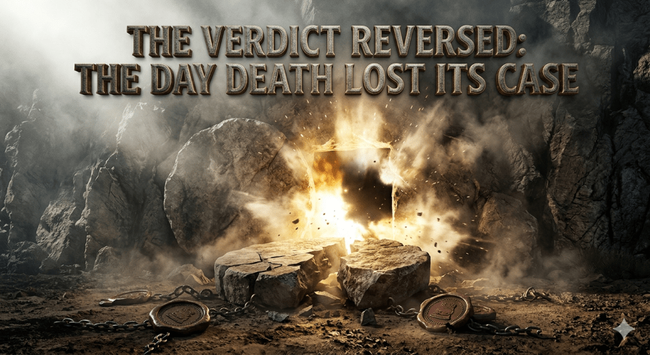
Sunday’s On The Way
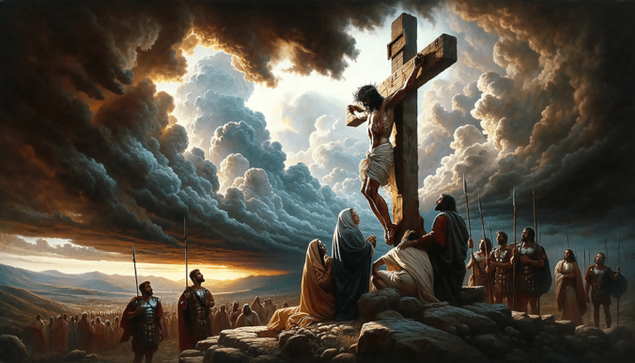
As a child, I wondered why today was labeled “Good Friday.” There was nothing good about the horrific suffering and death of Jesus. As a teen, I heard a song by Carman called “Sunday’s On The Way,” and it gave me hope. My tears of grief turned to expectation. Now as an adult, I understand that the “good” part of today is that Jesus willingly laid down His life for mine. His precious blood and broken body set me free from sin and shame! God used the devil’s plan to stop Jesus as a launching pad for the greatest event in history! JESUS IS ALIVE!!!
Music has always been able to put words and a melody to my emotions, helping me to express them when I didn’t know how. Here is a playlist I made years ago of songs that remind me both of the pain of Good Friday and the JOY of Easter Sunday. I hope these songs will encourage you today.
 phillipmedhurst
 Slow Mover
 Bryan King
 ReverendRef
 hlmillerblog