Park Slope condo becomes New York City's "largest mass-timber building"

Local studio Mesh Architectures has completed Timber House, a condominium in Brooklyn that developer The Brooklyn Home Company claims is "the largest mass timber building in New York City."

Timber House is made of glue-laminated timber, a type of structurally engineered wood used to make mass timber structures, and is the largest mass-timber project in New York City in terms of square footage and height, according to The Brooklyn Home Company.

It is also the first condominium project in the city to be built using mass timber, the developer said.

The building has 14 condos

"Timber House started with the simple notion of creating a sense of life in a building, which engages, stimulates, and at the same time, calms us," said Eric Lifton, founder and principal of Mesh Architectures.

"The way we do that here is by using a plant as the primary building material."

The building's columns, beams and floor plates are all mass timber, while the core had to be made of concrete masonry because of city restrictions, the studio said.

The apartments stretch across the length of the structure

Timber House is located in the residential Park Slope neighbourhood in Brooklyn and comprises 14 condos that stretch from the street-side to the back of the building.

According to Mesh Architectures, the building was "constructed with passive house principles".

While not passive-house certified, it was built with solar photovoltaic panels on the roof to provide energy, and mineral wool and polyisocyanurate insulation to reduce the need for air conditioning.

Heating and air conditioning is provided by air-source heat pumps.

The building was developed in collaboration with The Brooklyn Home Company

It also features passive house-quality windows with triple glazing, and the 10 parking spaces in its ground-floor garage each have an electric charging station.

The building's facade is characterized by a flat face made with Danish brick that, according to the team, was chosen to integrate the building into the mostly brownstone neighbourhood.

On the upper levels, the envelope is sculpted into jutting windows and recessed balconies with glass railings. The balconies' undersides are wooden, giving the exterior palette a touch of the timber within.

The floors are also made of wood

A rooftop terrace provides views of Downtown Brooklyn and Manhattan.

Inside, wooden walls and ceilings line the corridors, which have hexagonal tiling on the floor that was designed custom by Mesh and produced in Turkey.

The condos have 11-feet-tall (3.3 metres-tall) ceilings and feature exposed timber beams with LED lights that are integrated directly into the wood.

[

Read:

The Dezeen guide to mass timber in architecture

](https://www.dezeen.com/2021/11/12/dezeen-guide-mass-timber-architecture/)

The timber beams also extend down from the ceiling to frame some of the walls and windows, providing insight into the building's structural makeup.

"The exposed wooden beams present in the home create a style reminiscent of city living in the 1960s and '70s when we picture those large loft-style residences, which is really special," said Bill Caleo of The Brooklyn Home Company.

"As a city, if we want to lower our carbon footprint we need to prioritize mass timber."

In addition to the ceiling and beams the condos have wooden accents

Flooring in the living areas is wood, while the kitchen is floored with white tile to match the white cabinetry – accented with natural wood tones – and a long, white island.

Other recently-announced designs for mass timber structures include the world's tallest timber building designed by Schmidt Hammer Lassen and a Henning Larsen-designed Volvo experience centre in Sweden.

_The photography is byTravis Mark. _

The post Park Slope condo becomes New York City's "largest mass-timber building" appeared first on Dezeen.

#all #residential #interiors #news #apartments #usa #brooklyn #newyorkcity #newyorkapartments #masstimber #gluedlaminatedtimber #newyork

SRG raises canopy with glue-laminated timber beams above Hayward Field

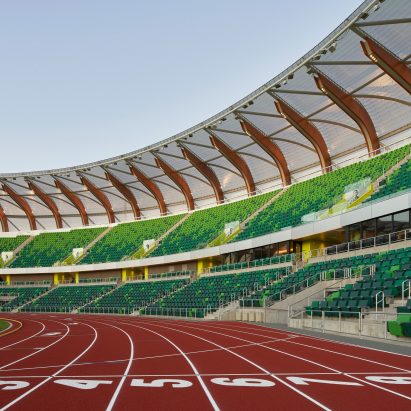
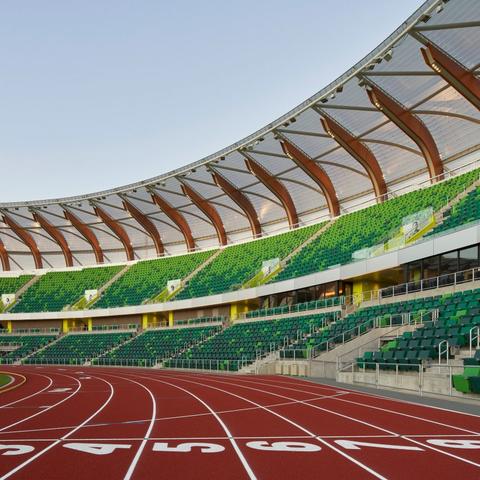
Seattle-based architecture firm SRG Partnership has reimagined the Hayward Field stadium in Eugene, Oregon, with glulam beams supporting an ETFE canopy.

Hayward Field, home to the track and field facility for the University of Oregon, was recently renovated in order to include a new grandstand and canopy.

SRG Partnerships redesigned the track and field stadium of the University of Oregon

The redesigned stadium has 12,650 seats with 84,085 square feet (25,630 square metres) of concourses and ramps, along with 40,000 square feet (12,190 square metres) of underground training facilities.

"Hayward Field sets a new standard for fan experience and connection to the sport," said SRG Partnership.

The wooden beams are a homage to the Pacific Northwest

The new canopy was built using glue-laminated wood that rises from the seating in slightly curved arches, which are a nod to the forests of the Pacific Northwest.

These arches support the ethylene tetrafluoroethylene (ETFE) canopy, which provides shade while not creating shadows on the field that are too severe.

The canopy stretches from the base of the exterior to cover the stands

Nearer the field, the material is more transparent, and towards the top, it becomes more fritted.

"We decided to go with a single layer of ETFE and stretch it taught, so it becomes kind of a diaphanous, simple form that
sits on this solid masonry base," SRG principal Rick Zieve said.

Mesh surrounds the base of the stadium bowl

The shape and material of the canopy also have acoustic properties that amplify the sounds from the stands.

A metaphor for the body of the athlete guided the canopy's design, said the architects, with the wood being the ribs "that support and protect the heart with a translucent 'skin' roof covering."

Hayward Tower is clad with designs in the perforated metal

On the exterior, supporting the canopy is a base of precast trapezoidal concrete panels. The panels lean in the same direction as the athletes run on the track.

This base encloses the training areas and supports the main concourse above where the canopy shields the entrance to the stadium bowl.

[

Read:

David Chipperfield Architects unveils Winter Olympics arena in Milan

](https://www.dezeen.com/2022/03/11/santa-giulia-arena-david-chipperfield-architects/)

The bowl is raised off the ground to promote airflow, and is clad with metal mess with graphics that depict original design sketches by Nike co-founder and funder of the project, Bill Bowerman.

More nods to Bowerman are included in a statue and historical plaques from the old stadium located in the plaza at the entrance to the site.

Underneath the field are training facilities

Presiding over the entrance is the nine-storey Hayward tower, which is clad in perforated metal that depicts iconic figures who have competed at Hayward Field.

Inside, the seating is cast in different shades of green. The architects did not use suspended boxes for VIP guests, instead putting the premier seating closer to the field in the area between the lower seating and stadium bowl.

Other buildings of architectural note recently completed on the University of Oregon's campus include a research facility designed by Ennead Architects and Bora Architecture & Interiors.

_The photography is by Kevin Scott. _

Project credits:

Architect: SRG Partnership
Interior design: SRG Partnership
Contractor: Hoffman Construction Company
Civil engineer: Mazzetti
Structural engineer: MKA
Mechanical engineer: PAE Engineers
Electrical engineer: PAE Engineers
Geotechnical engineer: GRI Geotechnical Resources
Landscape: Cameron McCarthy and PLACE Studio
Lighting: Horton Lees Brogden (HLB)
Branding: AHM Brands
Code: FP&C Consultants
Wind consultant: RWDI
Exhibit design: Gallagher

The post SRG raises canopy with glue-laminated timber beams above Hayward Field appeared first on Dezeen.

#all #architecture #publicandleisure #usa #sports #stadiums #oregon #gluedlaminatedtimber

MasFernandez Arquitectura tops Chilean home with triangular skylight

MasFernandez Arquitectura has completed a wooden home in the outskirts of Santiago, Chile, for a client that is continually training for triathlon races.

The home is located in Chicureo, a Chilean town within the metropolitan region of Santiago. Its site enjoys easy access to a network of running and cycling trails that the owner uses for training.

The Triathletes House is laid out as a three-point star

MasFernandez also added a lap pool to the property, to allow the owners to train for swimming events as well. According to the architects, the owners are "high-performance athletes, that dedicate much of their time to practicing triathlon".

Located in the centre of a relatively large plot, the home itself is laid out as a three-point star, with no defined front or back facades.

The residence is built from engineered wood, which is left visible inside and out

MasFernandez Arquitectura explains that this layout maximises the number of windows within each room, allowing every bedroom to have direct access to the outdoors.

"The three-point star-shaped floor plan expands the perimeter and maximises the relationship with the exterior," said the studio based in Santiago.

The home's layout allows for glazing on both sides of each wing

"The pattern offers a clear distribution and an efficient use of the floor plan, in a house that effectively engages with its surroundings," they added.

The building is topped with a gently sloping roof, which defines an angular geometry where the three volumes intersect with one another.

Wooden slats add visual intrigue to the walls

The perimeter of the single-storey home is protected from the elements by this roof's overhang. The main entrance is towards the centre, where the three arms of the building converge.

This central space is the main living area and helps organise the three wings. The shortest contains the kitchen and dining room, and a laundry room with separate access to the exterior.

[

Read:

Palicourea House by Bloco Arquitetos steps down hillside in rural Brazil

](https://www.dezeen.com/2022/02/06/palicourea-house-bloco-arquitetos-steps-hillside-brazil/)

The other two legs are of roughly equal size. One contains the residents' bedrooms with a small home office, and the other has a guest suite and a home gym.

At the centre of the house, a skylight helps illuminate the main living area. "Each arm converges to the centre, where a triangular skylight arranges the common spaces into each direction," said MasFernandez Arquitectura.

The overhanging roofs shelter a walkway around the perimeter

The property was built using engineered wood, including glue-laminated structural beams and columns, and wooden walls. This palette extends to wall-coverings, doors and ceilings, lending a cohesive feeling to the interiors.

According to MasFernandez Arquitectura, wood was chosen for its sustainability and energy-efficiency characteristics. In certain areas, the architects designed a slatted pattern for the walls, which adds visual interest to the material.

The main living space is located at the centre of the house

Throughout the residence, a continuously concrete slab forms the interior and exterior floor finish.

Other residential projects in Chile include a block of row houses that was designed to appear as if it were one large residence, and a ski chalet that was built upon the foundations of a previous, unfinished project.

The photography is byNico Saieh.

Project credits:

Architects: MasFernandez Arquitectura
Collaborating architects: Jaime Errázuriz, Daniela Bustamante

The post MasFernandez Arquitectura tops Chilean home with triangular skylight appeared first on Dezeen.

#all #residential #architecture #instagram #wood #houses #chile #woodenarchitecture #chileanhouses #masfernandezarquitectos #gluedlaminatedtimber

MasFernandez Arquitectura tops Chilean home with triangular skylight

MasFernandez Arquitectura has completed a wooden home in the outskirts of Santiago, Chile, for a client that is continually training for triathlon races.

The home is located in Chicureo, a Chilean town within the metropolitan region of Santiago. Its site enjoys easy access to a network of running and cycling trails that the owner uses for training.

The Triathletes House is laid out as a three-point star

MasFernandez also added a lap pool to the property, to allow the owners to train for swimming events as well. According to the architects, the owners are "high-performance athletes, that dedicate much of their time to practicing triathlon".

Located in the centre of a relatively large plot, the home itself is laid out as a three-point star, with no defined front or back facades.

The residence is built from engineered wood, which is left visible inside and out

MasFernandez Arquitectura explains that this layout maximises the number of windows within each room, allowing every bedroom to have direct access to the outdoors.

"The three-point star-shaped floor plan expands the perimeter and maximises the relationship with the exterior," said the studio based in Santiago.

The home's layout allows for glazing on both sides of each wing

"The pattern offers a clear distribution and an efficient use of the floor plan, in a house that effectively engages with its surroundings," they added.

The building is topped with a gently sloping roof, which defines an angular geometry where the three volumes intersect with one another.

Wooden slats add visual intrigue to the walls

The perimeter of the single-storey home is protected from the elements by this roof's overhang. The main entrance is towards the centre, where the three arms of the building converge.

This central space is the main living area and helps organise the three wings. The shortest contains the kitchen and dining room, and a laundry room with separate access to the exterior.

[

Read:

Palicourea House by Bloco Arquitetos steps down hillside in rural Brazil

](https://www.dezeen.com/2022/02/06/palicourea-house-bloco-arquitetos-steps-hillside-brazil/)

The other two legs are of roughly equal size. One contains the residents' bedrooms with a small home office, and the other has a guest suite and a home gym.

At the centre of the house, a skylight helps illuminate the main living area. "Each arm converges to the centre, where a triangular skylight arranges the common spaces into each direction," said MasFernandez Arquitectura.

The overhanging roofs shelter a walkway around the perimeter

The property was built using engineered wood, including glue-laminated structural beams and columns, and wooden walls. This palette extends to wall-coverings, doors and ceilings, lending a cohesive feeling to the interiors.

According to MasFernandez Arquitectura, wood was chosen for its sustainability and energy-efficiency characteristics. In certain areas, the architects designed a slatted pattern for the walls, which adds visual interest to the material.

The main living space is located at the centre of the house

Throughout the residence, a continuously concrete slab forms the interior and exterior floor finish.

Other residential projects in Chile include a block of row houses that was designed to appear as if it were one large residence, and a ski chalet that was built upon the foundations of a previous, unfinished project.

The photography is byNico Saieh.

Project credits:

Architects: MasFernandez Arquitectura
Collaborating architects: Jaime Errázuriz, Daniela Bustamante

The post MasFernandez Arquitectura tops Chilean home with triangular skylight appeared first on Dezeen.

#all #residential #architecture #wood #houses #chile #woodenarchitecture #chileanhouses #masfernandezarquitectos #gluedlaminatedtimber

Knotty cedar clads 5280 House in Montana by Barkow Leibinger

The founders of architecture studio Barkow Leibinger have created a square-shaped dwelling for themselves in Bozeman, Montana, that features ample use of wood, including cedar siding and glue-laminated timber beams.

The 5280 House is located in the tree-studded foothills of Mount Ellis, near the small city of Bozeman. The 3,200-square-foot (297-square-metre) dwelling rests on a gently sloping site along a creek, in an area with both farmland and suburban housing.

The 5280 House is arranged around a central courtyard

The home serves as a family retreat for Frank Barkow and Regine Leibinger, who started their Berlin-based architecture studio in 1993. Barkow has roots in Montana, and the dwelling sits on five acres that he purchased from his brother.

The studio said the home is for both living and working – the latter made possible by the proliferation of digital technologies and "the new mobility of work", both accelerated by the coronavirus pandemic.

Barkow Leibinger clad the house in knotty cedar

Because the Bozeman area is booming and becoming more densely populated, the architects wanted to ensure the home felt private but not confined.

The house consists of two, L-shaped wings and a flat roof that form a square. The dwelling is built atop a concrete slab that steps down incrementally to conform to the site's grade change.

The studio described the house as both introverted and extroverted

The wings vary in size, with the larger one containing the foyer, public area, primary bedroom, guest bedrooms and a two-car garage. The smaller volume – which overlooks the creek – holds a design studio, bathroom and sauna.

The wings are positioned around a courtyard that serves as "a common space for the entire house", the team said.

The dwelling's wings vary in size

An opening along the east elevation offers a view of the courtyard, which is adorned with aspen trees, river rock and gravel.

The southwestern corner of the house is defined by a retaining wall that provides privacy from a nearby neighbour, while also forming a cosy area to gather outdoors. The team built a fireplace into the wall and added a covered patio.

Rough-sawn cedar also makes up doors and cabinetry

The dwelling is largely constructed out of wood. Its balloon frame is made of pine lumber, along with glue-laminated roof beams made of Douglas fir. Facades are clad in knotty cedar.

Wood was also used indoors, including smooth larch for window frames and rough-sawn cedar for cabinetry and doors.

[

Read:

Timber-clad pavilions by Barkow Leibinger form a campus for a computing thinktank

](https://www.dezeen.com/2015/05/18/barkow-leibinger-fraunhofer-research-campus-timber-clad-pavilions-offices-computing-thinktank-bavarian-village/)

"We opted for on-site and prefabricated timber as the most sustainable material and approach," the studio said.

Other sustainable elements include an energy-saving heating system that enables the owners to warm specific rooms as needed.

Barkow Leibinger inserted a statement fireplace into the project

The studio described the house as introverted given its courtyard, yet extroverted in regards to its ample glazing and sweeping views. To design the house, the team took influences from not only the landscape, but also the local building stock.

In addition to its barns and ranch houses, the area has a smattering of mid-century architecture, including a Richard Neutra-designed log house with a sod roof, called the Helburn House, and homes by local architects Hugo Eck and Ozzie Berg.

Aspen trees, river rock and gravel adorn the courtyard

The team also looked to Bozeman's Brick Breeden Fieldhouse, which was among the longest clear-span wooden structures in the world when it was built in 1957.

Other projects by Barkow Leibinger include an arts hub at Harvard University that is covered in polycarbonate panels, and a factory and office building near Chicago that is clad in weathering steel.

The photography is byIwan Baan.

Project credits:

Architect and interior designer: Barkow Leibinger
Team: Frank Barkow, Annett Waegner (lead architect), Kateryna Bilyk (project architect)
General contractor: OSM Construction
Structural engineer: Bridger Engineers
Electrical engineer: ETAK Electric
Landscape architect: Lillian Montalvo
Landscaping: Valley of the Flowers Landscaping
Earthwork: Earth Surgeons
Special furniture and interior ambient lighting: Sam Chermayeff Office
Furnishings and lighting: Artemide, Duravit, Dornbracht, Fritz Hansen, FSB, E15, Knoll Internati-onal, Kvadrat, Louis Poulsen, Matiazzi

The post Knotty cedar clads 5280 House in Montana by Barkow Leibinger appeared first on Dezeen.

#all #residential #architecture #wood #courtyards #usa #cedar #houses #barkowleibinger #americanhouses #woodenarchitecture #montana #gluedlaminatedtimber

Glue-laminated timber structure forms San Crescente housing block in Santiago

Izquierdo Lehmann Arquitectos and Francisco Saul have completed a block of five row houses in Santiago, which are grouped under a large roof to give the impression of a single residence.

The San Crescente housing ensemble is named after its street in the Las Condes neighbourhood of the Chilean capital.

The San Crescente project comprises five conjoined houses

According to the architects, the land was purchased by a group of friends that wanted to develop a housing format different than the typical blocks available in Chile.

The long building is made of glue-laminated timber, a wood technology that makes long and sturdy members by glueing and compressing smaller wood elements.

The houses all open up onto a central outdoor area

This material forms the structure of each of the five houses that make up San Crescente, which are separated by concrete demising walls.

The Chilean pine structure forms a continuous pattern across the long facade of the building, lending the impression of a single volume rather than five separate units.

Glue-laminated timber was used to construct the building

"The repetition of this module qualifies the facades with a constant rhythm that masks the differences of rooms and ownership within a unitary volume," said the architects.

"Like a large house for five families that opens onto the street as if they were one."

Concrete walls divide each of the residences

Within each unit, the architects did not build any walls on the ground floor. Instead, the communal areas are delineated by shelving, furniture, and millwork.

These form a "diffuse border" between uses, with the added benefit of opening up sight lines from the front of the homes all the way to the garden.

Communal areas are delineated by shelving, furniture, and millwork

"The private courtyards and the street are visually connected across this framing structure," the architects explained.

On the upper level on each residence, a compact layout accommodates two smaller bedrooms facing the street, with a primary bedroom overlooking the garden. The main suite in each of the houses is slightly narrower than the full width of the property.

[

Read:

Iragüen Viñuela Arquitectos completes Chilean ski cabin atop reused foundations

](https://www.dezeen.com/2021/11/17/iraguen-vinuela-arquitectos-ski-cabin-corralco-chile/)

This arrangement enables the addition of a window to the centrally located bathrooms, and allowed Izquierdo Lehmann Arquitectos and Saul to include skylights in the living rooms below.

"These semi-detached houses, despite their limited perimeter to the outside, receive natural light from all four sides, like an isolated house," the architects explained.

The wooden structure is expressed across the building's exterior

The same pine wood as the structure was used for many of the building's interior finishes and furniture.

The entire building sits over a shared basement, providing parking and storage that is accessible from directly within the units.

The project is located in the Las Condes neighbourhood of Santiago, Chile

Glue-laminated timber is part of a larger trend in the construction industry towards developing wood products that lend themselves to longer structural spans.

Other projects using similar technology include a dining hall in a west London school that is topped by a soaring wooden structure, and a timber building in Sweden with claims to be "carbon-negative" over its full life-cycle.

The photography is byCristobal Palma.

Project credits:

Architect: Cristián Izquierdo L.
Collaborator: Francisco Saul
Structural engineering: Luis Soler P y Asociados
Builder: Tecton

The post Glue-laminated timber structure forms San Crescente housing block in Santiago appeared first on Dezeen.

#residential #all #architecture #cristobalpalma #wood #chile #housing #santiago #woodenarchitecture #gluedlaminatedtimber

Glue-laminated timber structure forms San Crescente housing block in Santiago

Izquierdo Lehmann Arquitectos and Francisco Saul have completed a block of five row houses in Santiago, which are grouped under a large roof to give the impression of a single residence.

Dezeen

Tigg + Coll Architects remodels Surrey home for children with limited mobility

Tigg + Coll Architects has added a timber-roofed wing to a house in Surrey, England, to support the needs of two children with a rare muscular disorder.

The project, called House for Theo and Oskar, prepares the two-storey suburban home in Boxhill for the family's future needs.

The new wing features a timber diagrid roof structure

Theo, eight, and Oskar, six, both have duchenne muscular dystrophy (DMD), a condition that causes muscle weakness and develops gradually over time, so they need their home to support increasingly limited mobility.

Tigg + Coll's design allows wheelchair accessibility in the existing building and adds a new wing containing specific facilities for the two boys.

The roof cantilevers out to create a sheltered terrace

This extension boasts an innovative wooden diagrid roof, which not only allows for larger bedrooms but also provides a flexible structure that can be used to support hoists.

"The family were key to the process," said studio co-founder David Tigg, "but we also spent a great deal of time with occupational therapists, and had discussions with other families who are living with DMD."

The extension extends out from the rear corner of the existing house

"We visited care and rehabilitation centres to understand more about living with DMD and how using hoists would impact the boys as they grow," he told Dezeen.

"This background work was so important to make sure what we designed really would be flexible and appropriate."

The diagrid roof could support hoists in the children's bedrooms

The extension provides generous bedrooms for the two boys, a wheelchair-accessible bathroom and WC, and a spare bedroom that could accommodate a carer.

The layout of the existing house was also altered, relocating the kitchen to the centre of the floor plan and creating a larger entrance hall than was there previously.

Sliding glass doors allow these rooms to open out to the garden

The diagrid roof structure spans the boys' bedrooms and also extends out to create a canopy for the garden.

It was built using plywood and a type of engineered wood known as glulam, creating a grid structure able to support hoists in various different locations.

The renovation places the kitchen and living room in the centre of floor plan

The entire structure was prefabricated in a factory, which meant it could be fully tested in advance.

This helped to significantly speed up the process of construction and helped to reduce the building's carbon footprint.

[

Read:

Tigg Coll Architects integrates bright-red steel frame in London house extension

](https://www.dezeen.com/2015/12/16/tigg-coll-architects-bright-red-steel-frame-victorian-house-extension-london/)

"The timber diagrid provides incredible strength and flexibility for the future," said Tigg.

"It allowed us to create very long cantilevers and wide spans, which were fundamental to the brief of delivering an adaptable home," he said.

Storage has been built into the walls

The roof cantilevers off the precast concrete sandwich panels that form internal walls. As a result, Tigg + Coll could design glazed facades that slide back completely, allowing the rooms to open to the garden.

These sandwich panels would not typically be used in a single house, but were possible here because housing developer Ballymore gave its support to the project. Tigg believes it is the first house in the UK to be built in this way.

A wheelchair-accessible wet room also features in the extension

"Our concept was always to have a relationship to the garden and in particular the idea of the tree canopy," he stated.

The idea, he said, was to create "a protective, sheltered and warm space where the light could be allowed to come through in a dappled way".

The house is located in Boxhill, Surrey

House for Theo and Oskar is one of four projects to so far make the shortlist for the RIBA's House of the Year prize, which is being announced as part of a special series of television show Grand Designs.

Tigg + Coll was invited to work on the project after winning a design competition organised by Colander Associates.

The studio has previously worked in various different types of residential projects, from a railway-influenced student housing building to a home extension with a bright red steel frame.

House for Theo and Oskar is shortlisted for the RIBA's House of the Year prize

Tigg hopes that some of the techniques they've used could be replicated in other house projects.

"I would certainly say that our cross-laminated timber roof system would work incredibly well in a variety of settings as it is so flexible and strong, and it also looks beautiful," he said.

Photography is byAndy Matthews.

Project credits:

Client : Nick and Klara Taussig
Architect : Tigg + Coll Architects
Structural engineer : Engenuiti
Landscape design : Studio Huw
Occupational therapists : Bethany Conway and Abigail Lewis, Children with Disabilities Team East, Surrey Council.
Approved inspector : Quadrant Building Control
Main contractor : Ballymore UK
Prefabricated walls and facade : Byldis, Hurks Roof: Buckland Timber
Mechanical and electrical : Cilantro MEP Engineering
Specialist joinery : Crofton Interiors
Demolition : Cognition Land and Water
Concrete and substructure : JRL Civil Engineering, Kilnbridge Construction Services
General structural alteratio : Comas Construction
Steelwork & general metalwork: Dearnside Fabrications
Brickwork : Lee Marley Brickwork
Screed : Progressive Group Ltd
MEP : Orlight, Orcomm, Premier Contract Supplies, Oventrop UK
Drylining : S&R London, Interior Partnerships, Penlaw
Waterproofing : Alltech Roofing Landscape: In-Ex Landscapes
General joinery : Pantera Carpentry, Ruddy Joinery, Vudex Flooring, JA Stott Carpentry
Scaffold : Artel Scaffolding
Carpets : Professional Flooring
Decorating : Apex Decorators, Sean Doyle Painting
Tiling and Stone : Copley Ltd, Domus Tiles, Jobber Projects
Kitchen : Potter Cowan, Flawless Kitchens, Booysen Installations, LW Cole
Logistics, labour and aaste: Madigan Gill, Alandale Logistics, DFDS Alphatrans
Site survey/engineer : Murphy Surveys UK
Plant hire : HSS Hire Services Group, Mainline Plant, Select Plant Hire.

The post Tigg + Coll Architects remodels Surrey home for children with limited mobility appeared first on Dezeen.

#residential #all #architecture #extensions #houses #residentialextensions #tiggcollarchitects #britishhouses #gluedlaminatedtimber

Tigg + Coll Architects remodels Surrey home for children with limited mobility

Tigg + Coll Architects has added a timber-roofed wing to a house in Boxhill, England, to support the needs of two children with a rare muscular disorder.

The Dezeen guide to mass timber in architecture

Thinking of using engineered timber in your project? Our latest Dezeen guide includes the most regularly used types of mass timber including CLT, glulam and dowel-laminated timber.

Mass timber is the name given to the various different types of engineered wood that can be used as structural building materials.

Developed for commercial use in Europe in the late 1980s, the materials are rapidly growing in popularity as an alternative to carbon-intensive concrete and steel that, unlike regular timber, can be used to construct tall buildings.

Mass timber can also allow quicker, cleaner assembly on site as well as being lighter than traditional construction materials.

[

Read:

The Dezeen guide to wood in architecture, interiors and design

](https://www.dezeen.com/2021/02/05/dezeen-guide-wood-in-architecture-interiors-design/)

Mass timber products are composed of layers of wood joined together to form strong panels or beams. The materials are usually made in factories and engineered to precise specifications.

Timber is a renewable material capable of sequestering large amounts of CO2, as the carbon that trees remove from the atmosphere throughout their life is stored in the wood.

As a result, the material is increasingly being used to lower the embodied carbon footprint of buildings, so long as the timber is harvested sustainably. This involves replacing cut timber with new trees, which need to be left growing long enough to replace the lost biomass.

Read on to learn about the different types of mass timber:

Glued laminated timber (glulam)

Usually referred to as glulam, glued laminated timber is a type of mass timber that is often used for structural members.

It is constructed from layers of timber that are all orientated in the same direction. This means that large structural members can be made from smaller pieces of timber.

The structural members can be made in straight lengths for beams and columns or in curved pieces that can be used to form arched structures. Glulam is usually made from fir, larch, oak or spruce.

London studio used Maccreanor Lavington created a diamond-shaped glued laminated timber structure for the roof of the dining hall at the Ibstock Place School in Roehampton (pictured above).

See projects featuring glulam ›

Cross-laminated timber (CLT)

Cross-laminated timber (CLT) is the best-known and most commonly used type of mass timber.

Often called super plywood, the material is a panel made by gluing layers of wood at right angles to each other. This gives it a similar appearance to plywood, but with much thicker layers, or laminations.

Due to the arrangement of the layers, the structural CLT panels have structural rigidity in two directions. The panels, which are cut to size before being assembled on-site, can be used to create structural walls as well as floors in multiple-storey buildings.

CLT is usually made from larch, spruce or pine.

Numerous CLT buildings have been built around the world with Waugh Thistleton Architects' nine-storey Murray Grove tower, completed in 2008, an early example of a timber high-rise. The studio's Dalston Lane project, completed in 2017, is one of the world's largest CLT projects.

Recently White Arkitekter used the material to create a "carbon negative" skyscraper and cultural centre in Sweden (pictured).

See projects featuring cross-laminated timber ›

Dowel-laminated timber (DLT)

Dowel-laminated timber, also known as DowelLam or DLT, is a type of mass timber made entirely from wood. DLT panels are constructed from layers of softwood that are connected by friction-fit hardwood dowels.

The panels are used in a similar way to CLT and are often used to construct floors and roof decks. Proponents of DLT claim it is faster and cheaper to produce than CLT as there is no need for gluing.

Neumann Monson Architects' 111 East Grand (pictured) was the first multi-story office building in North America to use DLT panels, which were combined with glulam columns.

Nailed-laminated timber (NLT)

Nailed-laminated timber (NLT), which is also called nail-lam, is manufactured from planks of timber that are placed on their side and nailed or screwed to each other to form panels.

These panels can be constructed from standard-sized and largely available planks of wood without the need for a dedicated manufacturing facility.

The material can be used for constructing floors and walls. Michael Green Architecture combined nailed-laminated timber with CLT and glulam to build a seven-storey tower in Minneapolis that, at the time of completion in 2016, was the largest mass-timber building in the USA.

Laminated veneer lumber (LVL)

Laminated veneer lumber (LVL) is a type of mass timber made from thin layers, or veneers, of timber.

The veneers, which are created by thinly slicing timber under heat and pressure, are all oriented in the same direction in a similar manner to glulam. This means the material is often used to make beams and columns, much like glulam.

British furniture brand Vitsœ used LVL to create its headquarters and production facility in the English town of Royal Leamington Spa (pictured). The company claimed the facility was the first in the UK to feature a framework made from LVL.

Parallel-strand lumber (PSL)

As its name suggests parallel-strand lumber (PSL) is a type of mass timber made from parallel strands of wood connected with glue.

The long thin strands of timber are glued under high pressure to create a high-strength material that is usually used for long-span beams or columns that need to carry large weight. Timber used to create PSL includes fir, pine and western hemlock.

Gray Organschi Architecture and Yale's Center for Ecosystems in Architecture used PSL to create a UN-backed, off-grid tiny home. The structure has parallel-strand lumber posts, laminated veneer lumber beams and cross-laminated timber walls.

This is the latest in our series of Dezeen guides. Previously we have created guides toplastic, stone, carbon and timber.

The post The Dezeen guide to mass timber in architecture appeared first on Dezeen.

#dezeenguides #all #architecture #crosslaminatedtimber #masstimber #gluedlaminatedtimber

Dezeen Guide to mass timber in architecture

Thinking of using timber in your project? Our latest Dezeen guide includes the most regularly used types of mass timber, including CLT and glulam.

Jackson Clements Burrows designs mass-timber student accommodation in Melbourne

Australian studio Jackson Clements Burrows has completed a mass-timber student accommodation scheme at La Trobe University in Melbourne, Victoria, which has been shortlisted in the housing category of Dezeen Awards 2021.

Two sweeping arcs providing accommodation for 642 students hug a central courtyard on the 18,000-square-metre site, which is the first to complete in a new masterplan for the university's eastern residential precinct.

Jackson Clements Burrows built the student housing using mass timber construction

With a total of 4,500 cubic metres of cross-laminated and glue-laminated timber used for its structure, the building is the largest mass-timber project in Victoria, an approach that saw it win out over a competing concrete design.

The local studio aimed to create a design that would mediate between the large scale of the buildings and "finer grain" experiences for residents, with numerous through-routes uniting the buildings with the courtyard and surrounding paths.

Aluminium sun panels in a variety of colours clad the exterior of the building

"The radial forms negotiate their way around the established gum trees which flank the site boundary and form sculptural clusters," explained the studio.

"While both buildings have respective 'front doors' to the street network, a finer grain of pathways sneak between to reveal the development's inner, more colourful heart."

Buildings are connected by a series of winding paths and walkways

The typical floor plan of each arc is split into two wings around a central lift and stair core. One wing houses a mixture of studio, four, five and six-bedroom apartments and the other communal spaces, study areas and kitchens.

Circulation areas have been treated as "vertical streets", where the lifts, staircases and theatre-style seating combine to encourage chance encounters and impromptu meeting areas.

[

Read:

Selencky Parsons reconfigures London house to create affordable co-living for music students

](https://www.dezeen.com/2021/07/18/bravura-house-selencky-parsons-affordable-co-living-music-students/)

Externally, the building is defined by a series of aluminium panels providing sun-shading. These are finished in grey on the outside of the arcs and shades of green, orange, pink and red on the inside.

These colourful panels, along with the glazed ground-floor areas and external seating spaces, are intended to enliven the routes that lead around the buildings, alongside seating areas in the central courtyard.

The wooden structure was left exposed throughout the interior of the building

"A transparent glazed curtain wall for communal spaces and continuous seating along perimeters create pedestrian scale and encourage students to informally sit, gather and engage with the buildings and broader street context," said the studio.

Much of the wooden structure was left exposed internally. In the communal circulation spaces, it is visible in monumental glulam columns almost 20 metres in height, as well as on staircases and sanded CLT ceiling and wall panels.

Living spaces have floor-to-ceiling windows

Other projects recently completed in Melbourne include Austin Maynard Architects' Teracotta House, clad in terracotta tiles and reclaimed bricks.

Also nominated in the housing category of the 2021 Dezeen Awards is Zozaya Arquitectos's set of curving beach-front apartments.

The post Jackson Clements Burrows designs mass-timber student accommodation in Melbourne appeared first on Dezeen.

#residential #all #architecture #australia #universities #studenthousing #melbourne #masstimber #gluedlaminatedtimber

Jackson Clements Burrows designs mass-timber student accommodation in Melbourne

Australian studio Jackson Clements Burrows has completed a mass-timber student accommodation scheme at La Trobe University in Melbourne, Victoria, which has been shortlisted in the housing category of Dezeen Awards 2021.

White Arkitekter unveils "carbon negative" skyscraper and cultural centre in Sweden

Architecture studio White Arkitekter has completed Sara Kulturhus Centre, a timber development featuring the world's second-tallest wooden tower, which it claims will be carbon negative over its lifetime.

Built from a combination of cross-laminated timber (CLT) and glued laminated timber (glulam), the project in Skellefteå includes a theatre, gallery, library, museum and a hotel.

The Sara Kulturhus Centre is in Skellefteå, located just outside the Arctic Circle in northern Sweden

The project follows a 2020 pledge by the Swedish architecture studio that by 2030, every building it designs will be carbon neutral.

Sara Kulturhus Centre was designed to be a landmark destination in the city, which is just south of the Arctic circle in northern Sweden.

The hotel tower stands above the cultural centre. Photo by Åke Eson Lindman

"We designed Sara to become a landmark in Skellefteå, marking the most central location of the city," said White Arkitekter partner Robert Schmitz.

"The building is planned to add life to the city centre, opening on all sides to show both public spaces but also the work behind the scenes," he told Dezeen.

It is the second tallest mass-timber building in the world. Photo by Åke Eson Lindman

The mass-timber building contains the Skellefteå Art Gallery, Museum Anna Nordlander, Västerbotten Regional Theatre and the city library on its lower levels and is topped with a 20-storey hotel.

At 75 metres tall, it is the world's second-tallest mass-timber building, just 10 metres shorter than the 85-metre high Mjøstårnet building by Voll Arkitekter in Brumunddal, Norway.

Timber is visible on the exteriors. Photo by Åke Eson Lindman

"Sara is an open and accessible culture centre that brings four cultural institutions together with a hotel under one roof where they can function together," said Schmitz.

"The building is composed of a series of volumes of varying transparency, that mitigate the scale from the existing buildings up to the tall building facing the main square."

The structure is made from CLT and glulam. Photo by Åke Eson Lindman

The timber used within the building sequesters twice as much carbon as the embodied carbon emitted during the building's construction, the architect claims.

The studio carried out a 50-year lifecycle analysis that took into account the embodied carbon emitted during the building's construction and operation, the carbon sequestered in the timber and the emissions over the building's lifetime.

They also took into account the amount of new timber that will be grown over this period to conclude that overall, the building sequesters more carbon than it emits.

"Embodied carbon emissions from materials, transport and construction as well as carbon emissions from operational energy during 50 years are less than the carbon sequestration in wood within the building," explained Schmitz.

"This is why we claim that the building is carbon negative."

Glulam was combined with steel for the long spans. Photo by Åke Eson Lindman

White Arkitekter carried out a 50-year lifecycle analysis that claims that Sara Kulturhus Centre will have a lifespan of at least 100 years.

"In terms of lifecycle assessments, new trees have to be planted to replace the ones harvested for the cultural centre in order to be able to count as carbon sequestration," he continued.

"New trees will grow during the building's lifespan. That is why we refer to the 50-year lifespan in our calculations."

Timber is exposed throughout the interiors

White Arkitekter chose to design the building's structure from engineered timber to take advantage of locally grown wood, which was processed at a sawmill around 30 miles from the site.

"We chose to work with a timber structure to make the building as sustainable as possible, the forest being an abundant local resource, and to build on the local timber knowledge and tradition from century-old houses to modern-day engineered timber," explained White Arkitekter partner Oskar Norelius.

"The structure is exposed to show the construction and shape the interiors," he told Dezeen.

Columns were built from glulam while floors and walls were made from CLT. Photo by Åke Eson Lindman

While the tower's structure was entirely made from CLT, the studio combined CLT with glulam columns and beams to create the large open spaces needed for the cultural buildings on the lower floors. Steel structural elements were also used to create the spans required for the theatres and large, open foyer space.

"The building is designed with material optimisation at its core, using the right material at the right place," said Norelius.

"For the large spans of the foyers, we designed bespoke trusses where timber is combined with steel. Considering various hybrid systems for slabs, the final construction is almost entirely made from timber."

Sara Kulturhus contains the Västerbotten Regional Theatre. Photo by Åke Eson Lindman

A geothermal heat pump and 1,200 square metres of solar panels on the building's roofs will provide the majority of the power to the building, while the remainder will be supplied from renewable sources.

White Arkitekter hopes that the building showcases how the carbon impact of buildings can be reduced or negated.

"Our goal has been to create a building that serves its purpose to the fullest as a living culture centre with a minimal impact on climate," said Norelius.

"Reaching carbon negativity means this is a great step towards a more sustainable construction industry, while building a greater city and exciting spaces for people," he added.

"The building, being a landmark in the city, it was important to create a showcase for sustainable construction."

The centre was designed as a landmark for the town. Photo by Åke Eson Lindman

At a Dezeen talk in Stockholm in 2020, White Arkitekter CEO Alexandra Hagen pledged that every building the studio designs after 2030 will be carbon negative.

"At White Arkitekter have made the promise that by the end of the decade all of our projects will be carbon neutral," said Hagen.

"Climate change is the most important challenge for the future for this decade," said Hagen, who is a judge for the 2020 edition of Dezeen Awards.

"We know that the materials used for products and for buildings are the major cause of carbon emissions," she added.

"So we have to use our abilities as designers to transform into a circular economy."

The photography is by Patrick Degerman, unless stated.

Project credits:

Client: Skellefteå Municipality
Contractor: HENT AS
Architect: White Arkitekter
Structural engineer: Dipl.-Ing.Florian Kosche, TK Botnia, WSP
M &E engineer: Incoord
Lighting engineer: White Arkitekter
Sawmill/ CLT/ GLT: Martinsons Trä AB
Module manufacture: Derome

The post White Arkitekter unveils "carbon negative" skyscraper and cultural centre in Sweden appeared first on Dezeen.

#cultural #all #architecture #sweden #hotels #culturalbuildings #whitearkitekter #crosslaminatedtimber #masstimber #gluedlaminatedtimber

White Arkitekter unveils mass-timber Sara Kulturhus and hotel in Skellefteå

White Arkitekter has completed the world's second-tallest timber building in the Swedish city of Skellefteå, which it claims will be carbon negative over its lifetime.