 (Roughly) Daily
“Tell me to what you pay attention and I will tell you who you are”*…
A test subject has his oxygen consumption measured while using Walter R. Miles’ Pursuitmeter, as pictured in the inventor’s 1921 article for the Journal of Experimental Psychology — Source.Before the attention economy consumed our lives, “pursuit tests” devised by the US military coupled man to machine with the aim of assessing focus under pressure. D. Graham Burnett explores these devices for evaluating aviators, finding a pre-history of the laboratory research that has relentlessly worked to slice and dice the attentional powers of human beings…
We worry about our attention these days — nearly all of us. There is something. . . wrong. We cannot manage to do what we want to do with our eyes and minds — not for long, anyway. We keep coming back to the machines, to the screens, to the notifications, to the blinking cursor and the frictionless swipe that renews the feed.
An ethnographer from Mars, moving among us (would we even notice?), might have trouble understanding our complaint: “Trouble with their attention? They stare at small slabs of versicolor glass all day! Their attentive powers are. . . sublime!”
And that misunderstanding rather sharpens the point: we don’t have any problem at all with the forms of attention that involve remaining engaged with, and responsive to, machines. We are amazing at the click and tap of durational vigilance to this or that stimulus, presented at the business end of a complex device. Our uncanny and immersive cybernetic attention is a defining characteristic of the age. Our human attention — our ability to be with ourselves and with others, our ability to receive the world with our minds and senses, our ability to daydream, read a book uninterrupted, or watch a sunset — well, many of us are finding it increasingly difficult to remember what that might even mean.
This isn’t really an accident. Over the last century or so, a series of elaborate programs of laboratory research have worked to slice and dice the attentional powers of human beings. Their aim? To understand the operational capacities of those who would be asked to shoot down airplanes, monitor radar screens, and otherwise sit at the controls of large and expensive machines. Seated in front of countless instruments, experimental subjects were asked to listen and look, to track and trigger. Psychologists stood by with stopwatches, quantifying our cybernetic capacities, and seeking ways to extend them. For those of us who have come of age in the fluorescence of the “attention economy”, it is interesting to look back and try to catch glimpses of the way that the movement of human eyeballs came under precise scrutiny, the way that machine vigilance became a field of study. We know now that the mechanomorphic attention dissected in those laboratories is the machine attention that is relentlessly priced in our online lives — to deleterious effects.
You could say that this process began with the fascinating and now mostly forgotten tool known as the “pursuit test”. Part steampunk videogame, part laboratory snuff-flick, the pursuit test staged and restaged the integration of man and machine across the first decades of the twentieth century…
Fascinating– and timely: “Cybernetic Attention– All Watched over by Machines We Learned to Watch,” from @publicdomainrev.bsky.social. Eminently worth reading in full.
* Jose Ortega y Gasset
###
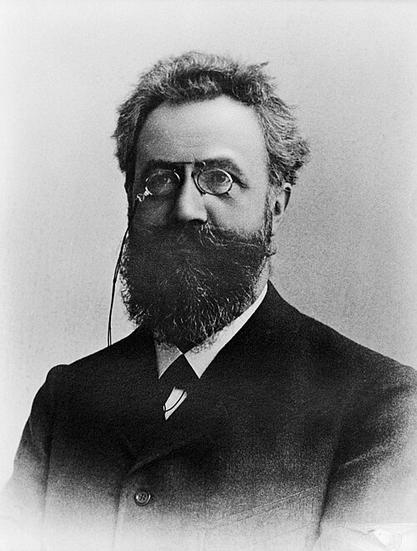
As we untangle engagement, we might send thoughtful birthday greetings to a man whose work influenced the endeavors described in the piece featured above, Hermann Ebbinghaus; he was born on this date in 1850. A psychologist, he pioneered the experimental study of memory and discovered the learning curve, the forgetting curve, and the spacing effect.
#attention #attentionEconomy #culture #education #forgettingCurve #HermannEbbinghaus #history #learning #learningCurve #memory #performance #Psychology #Science #spacingEffect #Technology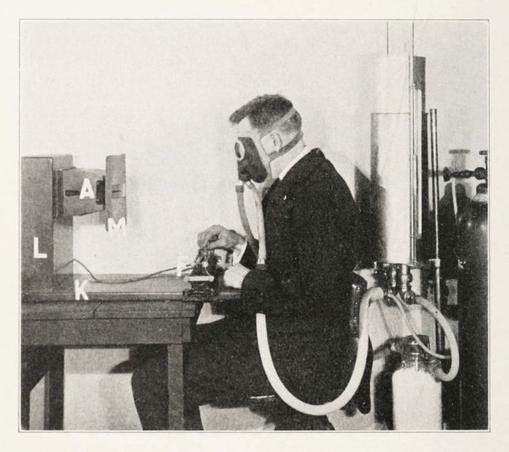
 Nyein Chan Htwe