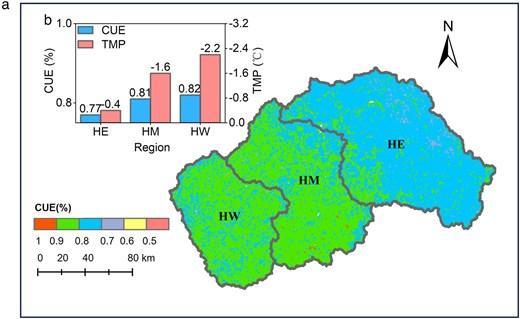
Differences in the rates of change in vegetation respiration and gross primary productivity (GPP) with increasing temperature (TMP) drive the quadratic response of Carbon use efficiency (CUE) to TMP, whereas the quadratic response of optimal temperature (TMPopt) to PRE serves as a potential mechanism for the nonlinear CUE–TMP response

#Sub_frigidZone | #ForestEcosystems | #GlobalClimateWarming

https://doi.org/10.1093/jpe/rtaf162

【🎉Latest accepted article】
Global patterns and drivers of #DroughtResilience across latitudes and forest taxa

#ForestEcosystems | #EcosystemStability | #LatitudinalPattern | #PlantFunctionalType | #TaxonomicRanks

https://doi.org/10.1093/jpe/rtaf223

#Trees absorb the #greenhousegas #CO2 and release oxygen, thus contributing to a better #environment. Yet, isolated street trees are more susceptible to disease than those in #forests, which are embedded in complex #forestecosystems with a #treespecies #diversity.
In light of #globalwarming and #anthropogenic #environmentalchanges, R. C. Gatti et al. (2022) estimated the number of tree #speciesonEarth.
© #StefanFWirth #Berlin 2025

Ref
https://doi.org/10.1073/pnas.2115329119

#Photos
©S F. Wirth

【🎉Latest accepted article】
Divergent Responses of Photosynthesis and Respiration Underlie the Nonlinear Response of #CarbonUseEfficiency to Temperature in Sub-Frigid Forest in China

#Sub_frigidZone | #ForestEcosystems | #GlobalClimateWarming

https://doi.org/10.1093/jpe/rtaf162

Divergent Responses of Photosynthesis and Respiration Underlie the Nonlinear Response of Carbon Use Efficiency to Temperature in Sub-Frigid Forest in China

Abstract. Forest ecosystems in the sub-frigid zone play a crucial role in global carbon cycle and exhibit distinct responses to climate change. The carbon

OUP Academic

Researchers developed new model calculations that estimate the global influences of lightning on #forestecosystems, showing that 320 million trees die each year due to #lightningstrikes: http://go.tum.de/970492 🌳

#treemortality

📷iStock/jarino47

320 million trees are killed by lightning each year

Researchers at TUM were able to show that each year, 320 million trees worldwide die directly as a result of lightning strikes.

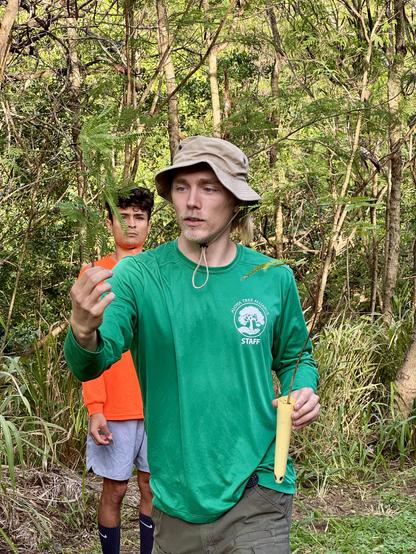
Spent the morning with @alohatreealliance caring for newly planted native trees in the beautiful Kuli’ou’ou Valley. It was pure magic connecting with the forest and building a sense of community. #ForestEcosystems