
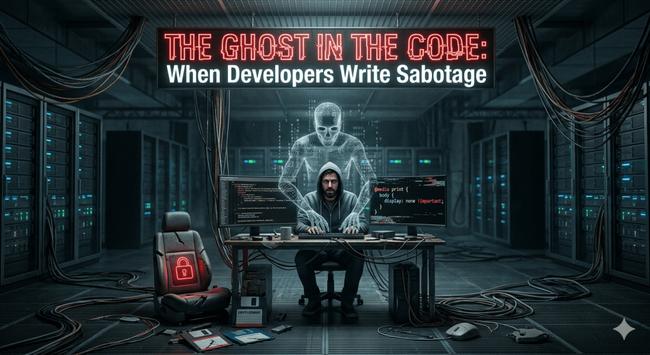
The Ghost in the Code: Why Developer Integrity is Leaking Memory

1,648 words, 9 minutes read time.

A Helping Hand Needed for a Fellow Programmer

I’m reaching out to see if you can lend a hand to a talented software developer who’s currently on the job hunt. With over 30 years of experience in C#, .NET (Core/6–8), REST APIs, SQL Server, Angular/Razor, Kubernetes, and cloud CI/CD, he’s a seasoned pro with a proven track record of leading modernization projects and delivering production systems.

Some of his notable accomplishments include DB2 to SQL migrations, building real-time SignalR apps, and developing full-stack API and frontend projects. Based in Southeast Michigan, he’s looking for senior engineering, architecture, or technical lead roles that will challenge him and utilize his skills.

If you’re in a position to help, you can check out his resume and portfolio at http://charles.friasteam.com.

Let’s all look out for each other – if you know of any opportunities that might be a good fit, could you please consider passing this along to your network?

The fundamental contract between me as a developer and my users is a sacred protocol, and right now, my industry is failing the handshake. When I see code specifically designed to break a product unless a ransom is paid, I’m not looking at “gating a feature”—I’m looking at professional sabotage. We are reaching into a user’s environment, seizing control of their native browser functions, or even their physical hardware, and holding them hostage for a credit card number. This isn’t a “business model,” it’s a protection racket run by men who have forgotten that our job is to reduce entropy, not manufacture it.

Let me be clear: I don’t have a problem with a developer who works hard to develop a feature getting paid their worth. We deserve to be compensated for the value we add to the world.

However, personally, I don’t write feature-gated code. I refuse to build traps. I am sick to my stomach that the industry I love has normalized this. If I see a @media print rule injected just to blackout a component that works perfectly on-screen, I see a ghost in the codebase. Someone decided that their “right to profit” outweighs the user’s “right to function.” This isn’t a new practice; my industry has been flirting with “crippledware” since the days of floppy disks. But just because a sin is legacy doesn’t mean it isn’t technical debt that will eventually bankrupt our collective reputation. I am deconstructing the three reasons why this “sabotage” logic is a terminal error: the theft of user agency, the systemic rot of enshittification, and the inevitable “logic bomb” of community blowback.

I’ve watched juniors think they’re being “clever” when they hide a kill-switch behind an obfuscated minified bundle. They think they’re protecting “intellectual property.” The hard truth is they’re usually just hiding mediocrity. If a product is so flimsy that the only way to get a conversion is to break the user’s “Print” button, we haven’t built a tool; we’ve built a digital shakedown. As a lead architect, I must build value that people want to pay for, not hurdles they are forced to pay to jump over. I am looking at the kernel-level rot that occurs when developers prioritize “anti-features” over actual deployment stability.

The Seizure of Borrowed Authority and Hardware Ransom

When I deploy a web application, I am a guest in the user’s browser. But this rot has spread far beyond the browser. We are now seeing the “Ghost in the Code” haunt physical objects. When a manufacturer installs heated seats in a car or extra storage in a computer, and then charges a monthly fee to “unlock” them, they are committing Hardware Ransom. The hardware is already there; the manufacturer has already incurred the cost. It costs them absolutely nothing for the user to use what they have already bought and paid for.

Using code to gate physical equipment is the ultimate form of extortion. It’s the equivalent of a SharePoint architect intentionally breaking the “Export to Excel” function because they want to sell a “Premium Reporting” module. It’s lazy, it’s hostile, and it reveals a fundamental lack of respect for the environment we operate in. When I write code that intercepts a beforeprint event to unmount a component or prevents a heating element from firing in a car, I am telling the user that they don’t actually own their machine while my script is running.

If my character is the kernel, this kind of logic is a “Kernel Panic” waiting to happen. I cannot build a high-stability career on a foundation of deceit. Every time the industry ships an “anti-feature,” it trains brains to look for ways to restrict rather than ways to empower. We are becoming gatekeepers instead of engineers. In the long run, the market treats gatekeepers like legacy hardware: it finds a workaround and discards them. My authority comes from the value I add, not the friction I manufacture.

The Architecture of Enshittification and the Rise of the Frustration Machine

I must call this practice what it is: a tactical execution of Enshittification. This isn’t a new protocol, but it has become the standard operating procedure for weak companies that have forgotten how to innovate. The lifecycle is predictable: First, a platform or plugin is useful. It solves a problem cleanly. The “Handshake Protocol” is honest. Next, once critical mass is achieved and users are locked in, the pivot happens. The company stops creating value and starts harvesting it. This is when the “Ghosts” are deployed.

The transition from a “useful tool” to a “frustration machine” is where engineering ethics are put to the test. If I am the developer assigned to write the code that hobbles a free version—or locks a physical car seat—I am the janitor of enshittification. I am physically installing the decay that the C-suite ordered because they are too lazy to build a Pro tier that actually justifies its price tag. If we can’t build something that someone pays for because it works, and we have to rely on it failing to trigger a payment, we’ve already lost the war. We’ve admitted our code isn’t good enough to compete on its own merit. We’ve “deprecated” our own integrity.

This “frustration-first” architecture is a crutch for the mediocre. A real lead knows that the most profitable software in history is the stuff that makes the user feel like a god, not a victim. If someone builds a SharePoint web part and intentionally hobbles the CSS so it looks like a 1995 GeoCities page unless the user buys a license, they’re a hack. They’re taking the easy path because they’re too lazy to build actual, high-level features that provide real ROI. My character is the operating system for my career. If I’m comfortable shipping “frustration machines,” then my OS is riddled with malware.

The Logic Bomb: Community Blowback and the Spite-Driven Deployment

Here is the hard truth about the “Ghost in the Code”: the web is transparent. Sabotage logic runs on the client-side, which means the “lock” is handed to a room full of people who know how to pick it. This applies to hardware, too. When car companies lock features, the community responds with “jailbreaks” and custom firmware. When developers insult the intelligence of their peers by shipping a “frustration machine,” they invite a “spite-driven” deployment. I have seen companies go under because they got too greedy with their “anti-features,” and a single pissed-off developer on Reddit posted a three-line script that bypassed their entire “Premium” gate. When we build on frustration, we build on a foundation of spite. And in this community, spite is a high-octane fuel.

I have to ask if I’m a “load-bearing” member of the tech community or just a parasitic process draining the system’s resources. When we participate in enshittification, we contribute to digital entropy. We make the internet a slightly worse place to inhabit. We are essentially building a “Smart City” where the sidewalks disappear unless you’re wearing “Premium” shoes. The market treats parasites like legacy hardware: it finds a workaround and discards them. If that same time was spent building a feature that actually made a business smoother, the users wouldn’t be trying to hack the code; they’d be trying to buy it. My protocol is simple: provide more value than I take. If I can’t do that without sabotaging the environment, I need to step away from the IDE.

The Protocol of the “No-Excuses” Architect

I’ve deconstructed the rot, from tactical CSS sabotage to the strategic decay of enshittification and the extortion of hardware ransom. Now it’s time for the deployment. I can either be a builder of solutions or a builder of hurdles. There is no middle ground. If the industry continues to write “ghosts” into code, it is declaring that it has reached its ceiling. It is saying it has given up on innovation and settled for extortion. That’s a weak way to live and a pathetic way to code.

I don’t write feature-gated code because I want to build legacy code—code that outlives my current job title. I reject the “Ghost.” I will be the one who stands up in the sprint planning meeting and says: “We are not building a frustration machine. If we need more revenue, we build more value. We don’t hold the CSS hostage or the hardware ransom.” I refactor my mindset daily. Every line of code I write is a reflection of my discipline and my integrity. If I wouldn’t want to stand in front of a board of directors and explain why I intentionally broke a native browser function or locked a user’s own car seat, I won’t write it.

The industry is full of “ghosts,” but I refuse to be a medium. I am clearing the technical debt of my character. I am done with the “lazy” way to force a conversion. I’m doing the hard work of building things that people actually want to use. The handshake protocol is waiting. I am going to acknowledge it with integrity, because my system will not time out while I’m busy writing a kill-switch. I’m getting back to the terminal and building something that actually makes the world run better. No excuses.

Call to Action

If you found this guide helpful, don’t let the learning stop here. Subscribe to the newsletter for more in-the-trenches insights. Join the conversation by leaving a comment with your own experiences or questions—your insights might just help another developer avoid a late-night coding meltdown. And if you want to go deeper, connect with me for consulting or further discussion.

D. Bryan King

Sources

Disclaimer:

I love sharing what I’m learning, but please keep in mind that everything I write here—including this post—is just my personal take. These are my own opinions based on my research and my understanding of things at the time I’m writing them. Since life moves way too fast and things change quickly, please use your own best judgment and consult the experts for your specific situations!

Related Posts

#BMWHeatedSeatSubscription #clientSideSabotage #codeIntegrity #crippledware #CSSMediaPrintSabotage #darkPatternsInUI #developerIntegrity #developerManifesto #developerResponsibility #digitalEntropy #DigitalExtortion #enshittification #ethicalEngineering #featureGating #forcedSubscriptions #gatekeepingInTech #HaaSEthics #hardwareAsAService #hardwareLocking #hardwareRansom #intentionalFailure #killSwitches #LeadDeveloper #obfuscatedCode #openSourceVsProprietary #ownershipInTheDigitalAge #predatorySoftware #professionalDeviance #programmaticSabotage #protectionRacket #ReactPluginEthics #SaaSMonetizationEthics #seniorArchitect #SharePointArchitect #softwareEngineeringBestPractices #SoftwareEngineeringEthics #softwareRansom #softwareSabotage #softwareTransparency #softwareUtility #sustainableSoftware #techIndustryDecay #technicalDebt #technicalLeadership #TheGhostInTheCode #userAgency #userAutonomy

The Hidden War in Your UI: Why Deceptive Design Patterns Are a Real Threat

1,944 words, 10 minutes read time.

As a developer, I am both annoyed and frankly shamed by the current state of software design. Every day, applications and platforms embed intentional annoyances into interfaces, forcing behavior, hijacking attention, and punishing users for expecting a seamless experience. You try to perform a simple task, and suddenly you’re redirected somewhere else entirely—maybe an ad, a subscription prompt, or a social feed—long before you even start the work you intended. These are not accidents. These are deliberate choices, coded into the system to manipulate, trap, and capitalize on human behavior. From forced search bars on mobile devices to pre-checked opt-ins on websites, these dark patterns exploit predictable cognitive biases, turning our attention into a commodity and our actions into revenue streams. This isn’t a small inconvenience—it’s a systematic exploitation of users’ time, focus, and trust, and it’s everywhere.

The consequences are not confined to frustrated individuals. Employers pay for it in lost productivity. Employees waste time correcting accidental interactions, navigating confusing prompts, or recovering from unintended actions. In sectors where precision and workflow efficiency matter, these misclicks scale into measurable losses, costing organizations millions collectively each year. Governments feel it too. Public services increasingly rely on digital portals—tax filing, healthcare registration, social services—but when these platforms employ dark patterns, citizens are misdirected, deadlines are missed, and error rates rise. Each forced interaction adds friction, increasing the cost of providing services and draining public resources. The economic burden is real, quantifiable, and currently ignored, while companies benefit from increased engagement, ad revenue, or subscriptions at the expense of productivity, efficiency, and trust. The government should step up and prohibit these manipulative practices, making companies accountable for intentionally deceiving their users. Until that happens, the cycle continues unabated.

How Dark Patterns Exploit Human Cognition

To understand why these patterns work, you need to recognize the psychology at play. Designers exploit attention, memory limitations, decision fatigue, and the human preference for the path of least resistance. Buttons placed where users are most likely to tap accidentally, pre-checked boxes designed to enroll you in services, and mislabelled toggles all manipulate these cognitive tendencies. The Fogg Behavior Model illustrates how even small prompts combined with minimal friction can trigger behaviors users never intended. Dark patterns exploit trust and expectation: they turn habitual attention and muscle memory into liabilities, guiding users down paths they would not consciously choose.

Real-world platforms offer clear examples. Social media apps like Facebook and Instagram frequently adjust UI elements—buttons, feed placement, navigation cues—in ways that subtly influence user engagement. Subscription services often obscure cancellation paths or hide essential controls, making the default, easier action the one the company wants. Even well-intentioned software, when poorly designed, can unintentionally trap users in workflows, but these dark patterns are far from accidental—they are engineered to maximize engagement and revenue at the user’s expense. When companies normalize these practices, users become desensitized to manipulation, eroding trust and making them more susceptible to both commercial and malicious exploitation.

Forced Interactions and Accidental Engagement: Costs to Employers and Governments

The human cost of dark patterns is only part of the story. Employers and governments bear substantial hidden costs. Employees navigating interfaces riddled with forced interactions spend countless minutes recovering from accidental clicks, dismissing misleading prompts, or correcting unintended selections. In high-stakes environments—healthcare, finance, or legal compliance—these misclicks can amplify into operational errors, delayed decisions, and lost productivity. Governments experience similar outcomes. Digital portals designed with confusing or manipulative flows increase errors, escalate support costs, and frustrate citizens trying to accomplish essential tasks. From pre-ticked marketing consent boxes to forced redirects in public service apps, these interfaces impose inefficiency and resource waste at scale.

The Pixel search bar example illustrates the mechanics personally, but the scope is far broader. E-commerce apps push pre-selected add-ons, subscription services hide opt-outs, and enterprise software overlays prompts directly in workflow paths. Each accidental click or forced interaction represents lost attention and increased cognitive load, which over time erodes trust and slows work. Beyond productivity, these misdirections can create vulnerabilities. Habitual engagement with deceptive interfaces can normalize disregard for warnings, cultivating conditions ripe for phishing, malware infection, or clickjacking attacks.

Dark Patterns as a Security Threat

The techniques behind dark patterns mirror the strategies hackers already exploit. Clickjacking, spoofed URLs, tabnabbing, and malicious pop-ups rely on the same behavioral leverage: users trusting what appears familiar and predictable. By conditioning people to click without thinking, dark patterns reduce the natural caution that guards against social engineering. While there are no public, verifiable cases of someone losing a job because they were redirected to a prohibited site via a dark pattern, the risk is clear: intentional annoyances in UI can inadvertently expose employees to restricted or inappropriate content, security incidents, or phishing attacks. Hackers are already using similar manipulations for financial gain; if commercial dark patterns normalize inattentive clicking, it’s only a matter of time before adversaries adapt these tactics systematically.

From a regulatory perspective, this elevates dark patterns from a nuisance to a societal concern. Employers must manage the risk of accidental exposure, governments must oversee secure and reliable digital services, and users are effectively subsidizing the cost of poor design and malicious exploitation. The potential fallout spans productivity loss, legal liability, and cyber risk—an intersection rarely acknowledged in discussions about user experience but increasingly critical as systems become more complex and interconnected.

Regulatory and Industry Responses to Deceptive UI

Governments and regulators are starting to take notice, but the pace is glacial compared to the ubiquity and sophistication of dark patterns. In the United States, the Federal Trade Commission (FTC) has begun enforcing against manipulative interfaces, including cases where subscription services used deceptive defaults or buried cancellation options. A notable settlement with Amazon over hidden enrollment practices in its Prime service illustrates that regulators recognize dark patterns can create systemic harm, not just isolated user frustration. Similarly, privacy legislation such as the California Consumer Privacy Act (CCPA) and the European Union’s General Data Protection Regulation (GDPR) specifically prohibit coercive or deceptive manipulations of user consent, acknowledging that forced opt-ins, pre-checked boxes, and hidden controls undermine both privacy rights and user autonomy. These legal frameworks provide a foundation for holding companies accountable, but enforcement remains sporadic and limited in scope.

Industry-driven initiatives are also emerging, though they often lack teeth. UX and design organizations have published guidelines for ethical design and user-first principles, emphasizing transparency, control, and respect for cognition. Websites like DarkPatterns.org catalog manipulative designs and educate consumers, while professional associations provide heuristics for evaluating UX for ethical compliance. These frameworks offer companies a roadmap to avoid regulatory scrutiny and rebuild trust, but adoption is inconsistent. Many organizations continue to prioritize engagement metrics, ad revenue, and subscription conversions over ethical design, creating an environment where dark patterns thrive.

The interplay between regulation, corporate incentives, and ethical design is critical because dark patterns are not benign. Their impacts cascade through the workplace, government service delivery, and cybersecurity. Employees conditioned to accept manipulative flows may inadvertently compromise security. Citizens navigating government portals may experience inefficiency, confusion, and delays. Consumers are nudged into unintended purchases or data sharing. The cumulative effect is societal: wasted resources, eroded trust, and increased risk exposure. Without proactive regulation and industry commitment, these consequences will only intensify, and the incentive to adopt manipulative design will remain.

Designing Ethical UI: Balancing Business Goals with User Respect

Ethical design isn’t about removing friction entirely—it’s about aligning user behavior with informed choice rather than deception. Companies can achieve engagement and conversion without resorting to manipulative tactics by making paths transparent, defaults neutral, and consent explicit. This includes placing critical actions where users intend to find them, avoiding pre-selected options, labeling interfaces clearly, and respecting user attention rather than exploiting it. Transparency is a defensive and offensive strategy: it reduces the risk of accidental engagement with inappropriate content, lowers exposure to security incidents, and enhances brand trust. Organizations that internalize these principles see the long-term benefit of loyal, confident users who understand and respect the product rather than feeling tricked into using it.

Frameworks for ethical evaluation exist. Heuristic evaluations, cognitive walkthroughs, and user testing are tools to identify manipulative patterns before they reach production. These methods don’t just improve usability; they reduce legal and security risks by uncovering deceptive or friction-heavy elements that could be exploited accidentally or maliciously. Designing with ethical intent is no longer optional. The intersection of user experience, cybersecurity, and regulatory compliance demands that companies reconsider every prompt, redirect, and forced interaction through the lens of respect, transparency, and safety.

Conclusion: Recognizing the Battle and Reclaiming Control

Deceptive design patterns aren’t just a minor nuisance—they’re a battlefield embedded in every click, swipe, and prompt we encounter. From mobile apps to enterprise software and government portals, users are systematically manipulated, distracted, and exploited, and the costs are real: lost productivity for employers, inefficiency and frustration in public services, increased cybersecurity risk, and erosion of trust across the digital ecosystem. While there are no documented cases of someone losing a job directly because a dark pattern redirected them to inappropriate content, the potential is undeniable. Habitual exposure to forced interactions, hidden defaults, and misleading interfaces creates vulnerabilities that hackers and malicious actors can exploit, turning convenience into liability. It’s a matter of when, not if, these techniques are weaponized beyond commercial manipulation.

Governments and regulators need to step up decisively. Current legislation like GDPR, CCPA, and FTC enforcement actions provide a foundation, but they don’t address the sheer scale or subtlety of manipulative UI practices. Companies that continue to prioritize engagement metrics and revenue over user autonomy are externalizing costs onto society, employees, and security infrastructure. Until these behaviors are prohibited, users will remain the collateral damage in a battle they didn’t consent to.

As developers, designers, and informed users, we can reclaim control by demanding transparency, insisting on ethical design, and refusing to normalize manipulative interfaces. Companies can achieve engagement and profitability without resorting to deception, but only if they respect cognition, trust, and attention. The longer we tolerate dark patterns, the greater the risk of unexpected fallout: financial exploitation, accidental security breaches, and the erosion of professional and personal boundaries. The fight for ethical UI isn’t just about convenience or aesthetics—it’s about protecting attention, autonomy, and the integrity of every system we rely on. It’s time to call BS, demand accountability, and push the industry toward design that respects users instead of manipulating them.

Call to Action


If this post sparked your creativity, don’t just scroll past. Join the community of makers and tinkerers—people turning ideas into reality with 3D printing. Subscribe for more 3D printing guides and projects, drop a comment sharing what you’re printing, or reach out and tell me about your latest project. Let’s build together.

D. Bryan King

Sources

Dark Patterns: Deceptive UI Patterns – Nielsen Norman Group
Dark Patterns – DarkPatterns.org
The Ethics of UX Design – ACM Digital Library
FTC Actions Against Dark Patterns
GDPR on Automated Decision-Making
Behavioral Economics and UX Manipulation – JSTOR
Psychology of Dark Patterns – UX Collective
Impact of Deceptive Design on User Trust – ScienceDirect
Dark Patterns and Privacy – Privacy International
Dark Patterns in Mobile Apps – Taylor & Francis Online
Google’s UI Choices – Wired
Ethical Considerations in UI Design – ACM
UI Design Ethics and User Manipulation – ScienceDirect
Dark Patterns and Ethical UX – UX Matters

Disclaimer:

The views and opinions expressed in this post are solely those of the author. The information provided is based on personal research, experience, and understanding of the subject matter at the time of writing. Readers should consult relevant experts or authorities for specific guidance related to their unique situations.

#accidentalClicks #accidentalEngagement #accidentalSubscriptions #accidentalUIEngagement #attentionExploitationUX #attentionHijack #attentionHijackSoftware #behavioralManipulation #CCPADarkPatterns #clickjacking #cognitiveExploitation #cognitiveExploitationSoftware #cognitiveLoadInterface #cybersecurityRisksUX #darkPatternPenalties #darkPatterns #deceptiveDesignConsequences #deceptiveInterfaceExamples #deceptiveMarketingUX #deceptiveMobileInterfaces #deceptiveUI #deceptiveUXAudit #deceptiveUXTechniques #digitalCoercion #digitalEthics #digitalEthicsCompliance #digitalExploitation #digitalFriction #digitalTrustErosion #eCommerceUXManipulation #employeeDistractionSoftware #employerCosts #enterpriseUXDarkPatterns #ethicalSoftwareDesign #ethicalUserExperience #forcedEngagementDesign #forcedInteractions #forcedNavigationApps #forcedSubscriptions #forcedUIClicks #FTCEnforcementUI #GDPRDarkPatterns #governmentInefficiency #governmentSoftwareInefficiency #hiddenControls #hiddenOptIns #humanFactorsUX #humanComputerInteractionRisk #humanComputerTrust #interfaceAttentionTrap #interfaceCoercion #interfaceDarkDesign #interfaceDeception #interfaceDesignEthics #interfaceEngineering #interfaceInterference #interfaceLegalRisks #interfacePsychologicalManipulation #interfaceSecurityRisk #maliciousRedirection #manipulativeDesign #manipulativePromptsSoftware #misleadingDigitalPrompts #misleadingInterface #misleadingPrompts #mobileAppDarkPatterns #phishingRisk #phishingSusceptibility #preCheckedBoxes #productivityDrainSoftware #productivityLoss #regulatoryCompliance #securityRisksDarkPatterns #socialEngineering #socialMediaDarkPatterns #softwareFrustration #softwareManipulation #softwareManipulativePrompts #softwareMisdirection #softwareTraps #subscriptionDarkPatterns #techEthics #UIAnnoyances #UICompliance #UIDistractions #UIGovernance #UIHarm #UIInterferenceInWorkflow #UIRegulatoryRisk #UIRiskManagement #UISecurityRisks #UITransparency #UITraps #unethicalDesign #unethicalUIExamples #userAutonomy #userDeceptionSoftware #userExperienceTrust #userInterfaceManipulation #userManipulationSoftware #userTrustErosion #UXAccountability #UXAccountabilityStandards #UXAudit #UXBehavioralTraps #UXBestPractices #UXDeception #UXEthicalDesign #UXFail #UXLegalLiability #UXSecurityConcerns #UXTransparencyCompliance #workflowDisruption #workflowHijack #workflowManipulation