Things I could have been doing last night: Sleeping

Things I did do last night: Reworked my Manchester Baby emulator and assembler libraries to work with an 8 bit word length so I could have a http endpoint on a server at @nottinghack that I could submit valid assembly to and watch it run on a newly installed flip dot display courtasy of @asj

#VintageComputing #flipdotdisplay

Everything Is Awesome

YouTube
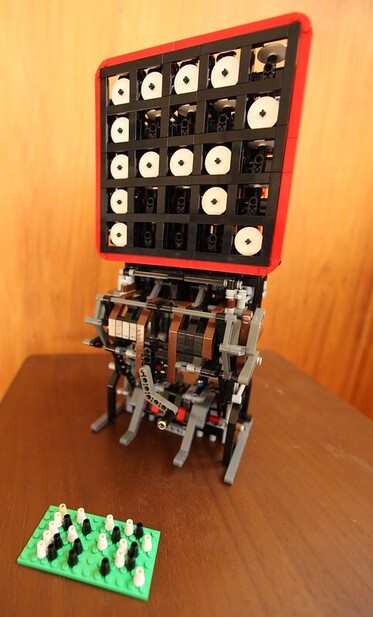
[MOC] Bitmap Display

This is a mechanical bitmap display Ive just built. Currently putting together an LDD file for it.

Eurobricks Forums
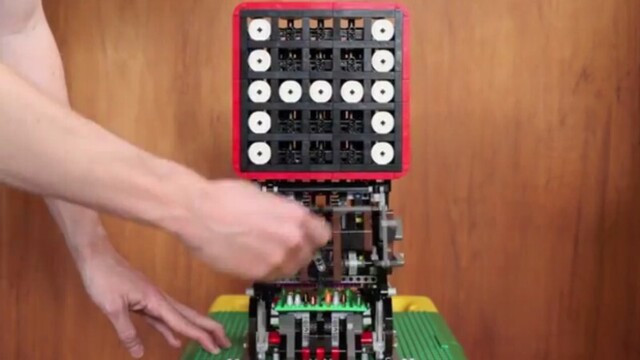
Lego Flip-dot Display

We don’t need to mention that flip-dot displays are awesome. They use no power except in transitions, are visible on even the brightest of days, and have a bit of that old-school charm. So th…

Hackaday
Flip-disc display - Wikipedia

Giving Flip Dots the Oil Treatment to Shut Them Up

Flip dot displays are awesome -- too bad it's so hard to find large panels to play around with, but that's for another article. [Pierre Muth] has been working to find different and interesting things to do with these flip dots, and he recently explored how you can flip them very very gently.

Now you likely remember [Pierre's] work from earlier this year where he was pushing the speed of the displays as high as possible. Using a capacitor discharge trick he made it to 30 fps, which absolutely stunning work. This time around he attempted to do something equally impressive by micro-stepping the dots. It's a bonkers idea and unfortunately didn't work. It seems the dots are engineered for two steady states and you just can't get very good performance with the in-between states.

However, along the way he had an a-ha moment. Part of what he wanted to do with the microstepping was to slow down the change of the state and for that, he just grabbed a viscous fluid that's thicker than air: Vaseline oil. (We'd imagine it's not the cocoa-scented variety, but who knows?) He's taken a page out of the mineral-oil-cooled PC sub-genre and applied it to flipdots. But watch the video after the break and you'll see that the slower animations are super pleasing to watch, and the clickity-clackity that was driving you nuts while trying to works is now whisper quiet. It's a new dawn for displays.

#mischacks #flipdotdisplay #oil #oilcooling

Giving Flip Dots The Oil Treatment To Shut Them Up

Flip dot displays are awesome — too bad it’s so hard to find large panels to play around with, but that’s for another article. [Pierre Muth] has been working to find different and…

Hackaday

Mechanically Multiplexed Flip-Dot

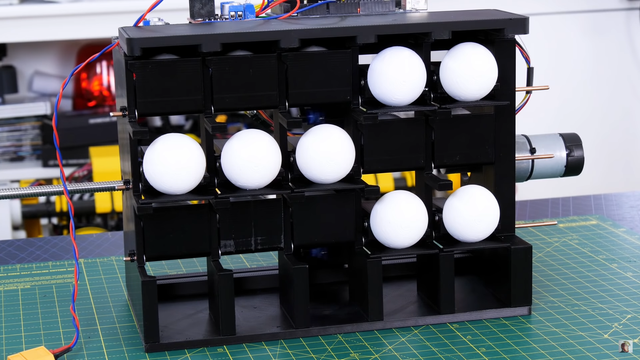
Flip dots displays are timeless classics, but driving the large ones can quickly turn into a major challenge. The electromagnets require a lot of current to operate, and the driver circuits can get quite expensive. [James Bruton] wanted to build his own, but followed a bit of a different route, building a mechanically multiplexed flip dot (ball?) display.

Each of the dots on [James]' 5×3 proof of concept is a bistable mechanical mechanism that can either show or hide a ping pong ball sized half sphere. Instead of using electromagnets, the dots are flipped by a row of micro servos mounted on a moving carriage behind the display. The mechanism is derived from one of [James]' previous projects, a mechanical multiplexer. Each dot mechanism has a hook at the back of the mechanism for a servo to push or pull to flip the dot. A major disadvantage of this design is the fact that the servo horn must match the state of the dot before moving through the hook, otherwise it can crash and break something, which also reduces the speed at which the carriage can move.

This build was just to get a feel for the concept, and [James] already has several ideas for changes and improvements. The hook design can certainly change, and a belt drive would really speed things up. We think this mechanical display is a very interesting design challenge, and we are interested to hear how our readers would tackle it? Let us know in the comments below.

Recently we covered a 3D printed flip dot display for the first time. It's still small and [Larry Builds] is working out the kinks, but we would love to see it eventually match the mesmerising effect of Breakfast's large installations.

#mischacks #3dprinted #flipdotdisplay #jamesbruton #multiplexer #servos

Mechanically Multiplexed Flip-Dot

Flip dots displays are timeless classics, but driving the large ones can quickly turn into a major challenge. The electromagnets require a lot of current to operate, and the driver circuits can get…

Hackaday

3D Printed Flip Dots

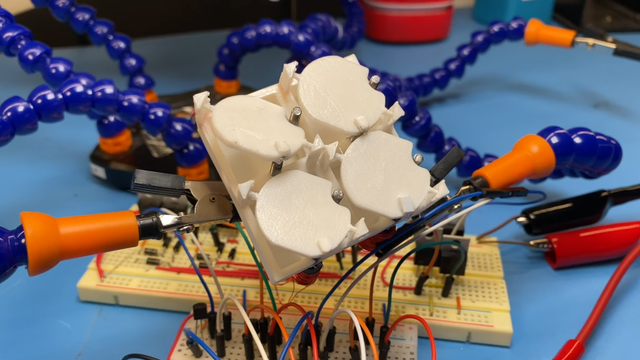
Displays have come a long way in the last few decades, but none can deliver the mesmerizing visual and audio experience of a large flip dot display. Both old panels and new panels can be expensive and difficult to source, so [Larry Builds] made his own flip dots with the help of 3D printing.

Flip dots are driven by a pair of electromagnetic posts that attract or repel a magnet embedded in the dot, and [Larry Builds] version is no different. For the electromagnets, he used M3 threaded rod with enamel wire wound around them using a drill. At first, he used a large magnet in the center of the 3D printed dot, but the magnetic field was large and strong enough to flip the surrounding dots in an array. He then changed the design to a small 4 mm diameter magnet in the edge that aligns directly with the electromagnets. This design looks very similar to those used by Breakfast for their massive installations. By modifying electromagnets and adding spacers around the magnets, he was able to reduce the operating current from 2 A to below 500 mA. [Larry Builds] also breadboarded a basic driver circuit consisting of H-bridges multiplexed to rows and columns with diodes.

We will be keeping a close eye on this project, and we look forward to seeing it evolve further. It's definitely on our "things to build" list. We've embedded multiple videos after the break showing the progress thus far.

We've covered several interesting flip dot projects, including a water level indicator that doesn't use any electronics and another that is crocheted.

Thanks for the tip [Baldpower]!

#3dprinterhacks #mischacks #3dprinted #eletromagnet #flipdisc #flipdotdisplay #hbridge #multiplexing

3D Printed Flip Dots

Displays have come a long way in the last few decades, but none can deliver the mesmerizing visual and audio experience of a large flip dot display. Both old panels and new panels can be expensive …

Hackaday