
This time, the resulting clash centers on a basic question: Should federal #law require more #financial professionals to put #retirees’ needs above all else — including their own paychecks — when they offer advice about how to #invest?

In April, the #Labor Dept finalized rules that would subject a wide array of #brokers to a higher #legal standard, requiring them to act as #fiduciaries.

#law #PublicInterest #Retirement #ethics

Financial professionals should be required to handle our retirement money with the utmost care, putting investors’ interests first.
But that type of care comes in degrees, and deciding exactly how far advisers should go has been the center of heated debate for nearly 15 years,
pitting financial industry stakeholders, who argue their existing regulatory framework is enough,
against the U.S. Labor Department, the retirement plan regulator, which says there are gaping holes.

The issue has re-emerged as the department prepares to release a final rule that would
require more financial professionals to act as #fiduciaries
— that is, they’d be held to the highest standard, across the investment landscape, when providing advice on retirement money held or destined for tax-advantaged accounts, like individual retirement accounts.

Most retirement plan administrators who oversee the trillions of dollars held in 401(k) plans are already held to this standard, part of a 1974 law known as #ERISA, which was established to oversee private pension plans before 401(k)s existed.
But it doesn’t generally apply, for example, when workers roll over their pile of money into an I.R.A. when they leave a job or retire from the work force.
Nearly 5.7 million people rolled $620 billion into I.R.A.s in 2020, according to the latest Internal Revenue Service data


https://www.nytimes.com/2024/03/26/business/fiduciary-rule-retirement.html?smid=nytcore-ios-share&referringSource=articleShare

Labor Department Proposes New Fiduciary Rule to Protect Investors

The Labor Department’s latest push for a new fiduciary rule would protect investors’ retirement savings and require financial services providers to change.

The New York Times
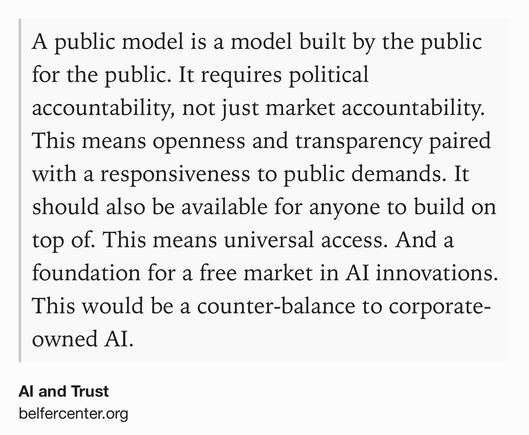
AI and Trust https://www.belfercenter.org/publication/ai-and-trust (interesting thoughts from Bruce Schneier) #AI #public #transparency #fiduciaries
AI and Trust

Bruce Schneier argues that trust is crucial to society, distinguishing between interpersonal trust (based on personal relationships) and social trust (based on systems and reliability). With the rise of AI, Schneier warns that people might mistakenly treat AIs as friends rather than services, leading to potential exploitation by corporations. They advocate for government regulation of the entities controlling AI, emphasizing the need for transparency, accountability, and public AI models to ensure AI remains trustworthy and serves public interests rather than corporate gains.

The Belfer Center for Science and International Affairs