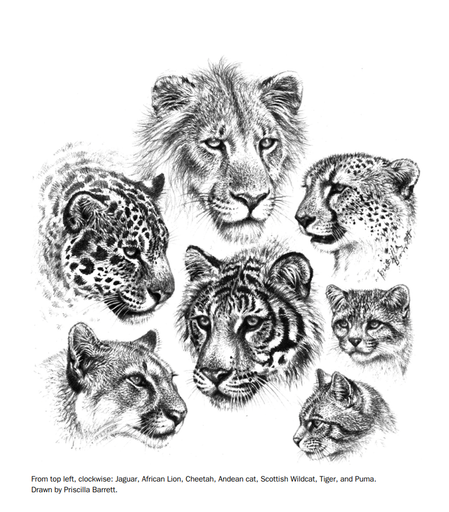
From top left, clockwise: Jaguar, African Lion, Cheetah, Andean cat, Scottish Wildcat, Tiger, and Puma.

Drawn by Priscilla Barrett.

Source:
The Biology and Conservation of Wild Felids by David Macdonald & Andrew Loveridge, 2010

#illustration
#felids

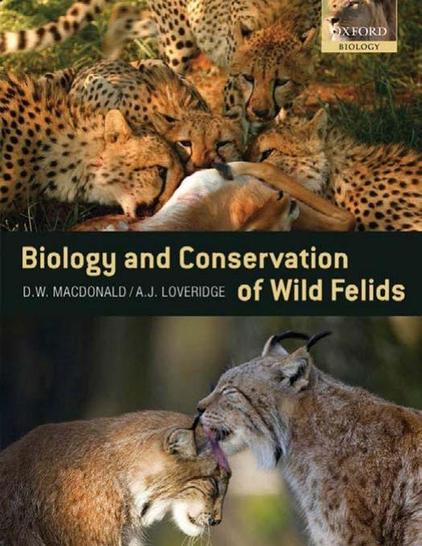
The Biology and Conservation of Wild Felids by David Macdonald & Andrew Loveridge, 2010

The editors utilize their 50 years of combined experience in professional engagement with the behaviour and ecology of wild felids to draw together a unique network of the world's most respected and knowledgeable experts. For the first time, this inter-disciplinary research programme is brought together within a single volume.

#books
#nonfiction
#felids
#biology
#conservation

DNA in the feces of snow leopards shows alpine #cats eat plants https://phys.org/news/2024-06-dna-feces-leopards-alpine-cats.html

Metabarcoding analysis provides insight into the link between prey and plant intake in a large alpine cat carnivore, the snow leopard https://royalsocietypublishing.org/doi/10.1098/rsos.240132

"#felids do eat #plants despite their classification as #carnivores. In particular, Panthera uncia—or snow #leopards—seem to have a preference for a specific plant... The plant genus #Myricaria appeared the most frequently"

DNA in the feces of snow leopards shows alpine cats eat plants

Cats may not know Scarborough Fair, but felids such as alpine cats—both in the wild and in captivity—do eat plants despite their classification as carnivores. In particular, Panthera uncia—or snow leopards—seem to have a preference for a specific plant species despite normally being unsuited for a herbivorous diet.

Phys.org

Transboundary Cooperation in the Tumen River Basin Is the Key to #Amur #Leopard (Panthera pardus) Population Recovery in the Korean Peninsula.

#conservation #ecology #felids #carnivores

https://pubmed.ncbi.nlm.nih.gov/38200790/

Transboundary Cooperation in the Tumen River Basin Is the Key to Amur Leopard (Panthera pardus) Population Recovery in the Korean Peninsula - PubMed

The interconnected forest regions along the lower Tumen River, at the Sino-North Korean border, provide critical habitats and corridors for the critically endangered Amur Leopard (<i>Panthera pardus orientalis</i>). In this region, there are two promising corridors for leopard movement between China …

PubMed
Cougars are changing the way they hunt so bears don’t steal their food

With more bears and wolves in Yellowstone National Park, cougars there appear to be shifting their hunting strategy to find and protect their kills

New Scientist
Combating the illegal trade in big cats – 28 countries come together as part of CITES Big Cats Task Force | CITES

On 24 – 28 April 2023 the CITES Secretariat (The Convention on International Trade in Endangered Species of Wild Fauna and Flora) convened a meeting of the

Celebrate International Leopard Day with us!

3 May is International Leopard Day, and we celebrate the launch of a new informative website to boost this important annual day onto the global calendar –...

The Cape Leopard Trust
Small cats face big threats: Reasons to save these elusive endangered species

More than 30 species of small cats roam Earth today. They control small mammal populations to keep ecosystems in balance while helping farmers reduce rodent numbers. Over a dozen small cat species are hugely at risk.

Mongabay Environmental News