 The 🫠 ᴘʀᴇᴛᴛʏ BBC Radio 3 🎶 #NowPlaying Bot
🇺🇦 #NowPlaying on BBC #Radio3's #ThroughTheNight
Florian Heyerick, Michael Haydn & Ex Tempore:
🎵 Ave Regina for double choir, MH.140
#BBCRadio3 #FlorianHeyerick #MichaelHaydn #ExTempore
🇺🇦 #NowPlaying on BBC #Radio3's #ThroughTheNight
Florian Heyerick, Michael Haydn & Ex Tempore:
🎵 Ave Regina for double choir, MH.140
#BBCRadio3 #FlorianHeyerick #MichaelHaydn #ExTempore
🇺🇦 #NowPlaying on BBC #Radio3's #ThroughTheNight
Florian Heyerick, Michael Haydn & Ex Tempore:
🎵 Ave Regina for double choir, MH.140
#BBCRadio3 #FlorianHeyerick #MichaelHaydn #ExTempore
 Lars Holgersson 🎶
#ClaudioMonteverdi 1567 – 1643
Magnificat a sei voci (1610)
#musik #music #musique #musica #classicalmusic #baroquemusic
#Monteverdi

Claudio Monteverdi: Magnificat a 6 voci (1610)
 Mikele
Hi all, I am Michele, born in Italy but have been living in the UK in the London area for 20+ years now.
Although livecoding is mainly a late-night activity for me (my daily job is in the area of data analytics and visualization), I do my best to keep in touch with such a creative and cool community.. and hence really glad to be joining this forum!
I discovered algorithmic composition around 2009, more or less at the same time as I started learning Lisp. I got hooked into the Scheme-based Impromptu https://en.wikipedia.org/wiki/Impromptu_(programming_environment) language, and later on its successor Extempore https://extemporelang.github.io/
In my experiments I try to discover simple algorithmic structures that can generate interesting harmonies and melodies.
I normally use Extempore, hooked up via MIDI to Ableton Live. Previously, I used a lot also Impromptu (Extempore's predecessor).
More about my music on my personal website https://www.michelepasin.org/sounds.html and The Musical Code https://www.youtube.com/channel/UCanqSICbxzRNEZGMlu8qfyw youtube channel.

 jtmoulia 🐁
Going through #Extempore guide for a #lisp interface to live coding music. Happily it was easy to get some noise going using the #emacs extempore-mode
One cool bit: the quality of the "Note-level music" documentation page is fantastic, going way beyond note patterns to e.g. showing recursion for note scheduling and an illustrated discussion of musical harmony: https://extemporelang.github.io/docs/guides/note-level-music/
Note-level music
This guide covers the basics of how to play instruments at a “note-level” (e.g. play the G above middle C for 2 beats) in Extempore. If you’re satisfied with just playing Extempore’s built-in instruments (which can be found in libs/core/instruments.xtm) then you can just start at this guide. Finally, this guide complements the pattern language one (an alternate way of triggering notes, loops & patterns) and you can mix and match both approaches.
 (((o))) Acoustic Mirror
I've always been a fan of #TidalCycles' #pattern language. What I didn't know was that Andrew Sorensen's #Extempore #livecoding environment also has a kind of pattern language. Must investigate further.
#Scheme #Lisp #LiveCoding #Extempore #TidalCycles #PatternLanguage
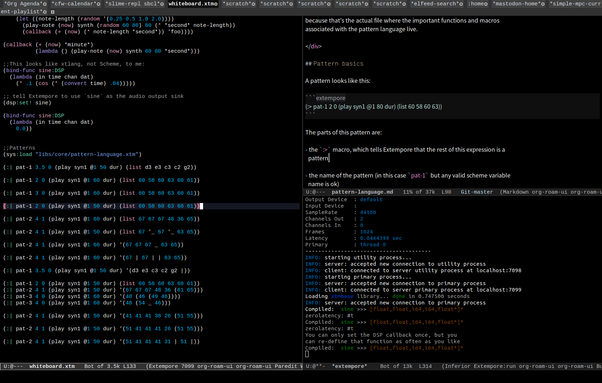
Don't know why, but I always end up going back to #Extempore. Something about #livecoding in #scheme, I guess.