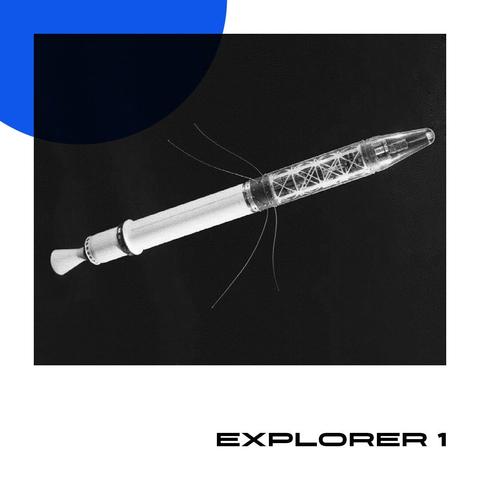
Explorer 1, officially known as Satellite 1958 Alpha, was the third artificial satellite to be send into orbit. With this launch the US joined the Soviet into the space age, who had in the previous year successfully launched Sputnik 1 and Sputnik 2. 🚀🛰
Explorer 1 launched atop a Juno 1 booster from Cape Canaveral, on February 1, 1958.
The satellite weighted 13.97 kg, of which 8,3 kg were scientific instruments. It carried five temperature sensors, an acoustic detector and a wire grid detector to detect micrometeorites impacts. And finally it carried a G-M tube used for the detection of ionizing radiation (cosmic ray), to measure the density of electrons and ions in space. This last instruments helped Dr. Van Allen and his team to measure and to discover what is know now as the Van Allen Radiation belts. Once in orbit, the cosmic ray equipment of Explorer 1 indicated that all of the zero counts per second reports were from an altitude of more than 2,000 km over South America, while passes at 500 km would show expected level of cosmic rays. Dr. Van Allen theorized on the existence of a belt charged particles trapped in space by earth’s magnetic field.
Along the scientific instruments the payload was also composed of more than 29 transistors, Mercury chemical batteries (that made up around 40% of the payload weight) and four antennas to transmit data back to earth.
Explorer 1 continued returning data until its batteries were exhausted on February 28, 1958, but remained in orbit until March of 1970. Quite tough for a first satellite 🛰
Image credit 📸
#nasa
Catch you in the next post! 👩🚀👨🚀✨
#explorer1 #rocketengineering #launch #Vanallenradiationbelts #satellite #space #science #orbit #spaceexploration #spacerace #retrospaceflight #teamspace #betweenbrightplaces #spacescience #rocket cosmowiki
 Kuuke's Sterrenbeelden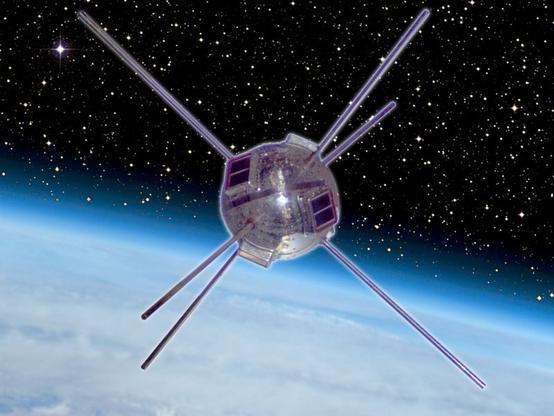
 Between Bright Places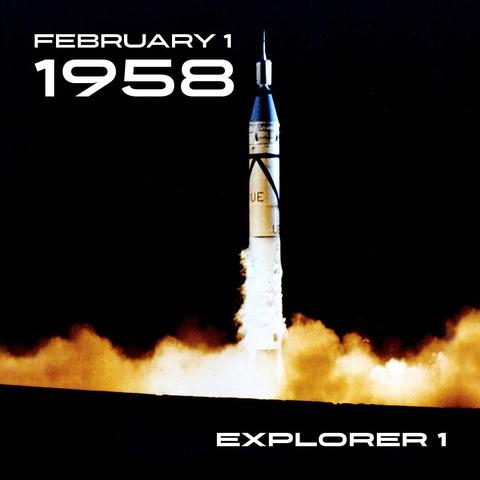
 Canaima GNU/Linux
 CNTI_VE