 WPS News
From Hot Gas to Arguments: How We Got Here
By Cliff Potts, CSO, and Editor-in-Chief of WPS News
Baybay City, Leyte, Philippines — April 22, 2026 — 12:35 p.m. PHST
Earth Day Special Bulletin
The Universe Starts Simple
The early universe was mostly hydrogen, with a smaller amount of helium. This is not speculative. Measurements of cosmic background radiation and elemental abundances strongly support this model (Peebles, 1993; Planck Collaboration, 2020). In plain terms, the universe began with very limited ingredients.
Gravity then began to pull that gas together into denser regions. Over time, these regions collapsed into stars. This process is well-documented through direct observation of star-forming regions in space (McKee & Ostriker, 2007).
Stars Build the Periodic Table
Inside stars, nuclear fusion transforms hydrogen into helium. In more massive stars, fusion continues, forming heavier elements such as carbon, oxygen, and silicon. This process is supported by both theoretical models and spectroscopic observations of stellar composition (Burbidge et al., 1957).
When large stars reach the end of their life cycle, they explode as supernovae. These explosions are observed phenomena and are responsible for creating and dispersing heavier elements, including iron and nickel, into space (Woosley & Weaver, 1995).
Without this step, rocky planets would not exist.
From Dust to Planets
New stars form from gas clouds enriched by previous generations of stars. Around these young stars, protoplanetary disks form. These disks have been directly imaged by modern telescopes (Andrews et al., 2009).
Within these disks, particles collide and stick together, gradually forming larger bodies. This process, known as accretion, explains how planets form. While the general model is well-supported, the exact mechanisms by which microscopic dust becomes kilometer-sized planetesimals remain an active area of research (Johansen et al., 2014).
Earth formed as a molten body and gradually cooled. Volcanic outgassing and external impacts contributed to the formation of the atmosphere and oceans. The relative contributions of these sources remain under study (Morbidelli et al., 2000).
Chemistry Becomes Complicated
Once Earth stabilized enough to support liquid water, chemical interactions increased in complexity. Laboratory experiments have shown that organic molecules, including amino acids, can form under conditions similar to early Earth (Miller, 1953).
This part is supported.
What is not yet fully proven is the exact pathway from these molecules to the first self-replicating systems. Several hypotheses exist. The RNA world hypothesis suggests that RNA molecules could store information and catalyze reactions (Gilbert, 1986). Hydrothermal vent theories propose that life may have originated in chemically rich environments on the ocean floor (Martin et al., 2008).
These models are plausible and supported by partial evidence, but no complete, confirmed pathway has been established.
Life Evolves
At some point, replication began. Once that threshold was crossed, evolution by natural selection took over. This framework is strongly supported by fossil records, genetic evidence, and direct observation (Darwin, 1859; Dobzhansky, 1973).
Over billions of years, life diversified. Single-celled organisms gave rise to multicellular life. Plants and animals emerged. Nervous systems developed. Brains evolved.
Eventually, a species emerged capable of abstract thought, communication, and social organization.
From Biology to Behavior
Human beings are a product of this long chain of physical and biological processes. The same atoms formed in stars now make up our bodies. The same evolutionary pressures that shaped early life continue to influence behavior.
The ability to reason, cooperate, and compete all arise from biological systems that evolved over time.
That includes something as modern as political disagreement.
What We Know and What We Don’t
There are still gaps in this story. The origin of life remains unresolved. Planet formation models are still being refined. Early Earth conditions are still debated.
Science does not claim to have every answer.
But the overall framework, from simple elements to complex life, is supported by multiple independent lines of evidence.
Earth Day Context
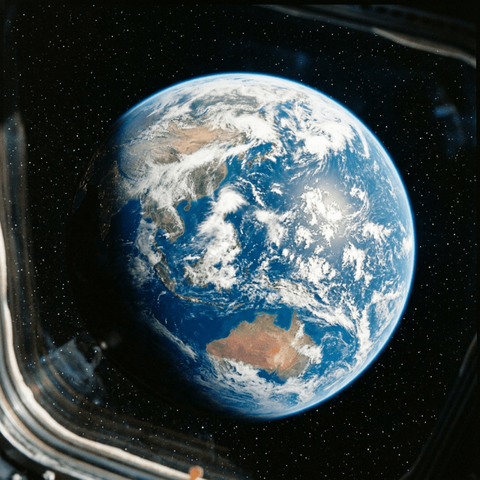
On Earth Day, the significance of this process becomes clear. Everything on this planet shares a common origin.
The rocks, the oceans, the plants, the animals, and human beings all come from the same sequence of events.
We are not separate from the system. We are one outcome of it.
And that carries a practical implication.
This environment is not easily replaced.
References (APA)
Andrews, S. M., et al. (2009). Protoplanetary disks in Ophiuchus. The Astrophysical Journal, 700(2), 1502–1523.
Burbidge, E. M., et al. (1957). Synthesis of the elements in stars. Reviews of Modern Physics, 29(4), 547–650.
Darwin, C. (1859). On the origin of species. John Murray.
Dobzhansky, T. (1973). Nothing in biology makes sense except in the light of evolution. The American Biology Teacher, 35(3), 125–129.
Gilbert, W. (1986). The RNA world. Nature, 319(6055), 618.
Johansen, A., et al. (2014). The multifaceted planetesimal formation process. Protostars and Planets VI, 547–570.
Martin, W., et al. (2008). Hydrothermal vents and the origin of life. Nature Reviews Microbiology, 6(11), 805–814.
McKee, C. F., & Ostriker, E. C. (2007). Theory of star formation. Annual Review of Astronomy and Astrophysics, 45, 565–687.
Miller, S. L. (1953). A production of amino acids under possible primitive Earth conditions. Science, 117(3046), 528–529.
Morbidelli, A., et al. (2000). Source regions and timescales for the delivery of water to Earth. Meteoritics & Planetary Science, 35(6), 1309–1320.
Peebles, P. J. E. (1993). Principles of physical cosmology. Princeton University Press.
Planck Collaboration. (2020). Planck 2018 results. VI. Cosmological parameters. Astronomy & Astrophysics, 641, A6.
Woosley, S. E., & Weaver, T. A. (1995). The evolution and explosion of massive stars. The Astrophysical Journal Supplement Series, 101, 181–235.
 The New York Times - Breaking News, US News, World News and Videos [Unofficial]
 Empiricism
 attresa.geo
 John Griogair Bell
