 Mike McCaffrey
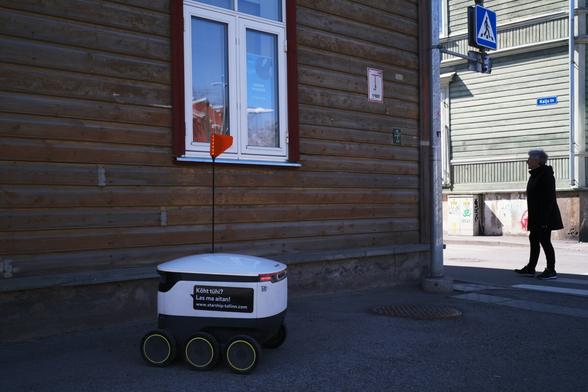
I'm so glad I don't have to watch #robots nearly get murdered every day right outside of my window.

 Jarjan (He/Him)
I'm afraid it's lost, it's just quietly sitting there on the pavement. Can someone call the parents please? 😅
#ai #stuck #deliverybot #Talinn
#ai #stuck #deliverybot #Talinn
 hackaday unofficial
It looks like the ongoing semiconductor shortage isn't getting any better, and if the recent spate of computer thefts from semi trucks is any indication, it's only going to get worse. Thieves seem to be targeting the Freightliner Cascadia, probably the most popular heavy freight truck on the road in North America today, with "smash and grab" thefts targeting the CPC4, or Common Powertrain Control module. These modules are sitting ducks -- they're easy to locate and remove, the chip shortage has made legit modules nearly unobtanium from dealers, and they truck won't run without them. That's driven the black market price for a CPC up to $8,000 or more, making them a tempting target. And it's not only individual trucks parked in truck stop lots that are being hit; gangs are breaking into trucking company lots and bricking dozens of trucks in short order. So the supply chain problem which started the semiconductor shortage caused the module shortage, which drives the thieves to steal modules and take trucks off the road, which only worsens the supply chain shortage that started the whole thing. Nice positive feedback loop.
Speaking of crime, among the gadgets 007 had available on his Aston-Martin DB5 courtesy of the Q Branch boffins, probably the least-prosecutable one to actually equip your car with would be the license plate flipper. But least-prosecutable doesn't mean legal, as two people in California learned when they were nabbed for allegedly having a plate-flipper on their Mercedes. The pair allegedly used the flipper, which just turned the plate over so it couldn't be seen, to help dodge the notice of security cameras while committing burglaries from vehicles in parking garages. The plate flipper shown in the video below is pretty clever -- it poses as a somewhat stocky-looking license plate frame that obviously hides a small motor. It looks like something that's commercially available, although it would be pretty easy to 3D print something like that. Nah, forget we even said that.
Are you tired of the heartbreak of self-unwrapping burritos? God knows we are, but thankfully we're living in the future, where edible adhesive tape is a thing. Or soon will be, if the "Tastee Tape" invented by some engineering students at Johns Hopkins goes anywhere. The ingredients of the edible tape are being kept under tight wraps (lol) due to a pending patent application, but they will say that the tape is completely edible and uses ingredients and additives common to the food industry. A casual inspection of the ingredients list on any pre-packaged food item suggests that this means they had a huge cupboard to work from, so we'd be curious to see what's in there. From the picture in the article it almost looks like nori, but they say that version was dyed for presentation, and the production recipe yields a clear tape. Which is good, because that blue stuff doesn't look too "Tastee."
And finally, last week we featured the last painful seconds of a Starship delivery robot, whose guidance system betrayed it by telling it to cross railroad tracks at a most inopportune moment. Knowing that nobody got hurt -- aside from the college students who didn't get their pizza, of course -- made it easy to laugh at the snuff film, especially when the bot's lithium batteries did the thing that lithium batteries tend to do when smooshed by a train. But this photo of a seemingly lost Starship wandering around in the woods is somehow a little less funny. It was taken in England, where the delivery bot was spotted trundling down a trail in a nature preserve. It turns out that rather than being lost, the bot was exactly where it wanted to be -- the paved trail was actually the shortest route to its delivery destination, so everyone who thought the bot had gone feral turned out to be wrong. After all, not all who wander are lost.
#hackadaycolumns #hackadaylinks #slider #007 #adhesivetape #chipshortage #crime #deliverybot #foodscience #jamesbond #licenseplate #starship #theft


Hackaday Links: April 10, 2022
A funny thing happened on the way to the delta. The one on Jezero crater on Mars, that is, as the Perseverance rover may have captured a glimpse of the parachute that helped deliver it to the Red Planet a little over a year ago. Getting the rover safely onto the Martian surface was an incredibly complex undertaking, made all the more impressive by the fact that it was completely autonomous. The parachute, which slowed the descent vehicle holding the rover, was jettisoned well before the "Sky Crane" deployed to lower the rover to the surface. The parachute wafted to the surface a bit over a kilometer from the landing zone. NASA hasn't confirmed that what's seen in the raw images is the chute; in fact, they haven't even acknowledged the big white thing that's obviously not a rock in the picture at all. Perhaps they're reserving final judgment until they get an overflight by the Ingenuity helicopter, which is currently landed not too far from where the descent stage crashed. We'd love to see pictures of that wreckage.
We recently had a Hack Chat on 3D printing metal where Agustin Cruz came on to talk about his attempt to build an affordable electron beam sintering printer. The chat was great, and now Agustin has made a bunch of progress that's worth a look. The idea behind electron beam sintering is simple -- it's basically a souped-up version of the electron gun and deflection coils in the back of a CRT, which blasts away at a bed of fine metal powder to sinter it together, layer by layer. The details, though, like working in a vacuum, precisely depositing a fresh layer of powder, and precisely controlling beam power and position, are non-trivial. Check out Agustin's progress on his Hackaday.io project.
Do you think of yourself as a boring person? Chances are you don't -- it seems like being a bore is like having bad breath, in that it's hard to tell if you've got it. But according to a new study, boring people are not only quantifiable, but the stereotypes about them are all pretty much true -- or at least consistent. The methodology seems a little subjective, though -- participants were asked to provide a brief description of a boring person, which hilariously included former US Vice President Al Gore for his "really monotone speech" and "no emotion." They then imagined personality characteristics, hobbies, and occupations for these stereotypical bores, coming up with things like long-winded stories, geocaching, and accounting. Feeling personally attacked by this point, we read no further, but the take-home message seems to be that while everyone is boring to someone, you really have to work at it to be boring to everyone.
If you listen to the Hackaday Podcast, which of course immediately disqualifies you from the boring people cohort, you'll know about the "What's That Sound?" segment, where a short clip of some tech-relevant sound is played, and if you can identify it, riches and fame await. Well, if you can't get enough of that stuff, head over to the Museum of Endangered Sounds, which seeks to preserve our auditory heritage before it slips away. The site has a mere smattering of sounds so far, including the AIM message alert, the old Nokia ringtone, Windows 95 startup, a floppy drive seeking tracks, and the sound of a cartridge being inserted into a Nintendo NES, complete with the obligatory blowing on the connector. We can think of literally thousands of more sounds worth preserving, and while we don't see a way to contribute sounds, it might be worth pinging the proprietor if you can think of anything.
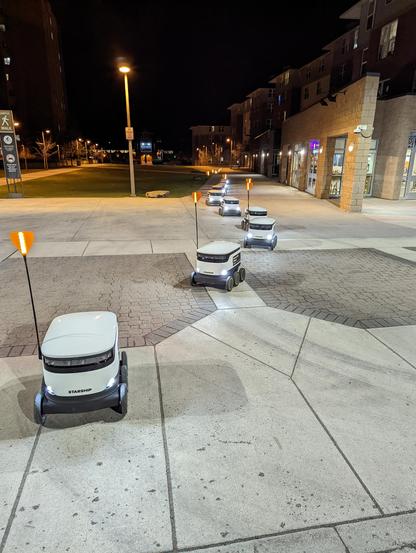
And finally, I share with you the following photo, sent by my son, currently studying at the University of Idaho, snapped moments before his attempted abduction:
Thankfully, he managed to sidestep the slow-moving swarm and make good his escape. I count thirteen of these Starship delivery bots in the picture, doing who the hell knows what. Are they heading back to base for the night? Off to an all-hands meeting? Or perhaps they're on strike and working the picket line? Hard to say, but it's interesting behavior for these things.
#hackadaycolumns #hackadaylinks #audioclip #boringpeople #deliverybot #electronbeam #ingenuity #jezero #mars #metal3dprinting #perseverance #starship #whatsthatsound

Hackaday Links: February 13, 2022
If you need evidence that our outwardly peaceful little neck of the solar system is actually a dangerous place, look no further than the 40 newly launched Starlink satellites that were just clobbered out of orbit. It seems that the SpaceX launch on February 3 was ill-timed, as it coincided with the arrival of energetic plasma from a solar storm that occurred a few days before. The coronal mass ejection followed an M-class flare on the Sun, which was aimed just right to hit just as the 49-satellite addition to the Starlink constellation was being released. This resulted in an expansion of the upper atmosphere sufficient to increase drag on the newborn satellites -- up to 50% more drag than previous launches had encountered. Operators put the satellites into safe mode, but it appears that 40 of them have already met a fiery demise, or soon will. Space is a tough place to make a living.
In better space news, mirror alignment on the James Webb Space Telescope is proceeding according to schedule. The alignment process is complex, and it required operators to start gathering the first of many photons the telescope will see over the next couple of decades. The video below is a fascinating look at the alignment process, which is needed to move the 18 separate hexagonal mirror segments into a single optical surface. The fact that operators are able to attribute the individual spots to specific mirror segments is pretty cool, as is the accidental selfie Webb took during the process. For more on how they move the mirrors, check out [Zachary Tong]'s working model of the mirror actuators.
Seeing how the passage of time has seemingly lost all meaning lately, you'd be forgiven to be shocked to learn that it's "only" been two years since we had anything in the way of real, in-person conferences to announce. But it looks like Hackers on Planet Earth will buck the trend, having announced the appropriately named "A New HOPE" for July. The conference will be held in its new venue on the St. John's campus in Queens, New York. We talked about the change in venue way back in the Before Time -- how little did we know then what was about to unfold. We're just glad to be announcing an actual meatspace conference for a change, so be sure to get your proposals in.
While trolling IEEE Spectrum, we noticed that they've had a series of articles lately focused on some of the classic games from the Golden Age of Arcades. So far we've spotted articles on Space Invaders, Pong, and Battlezone. That last one was a bit surprising -- it was never much of a factor in the arcades we favored in our youth, which tended to endless rows of Pac-Man machines. But according to the article, the US Army apparently contracted with Atari for a version of Battlezone to train its tank crews. That's an interesting tidbit we didn't know, and the whole series is full of great technical details on these classic games, and how the designers got so much done with so few resources. Of course we've done some of our own coverage on that front too.
It seems like big rigs aren't the only delivery vehicles Canadian authorities are taking exception to these days. Delivery robots are also causing some problems, at least in Toronto, where the City Council adopted rules to keep these adorable pink robots and their cohorts off the sidewalks and bike paths. A group representing those with disabilities objected to sharing the sidewalk with these remotely piloted delivery bots, as apparently did users of the city's bike lanes. Excluding these bots from either of these paths seems to present a problem to the business model of their operators. Perhaps they should invest in a fleet of vehicles that can operate safely on the roadways -- oh, wait…
And finally, we have to admit to never really getting the point of drift racing, a pursuit that seems to center around turning horsepower into the slowest possible progression around a track, all while turning expensive tires into air pollution. Of course, like most motorsports it's probably more exciting for the driver than for the audience, or at least it would be if they hadn't built a robot car that can drift itself. Sure, they offer fancy talk about how they're learning how to handle the extreme edge cases of driving, such as might be encountered while negotiating icy roads. But we know what the real agenda is here: not only do they want to put the drift racers out of business, they want to make sure no student driver ever has to experience what it means to "turn into the skid" again.
#hackadaycolumns #hackadaylinks #slider #battlezone #coronalmassejection #deliverybot #driftracing #hackersonplanetearth #hope #jameswebbspacetelescope #jwst #pong #satellite #solarflare #spaceinvaders #starlink