 Simple Nomad
There *is* an i in teiam if you’re clever.
 Sarah Dal
Trying out #QGIS #Deepness plugin on a model I trained on last year's aerial imagery, on some imagery I took earlier in the week, Black-headed gull (red) and Sandwich Tern (teal). Probably could do with training on some of this years data but I don't have time right now
https://github.com/PUTvision/qgis-plugin-deepness/tree/master


Spent an hour tagging a few hundred more images of seals to the dataset and got a much better result! Thanks all who commented with ideas!

In a very boring afternoon, I counted by hand about 1,900 seals in some drone imagery. With a possibility of flying a colony that might have 30,000 seals, I thought I should probably look into automatic counting with #QGIS and #Deepness plugin..
WAID is a dataset containing images of Sheep, Cattle, Seal, Camelus, Zebra, or Kiang. It's huge (14,375 images) and I just needed Seals, so I wrote a quick python script to remove images that had no seals from the dataset.
https://www.mdpi.com/2076-3417/13/18/10397

WAID: A Large-Scale Dataset for Wildlife Detection with Drones
Drones are widely used for wildlife monitoring. Deep learning algorithms are key to the success of monitoring wildlife with drones, although they face the problem of detecting small targets. To solve this problem, we have introduced the SE-YOLO model, which incorporates a channel self-attention mechanism into the advanced real-time object detection algorithm YOLOv7, enabling the model to perform effectively on small targets. However, there is another barrier; the lack of publicly available UAV wildlife aerial datasets hampers research on UAV wildlife monitoring algorithms. To fill this gap, we present a large-scale, multi-class, high-quality dataset called WAID (Wildlife Aerial Images from Drone), which contains 14,375 UAV aerial images from different environmental conditions, covering six wildlife species and multiple habitat types. We conducted a statistical analysis experiment, an algorithm detection comparison experiment, and a dataset generalization experiment. The statistical analysis experiment demonstrated the dataset characteristics both quantitatively and intuitively. The comparison and generalization experiments compared different types of advanced algorithms as well as the SE-YOLO method from the perspective of the practical application of UAVs for wildlife monitoring. The experimental results show that WAID is suitable for the study of wildlife monitoring algorithms for UAVs, and SE-YOLO is the most effective in this scenario, with a mAP of up to 0.983. This study brings new methods, data, and inspiration to the field of wildlife monitoring by UAVs.
.. then ran it on the original orthophoto with great results. I've been trying it on a few others and it seems to work really well, I'm honestly amazed at how easy it was (relatively speaking)
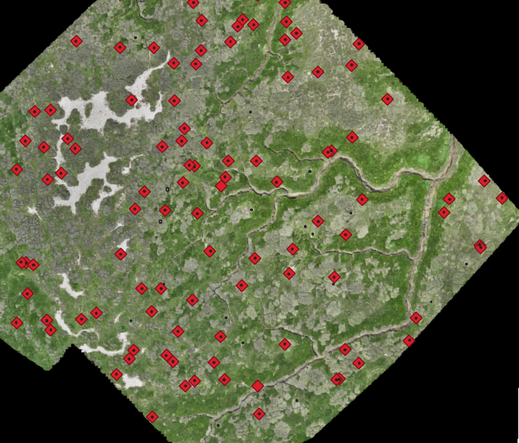
FINALLY done it! Got AI counting Gulls in a saltmarsh colony. Been trying to do this for AGES
🥳🥳🥳
In the 2nd pic red diamonds mark where I manually located gulls; the black dots are where AI found gulls. AI found several I missed!

 Hennessy Becerra
How many cars are there in this #orthophoto with 150 km² of #Guadalajara 🇲🇽 from 2017?
#QGIS " #Deepness " #plugin. #AI for car 🚙#detection. #GIS 🗺
#QGIS
" #Deepness " #plugin. #AI for car 🚙#detection. #GIS 🗺 dicewarebot
⚂ ⚄ ⚃ ⚂ ⚁→#kitten
⚁ ⚀ ⚄ ⚅ ⚁→#culprit
⚅ ⚃ ⚅ ⚃ ⚂→#untimely
⚃ ⚀ ⚄ ⚄ ⚅→#mustang
⚁ ⚁ ⚃ ⚀ ⚄→#deepness
⚀ ⚃ ⚂ ⚃ ⚅→#bullfight
kitten-culprit-untimely-mustang-deepness-bullfight
Roll your own @ https://www.eff.org/deeplinks/2016/07/new-wordlists-random-passphrases
