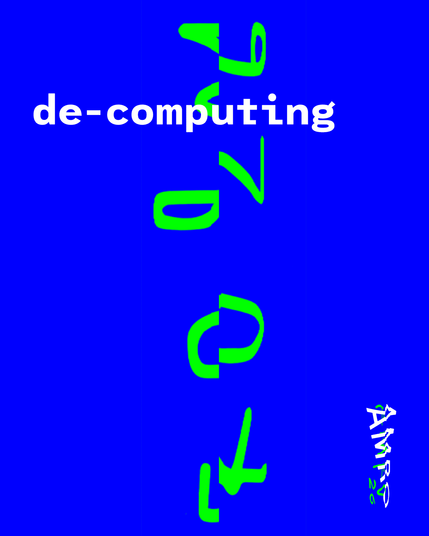
It questions automation and algorithmic decision-making. Decomputing opens space for simpler, more human-centered ways of thinking and acting.

Learn more about the festival’s themes and selected program points in the second episode of AMRO on Air 2026 with Davide Bevilacqua, Joseph Knierzinger and Gabriela Gordillo. Available today at 17:00 on Radio FRO.

#AMRO2026 #BecomingUnreadable #Decomputing #linz #culture #kultur #festival #mediaarts

Glossary 5/6 - De-computing

With this glossary series, AMRO 2026 introduces concepts, terms, and practices that shape the festival’s thematic field. Rather than fixed definitions, these entries are invitations to approach shared questions through different critical vocabularies.

“De-computing” asks what happens when we reduce reliance on computational systems.

#AMRO2026 #BecomingUnreadable #Decomputing #linz #culture #kultur #festival #mediaarts

Interesting pre-print: "This paper treats #AI as diagnostic for the deeper changes taking place in the existing order of things. […] AI's scaling and accelerationism are taken as examples of the wider tactics being invoked by hegemonic power to maintain control under changing conditions. […] the massive build-out of data centres isn't simply a seizure of energy resources but a manifestation of an aggressive and misogynist technopolitics. The paper argues that a liberal push for digital #sovereignty doesn't interrupt these dynamics but plays into the hands of emerging technofascism. It proposes instead the prefigurative tactic of 'decomputing', which draws on #degrowth, deautomatisation and a #convivial approach to technology. It explores decomputing as a means to mitigate both material & relational harms and as a decisive turn towards infrastructuring the common good."

McQuillan, D. (2026). #AI, #Decomputing and the Interregnum. Zenodo. https://doi.org/10.5281/zenodo.18908529

https://www.danmcquillan.org/ai_decomputing_interregnum.html

AI, Decomputing and the Interregnum

This paper treats AI as diagnostic for the deeper changes taking place in the existing order of things. It uses AI's alignment with both the political economy and with the dualisms that underpin it, including race, gender and anthropocentrism, to highlight the nihilistic character of the current restructuring. AI's scaling and accelerationism are taken as examples of the wider tactics being invoked by hegemonic power to maintain control under changing conditions. From this perspective, the massive build-out of data centres isn't simply a seizure of energy resources but a manifestation of an aggressive and misogynist technopolitics. The paper argues that a liberal push for digital sovereignty doesn't interrupt these dynamics but plays into the hands of emerging technofascism. It proposes instead the prefigurative tactic of 'decomputing', which draws on degrowth, deautomatisation and a convivial approach to technology. It explores decomputing as a means to mitigate both material and relational harms and as a decisive turn towards infrastructuring the common good. The paper concludes that AI is the contradiction that reveals many others, not least the gap between claims to legitimacy and the actuality of destructive violence, and proposes an alternative technopolitics of reciprocity that prioritises care and sustainability.

Zenodo

RE: https://hachyderm.io/@thomasfuchs/116440570565467277

"These long-running, parallelized workflows can yield great value, but they have also challenged our infrastructure and pricing structure: it’s now common for a handful of requests to incur costs that exceed the plan price! These are our problems to solve. The actions we are taking today enable us to provide the best possible experience for existing users while we develop a more sustainable solution." — Joe Binder, VP of Product

If people are already _commonly_ exceeding set monthly quotas/costs with just a handful of requests, you all have got much bigger problems, customers/users too (i.e. becoming deeply dependent on externally controlled & rented infrastructure from day one of your project/startup, plus slowly damaging your own cognitive abilities and a fast growing maintenance nightmare)! And this all is just the beginning... 🍿

Keeping up with other news about growing mineral, energy & supply chain shortages, the illusion that this might just be very short term, and the resulting cost bumps needed to produce and provision all the outstanding data center capacities at the heart of the above decisions (and similar ones made by Anthropic just days ago), I really don't understand where this optimism of AI boosters/users is coming from or on what planet they're living on...

genAI/agenticAI is a shoddily implemented/managed/secured technology & mentality for a computing-illiterate consumerist society, for an age of infinite resource abundance with stable climate/politics, all of which we're leaving (or have never really been in)! And that departure is partially driven/accelerated by said tech...

Instead of funneling trillions into this particular tech, we need focus/investment into methods, infrastructure, research/education, relationships, and above all, a culture focused on how to make computing magnitudes more sustainable, accessible, independent and which allows us to do generally more with less. Or, at least not with magnitudes more, just for some dubious, unspecified (and meaningless) measure of improved "productivity gains"... With almost no one ever questioning what this supposed extra productivity is even good for...

#GitHub #AI #ResourceScarcity #Decomputing #HouseOfCards

Decomputing in a Processed World.

From Dan McQuillan
(https://www.danmcquillan.org/resisting_genai_highered_cjuu.html)

*Resisting GenAI & Big Tech in Higher Education*

I suggest we situate our resistance to AI inside and outside higher education as forms of decomputing.
Decomputing rejects scale because that drives carbon emissions,
but also because our agency is undermined by our immersion in a system of machinic relations, which includes the contemporary university
Decomputing is based on the principles of degrowth, care and conviviality.
We need systems that don't depend on continuous expansion, whether that's AI, universities or entire economies.
We need to start from care to counter algorithmic detachment and eugenicist abstractions.
Conviviality gives us ways to collectively assess tech's effects on relatedness and bio-interaction.
Wherever AI is proposed as ‘the answer’ there's already a structural problem.
One that's best addressed through the direct social relations of those most affected.

#airesistance #decomputing #datasociety #academia

"1. Decomputing is a prefigurative technopolitics,
2. which tries to enact changed relations in the here-and-now.
3. One organisational form for this is worker's and people's councils on AI.
4. These are self-constituting assemblies that push back against AI bullshit,
5. while using consensus and critical pedagogy to tackle the divisive binaries we've all been programmed with.
6. Because universities are on the AI frontline, we're seeing resistance popping up all over the place.
7. Solidarity is the first priority of any of these critical collectives.
8. Some of the questions facing this emerging movement more broadly are:
9. how to move beyond reformism with minimum wasted energy and burn-out
10. how to coordinate and develop strategies without imposing rigid structure
11. how to position the push against AI as part of a movement-of-movements,
12. as part of an ecology of infrastructural intersectionalities.
13. AI isn't inevitable, but there's no going back because the past was already built on injustice; what we need to work towards are livable futures worth fighting for."

https://danmcquillan.org/resisting_genai_highered_cjuu.html

#AI #GenerativeAI #BigTech #Decomputing

Resisting GenAI & Big Tech in Higher Education

In these years we're seeing the big tech industry showing its true face: the issues and dangers of mainstream social media are well known by the broader society, "apps" are becoming more broken, bloated and riddled with trackers with every passing day, everything is becoming a subscription service, they're showing down our throats an expensive, polluting and often mediocre technology threatening to take most of our jobs with it... it was inevitable that these conditions spurred a backlash or how media calls it a #techlash.

I belive that's good, it was about time to wipe out most of the naivety many had towards big tech but its saddeing that the pendulum is already swinging in the opposite direction and nowadays many perceives all digital technology as the enemy and calls for getting rid of most of it dreaming of a Butlerian Jihad.

I'm a late 90s kid grew up during the Frutiger Aero era, one of my all time favourite movies is "Tron: Legacy" and I have lots of heartfelt memories of all the experiences and adventures that were possible only because of videogames.

In an era of #techlash and calls to #decomputing I still believe that computing can be a force for good, that the soft glow of an LCD or CRT screen can brighten some of your dull days, that sometimes the friendly words and interactions you need can arrive trough TCP/IP and that the virtual has the potential of significantly enhance (and not replace) the real life.

Like Tron I wanna fight for users.

…Anyway, my recommendation is that those of us not already living at the margins *voluntarily* downsize. And out of that comes the strong probability of less resentment.

Here’s the very wonderful @danmcquillan talking to @parismarx about #decomputing, a kind of #degrowth

https://overcast.fm/+ZpQCTh3cE

Decomputing For a Better Future w/ Dan McQuillan — Tech Won't Save Us

Paris Marx is joined by Dan McQuillan to discuss the global push by governments to rapidly adopt AI at all costs and how citizens can critically rethink our dependence on these technologies while imagining a collective future that benefits everyone.Dan McQuillan is a lecturer at Goldsmiths College, University of London and the author of Resisting AI.Tech Won’t Save Us offers a critical perspective on tech, its worldview, and wider society with the goal of inspiring people to demand better tech and a better world. Support the show on Patreon.The podcast is made in partnership with The Nation. Production is by Kyla Hewson.Also mentioned in this episode: Dan recently gave a talk about decomputing as resistance and published the text on his website. The UK Labour Government is going all in on data centre development, while planning for future water shortages. Academic institutions are rapidly adopting AI technologies, with a little help from industry leaders. The GKN Factory Collective offers an inspiring…

…aaaaand there’s a new hashtag for me to follow:

#decomputing

And, a very good podcast episode with @parismarx in which Dan spends the first 10 minutes providing a searing critique of UK Labour https://overcast.fm/+ZpQCTh3cE

Decomputing For a Better Future w/ Dan McQuillan — Tech Won't Save Us

Paris Marx is joined by Dan McQuillan to discuss the global push by governments to rapidly adopt AI at all costs and how citizens can critically rethink our dependence on these technologies while imagining a collective future that benefits everyone.Dan McQuillan is a lecturer at Goldsmiths College, University of London and the author of Resisting AI.Tech Won’t Save Us offers a critical perspective on tech, its worldview, and wider society with the goal of inspiring people to demand better tech and a better world. Support the show on Patreon.The podcast is made in partnership with The Nation. Production is by Kyla Hewson.Also mentioned in this episode: Dan recently gave a talk about decomputing as resistance and published the text on his website. The UK Labour Government is going all in on data centre development, while planning for future water shortages. Academic institutions are rapidly adopting AI technologies, with a little help from industry leaders. The GKN Factory Collective offers an inspiring…

" #AI performance is ludicrous, but its quite good at being distractive" @danmcquillan at #TechWontSaveUs

Learn more about #decomputing

https://danmcquillan.org/decomputing_as_resistance.html

Decomputing as Resistance