New paper out 📰
"The Schur product of evaluation codes and its application to CSS-T quantum codes and private information retrieval"
Comp. Appl. Math. 45, 293 (2026)
with Ş. Bodur, F. Hernando & E. Martínez-Moro
#quantumcodes #pir #csst
👇
https://doi.org/10.1007/s40314-026-03667-8
The Schur product of evaluation codes and its application to CSS-T quantum codes and private information retrieval - Computational and Applied Mathematics

In this work, we study the Schur (componentwise) product of monomial-Cartesian codes by exploiting its correspondence with the Minkowski sum of their defining exponent sets. We show that J-affine variety codes are well suited for such products, generalizing earlier results for cyclic, Reed–Muller, hyperbolic, and toric codes. Using this correspondence, we construct CSS-T quantum codes from weighted Reed–Muller codes and from binary subfield-subcodes of J-affine variety codes, leading to codes with better parameters than previously known. Finally, we present Private Information Retrieval (PIR) constructions for multiple colluding servers based on hyperbolic codes and subfield-subcodes of J-affine variety codes, and show that they outperform existing PIR schemes.

SpringerLink
Kính viễn vọng Không gian Xuntian của Trung Quốc vừa đạt được đột phá quan trọng trong mô phỏng dữ liệu. Với độ chính xác mức độ pixel, nhóm nghiên cứu đang sẵn sàng cho những khám phá mới trong vũ trụ. Hãy chuẩn bị chào đón kỷ nguyên mới! #Xuntian #KhoaHọcVũTrụ #CSST https://ift.tt/K9kuUTt
Kính viễn vọng Xuntian của Trung Quốc đạt được đột phá mô phỏng mức độ pixel - Thế Giới Trong Tầm Tay

Các nhà khoa học Trung Quốc hoàn thành mô phỏng dữ liệu mức độ pixel cho Kính viễn vọng Không gian Xuntian, đặt nền tảng cho những khám phá vũ trụ trong tương lai.

Thế Giới Trong Tầm Tay - Thế giới của bạn, tin tức của bạn, cách bạn muốn
Introduction to the China Space Station Telescope (CSST): https://arxiv.org/abs/2507.04618 (44 pages!) -> "The #CSST is equipped with five scientific instruments [and] is expected to make significant contributions and discoveries across various astronomical fields, including cosmology, galaxy and active galactic nuclei (AGN), the Milky Way and nearby galaxies, stars, exoplanets, Solar System objects, astrometry, and transients and variable sources. This review aims to provide a comprehensive overview of the CSST instruments, observational capabilities, data products, and scientific potential."
Introduction to the Chinese Space Station Survey Telescope (CSST)

The Chinese Space Station Survey Telescope (CSST) is a next-generation Stage-IV sky survey telescope, distinguished by its large field of view (FoV), high image quality, and multi-band observation capabilities. It can simultaneously conduct precise measurements of the Universe by performing multi-color photometric imaging and slitless spectroscopic surveys. The CSST is equipped with five scientific instruments, i.e. Multi-band Imaging and Slitless Spectroscopy Survey Camera (SC), Multi-Channel Imager (MCI), Integral Field Spectrograph (IFS), Cool Planet Imaging Coronagraph (CPI-C), and THz Spectrometer (TS). Using these instruments, CSST is expected to make significant contributions and discoveries across various astronomical fields, including cosmology, galaxy and active galactic nuclei (AGN), the Milky Way and nearby galaxies, stars, exoplanets, Solar System objects, astrometry, and transients and variable sources. This review aims to provide a comprehensive overview of the CSST instruments, observational capabilities, data products, and scientific potential.

arXiv.org

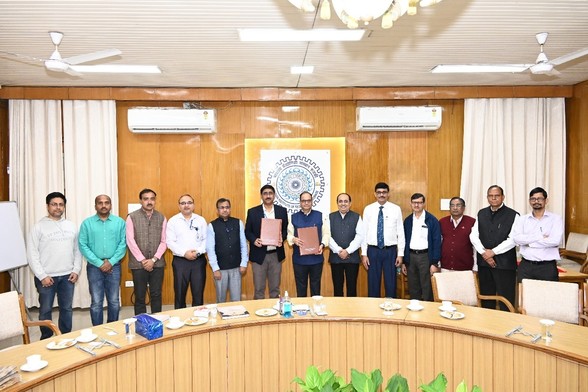
The Indian Institute of Technology (IIT) Roorkee and the Indian Institute of Remote Sensing (IIRS), ISRO, Dehradun signed a Memorandum of Understanding (MoU) on 07 November 2023 to foster academic collaboration in the field of Space Science and Technology and its applications. This collaboration represents a significant step towards advanced research and education in the space science and technology domain in India.

#ISRO #departmentofspace #csst #research #chairmanisro