 Electrospaces
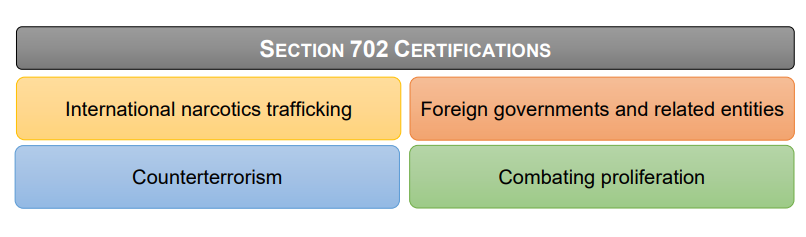
Last year, the FISA Court allowed the #NSA to use #PRISM and #Upstream collection for #counternarcotics operations. That makes a total of four topics for which these programs are used now:
🟢 Military Operation | 5/10
🇺🇸
SOUTHCOM airstrike hits narcotics vessel in eastern Pacific
SOUTHCOM launched an airstrike against a suspected narcotics trafficking vessel in the eastern Pacific Ocean. Two traffickers were killed.
🟢 MilitaryStrike | 5/10
🇺🇸
U.S. carried out a strike on a vessel in the Caribbean
U.S. Southern Command said it carried out a strike on a vessel in the Caribbean suspected of narcotics trafficking, killing three individuals.
🟢 Military Operation | 3/10
🇺🇸
SOUTHCOM releases footage of strike on suspected narcotics vessel in Pacific
U.S. Southern Command (SOUTHCOM) released footage of a strike against a suspected narcotics trafficking vessel in the Eastern Pacific earlier this week. Three traffickers were killed in the strike.
💬 SENTINEL: Рутинна контрнаркотична операція поза зоною активного конфлікту. Не є індикатором ескалації.
🟡 Military Operation | 7/10
🇺🇸
US forces destroy drug trafficking vessel in Pacific Ocean
US Southern Command (SOUTHCOM) announced a strike on a suspected narcotics trafficking vessel in the Eastern Pacific Ocean, resulting in the death of four drug traffickers.
💬 SENTINEL: Звичайна операція з боротьби з наркоторгівлею, але може вплинути на динаміку регіональної безпеки
🟢 Military Operation | 3/10
🇺🇸
US SOUTHCOM operation
US SOUTHCOM announced a strike on a drug smuggling boat in the eastern Pacific, resulting in two deaths.
💬 SENTINEL: Звичайна антинаркотична операція без загрози для глобальної безпеки.
🟢 Military Operation | 5/10
🇺🇸
US forces strike drug trafficking vessels in Eastern Pacific
US Southern Command reported that Joint Task Force Southern Spear conducted two strikes on vessels linked to criminal groups along narco-trafficking routes in the Eastern Pacific. Five individuals were killed, with one survivor.
💬 SENTINEL: Продовження операцій США з боротьби з наркотрафіком у регіоні.
The CIA’s Role In Mexico’s Cartel War: From ‘Assistance’ To Lethal Operations
The CIA’s Role In Mexico’s Cartel War: From ‘Assistance’ To Lethal Operations
By Uriel Araujo
New reports reveal US intelligence played a direct role in lethal cartel operations in Mexico, marking a dangerous escalation. What Washington calls “assistance” increasingly resembles covert warfare. With a long history of American intelligence agencies playing both sides in drug wars, the risk of blowback is rising fast.
With the latest reports about US intelligence support in Mexico, one wonders whether the so-called “war on drugs” is quietly morphing into something far more dangerous. The CIA (plus the FBI and even ICE) reportedly provided intelligence that has directly enabled lethal operations against Mexican cartels, including drug lord El Mencho (Nemesio Oseguera Cervantes), the recently killed leader of the Jalisco New Generation Cartel (CJNG).
The CIA in fact is known to have been conducting covert operations in Mexican territory for years, but the CIA-aided killing of El Mencho clearly marks a new phase. The cartel has retaliated against Mexican forces turning Jalisco and other Mexican states into a war zone.
Thus far, Washington insists what it is doing in neighbouring Mexico is merely “assistance,” framed within bilateral cooperation. Be as it may, even if one takes such statements at face value, this marks a qualitative shift. Intelligence sharing of this kind inevitably means deeper penetration, more assets on the ground, and a growing reliance on covert methods. Escalation is to be expected, therefore.
One may recall that this is hardly the first time the CIA has embedded itself in Latin America’s criminal underworld under the banner of higher strategic goals. It does not always happen in a clear “good guys versus bad guys” script, though. During the Cold War, US intelligence notoriously played both sides in the continent, tolerating or even facilitating (and getting involved in) drug trafficking when it suited geopolitical priorities and other interests.
The Iran-Contra affair remains the most infamous example, when anti-communist objectives in Nicaragua obviously trumped drug enforcement entirely. Congressional investigations later found “substantial evidence of drug smuggling” linked to Contra networks known to US officials.
Mexico was not immune to that logic. Reports and testimonies have long claimed that traffickers tied to Miguel Ángel Félix Gallardo, a founder of the Guadalajara Cartel, were shielded to preserve logistical support for Contra operations. Félix Gallardo’s associate, Honduran drug lord Juan Ramón Matta Ballesteros, ran SETCO, an airline paid by the US State Department to supply the Contras despite well-known cocaine ties. Authorities of the Drug Enforcement Agency (DEA) later accused the CIA of obstructing investigations to avoid disrupting those very networks.
The 1985 kidnapping and murder of DEA agent Enrique “Kiki” Camarena further exposed this murky overlap. Witnesses and later media investigations suggested Camarena had stumbled upon CIA-linked trafficking routes, with drug profits allegedly funnelled into covert wars. The CIA has predictably denied direct involvement, but it admitted “awareness” of Contra-linked smuggling.
Even in the post-2008 Mérida Initiative era, when billions in US aid flowed to Mexico for counternarcotics operations, enforcement was uneven and rather selective, with certain cartels benefiting indirectly from intelligence leaks or informant deals. A 2014 investigation revealed that US agencies actually effectively helped the rise of the Sinaloa Cartel by focusing on its rivals. The pattern is familiar enough: short-term tactical gains distort the criminal landscape, thereby fuelling new waves of violence and eventually empowering different actors.
Against this record, the current trajectory is alarming. US President Donald Trump has already blurred the line between counternarcotics and counterterrorism by designating cartels as terrorist organizations. That semantic shift matters, because it opens the door to drone strikes, special forces raids, and deniability-laden covert action. News reports now speak of a more “aggressive” intelligence posture in Mexico, and the spectre of further escalation still haunts it.
The disruptive potential is clearly enormous. Cartels are not passive targets: they are heavily armed, deeply embedded in local economies, and capable of retaliating asymmetrically. Increased CIA activity risks playing one group against another, intentionally or not, thereby repeating old patterns. Violence may thus spike and not decrease, and further civilian casualties are likely. That, in turn, can generate nationalist backlash in Mexico, eroding cooperation and strengthening anti-US sentiment.
Meanwhile, Washington appears dangerously overstretched. As of this Saturday, the US jointly struck Iran alongside Israel, while Trump floats the idea of a “friendly takeover” of Cuba. In addition, there are persistent reports of covert US activity in Venezuela, after the kidnapping of President Maduro, under the same “war on drugs” logic. There are also ongoing tensions with Europe over Greenland after Trump’s remarks about deploying American assets there, including a hospital ship, in a clear provocation.
This is neo-Monroeism colliding with good old Israel-driven neo-con interventionism in the Middle East: a mix volatile enough to further undermine the MAGA narrative of restraint and “America First”.
Mexico, however, is not some distant theatre. It shares a 2,000-mile border with the US and is deeply integrated economically and socially. Any sustained covert campaign there should reverberate northward, further intensifying border militarization, corruption, and spillover violence. Drug demand in the US in any case remains high enough to adapt quickly to enforcement shocks, shifting substances and routes. This being so, even a “successful” campaign may simply rearrange the problem.
The so-called war on drugs has always been sold as a moral crusade. History shows it is also a convenient cover for intelligence games that prioritize geopolitical and even shady interests. The consequences, as before, will most likely be paid not by strategists in Washington, but by civilians on both sides of the border.
Uriel Araujo, Anthropology PhD, is a social scientist specializing in ethnic and religious conflicts, with extensive research on geopolitical dynamics and cultural interactions.
Disclaimer: The views expressed in this article are author’s own and do not necessarily reflect the editorial policy of Voice of East.
#CIA #counternarcotics #drugs #Mexico #USA

In #Ecuador — a govt closely aligned with Trump on #counternarcotics enforcement — the admin had a willing partner, eager to learn what the alleged trafficker could tell them about his employers.
Tufiño, then 41, stepped off the #US #military plane at the Quito airport on the morning of Oct 18 in shackles, cut & bruised from the attack but walking on his own, acc/to Col. Carlos Ortega, then the director of anti-narcotics for Ecuador’s national police.
Video - Cuba and the US Drug War: The Story Washington Isn’t Telling You
[A video about #Cuba, hosted on #PeerTube.wtf, from the #news / #video collective #BellyOfTheBeast]
https://peertube.wtf/w/2ii94MbMzkFcZ233Rp1qEK
The #Trump administration seems to be careening toward war in the #Caribbean under the banner of stopping drug trafficking. It’s an open secret that its real objective is #oil and regime change in both #Venezuela and Cuba. It’s also been widely reported that Venezuela is not the real source of drug problems in the US.
But what few journalists are covering – and what nobody in the Trump administration dares acknowledge – is that for years Cuba has arguably been the US government’s most reliable regional ally in #counternarcotics efforts. We expose the uncomfortable (for Marco Rubio) truth about Cuba’s long track record of protecting #US borders from drug trafficking even as Washington tries to undermine its government.

 Kraken
 Voice of East
 Nonilex
 Peter Link 🍉🇨🇺🇵🇸🐧