Paper day for least-model-dependent astrophysics! On today's menu: an old-new mathem. robust galaxy clustering, a clever way to reduce large distance-uncertainties from non-redshift probes & our favourite friendly neighbouring cluster, Coma! 🧶🧶
https://arxiv.org/abs/2504.04135
#astronomy #astrophysics #cosmology #cosmicflows4 #DarkMatter #DarkEnergy

Unveiling the Coma Cluster Structure: From the Core to the Hubble Flow
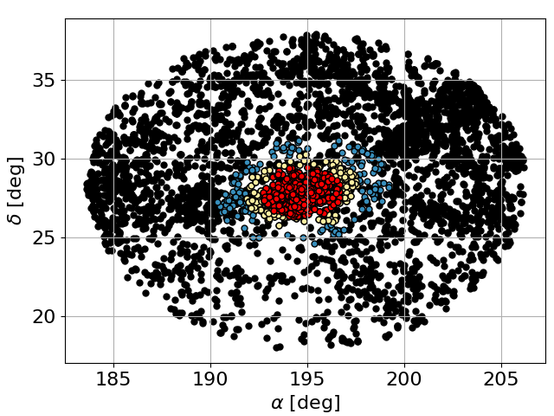
The Coma cluster, embedded in a cosmic filament, is a complex and dynamically active structure in the local Universe. Applying a density-based member selection (dbscan) to data from the Sloan Digital Sky Survey (SDSS), we identify its virilised core and zero-velocity boundary. Cross-correlating with the Cosmicflows-4 (CF4) catalogue enables a velocity-distance analysis, incorporating radial infall models and redshift-independent distance estimators. This reveals, for the first time, the Hubble flow surrounding Coma, a first step to investigate the entanglement between the dark matter in bound objects and the dark energy driving the expansion of their surroundings. The distance to the Coma centre is determined as $69.959 \pm 0.012 \, h^{-1}~\text{Mpc}$. From dbscan, we infer a virial radius of $r_{\rm vir} = \left(1.95 \pm 0.12\right)\,h^{-1}~\text{Mpc}$ and a turnaround of $r_{\rm ta} \geq 4.87~{h}^{-1}~\mbox{Mpc}$. Combining the SDSS redshifts with the CF4 distances, we estimate the Hubble constant to be $H_0 = (73.10 \pm 0.92)~\mbox{km}/\mbox{s}/\mbox{Mpc}$. However, with different calibrations for the distance moduli, $H_0$ varies between $[72, 80]$ km/s/Mpc. Mass estimates via caustics, the virial theorem, and the Hubble-flow method yield $M = [0.77, 2.0] \times 10^{15}\,h^{-1}\,M_{\odot}$, consistent with prior studies. Our systematic approach maps the structure of Coma into the local Hubble flow and shows the degeneracies between dynamical parameters such as the Hubble constant, the virial radius, and the total mass.
#AIP:
"Neue Karte des Universums enthüllt Mega-Strukturen
.. intel.Forschungsteam unter Leitung des ..AIP hat eine neuartige kosmographische Darstellungsmethode entwickelt und durch Analyse der Bewegungen von 56.000 Galaxien eine aktualisierte Karte des lokalen Universums erstellt. .. großräumige Vernetzung von Galaxien-Superhaufen in unserem Universum. .."
https://www.aip.de/de/news/cosmography-mega-structures/
27.9.2024
#Astronomie #CosmicFlows4 #Galaxien #Kosmographie #Kosmos #Superhaufen #Universum
So, with a group of 7 we've been working these past two years on the reconstruction and cosmography of Cosmicflows-4, and the result will go public tomorrow, stay tuned!
#Cosmicflows #Cosmography #Cosmology #CF4 #Cosmicflows4 #galaxies #astronomy #astrophysics #astrodon #science #STEM #physics #gravitation

A simultaneous solution to the Hubble tension and observed bulk flow within 250 h−1 Mpc
Abstract. The ΛCDM standard cosmological model is in severe tension with several cosmological observations. Foremost is the Hubble tension, which exceeds 5σ con
Rising Tension.
Early Cosmicflows-4 result: R. Watkins+co-authors present an estimate of the bulk flow, the average velocity of the survey volume: about 400 km/s. This has an epsilonesque chance of occurring in the ΛCDM model with CMB derived parameters.
https://arxiv.org/abs/2302.02028
#cosmology #universe #astronomy #astrophysics #space #science #research #astrodon #ΛCDM #cosmicflows #cosmicflows4 #galaxies #physics
Analyzing the Large-Scale Bulk Flow using CosmicFlows4: Increasing Tension with the Standard Cosmological Model
We present an estimate of the bulk flow in a volume of radii
$150-200h^{-1}$Mpc using the minimum variance (MV) method with data from the
CosmicFlows-4 (CF4) catalog. The addition of new data in the CF4 has resulted
in an increase in the estimate of the bulk flow in a sphere of radius
$150h^{-1}$Mpc relative to the CosmicFlows-3 (CF3). This bulk flow has less
than a $0.03\%$ chance of occurring in the Standard Cosmological Model
($Λ$CDM) with cosmic microwave background derived parameters. Given that
the CF4 is deeper than the CF3, we were able to use the CF4 to accurately
estimate the bulk flow on scales of $200h^{-1}$Mpc (equivalent to 266 Mpc for
Hubble constant $H_o=75$ km/s/Mpc) for the first time. This bulk flow is in
even greater tension with the Standard Model, having less than $0.003\%$
probability of occurring. To estimate the bulk flow accurately, we introduce a
novel method to calculate distances and velocities from distance moduli that is
unbiased and accurate at all distances. Our results are completely independent
of the value of $H_o$.
 Gravity Grinch
 RTN
RTN Daniel Pomarède