âYou get what you measureâ*âŠ
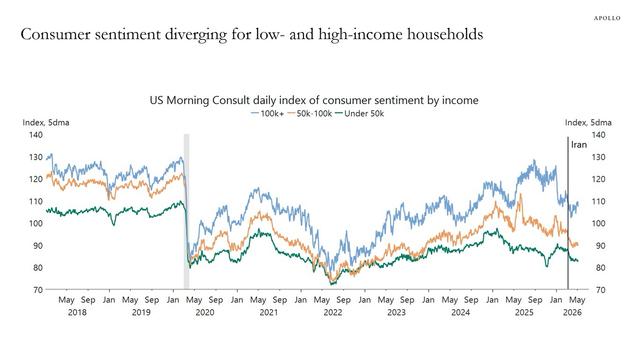
Matt Stoller takes the occasion of Trumpâs selection of Kevin Warsh to head the Fed (âan orthodox Wall Street GOP pick, though he is married to the billionaire heiress of the Estee Lauder fortune and was named in the Epstein files. Heâs perceived not as a Trump loyalist but as an avatar of capitalâ) to ponder why public satisfaction with the economy is so low (âif you judge solely by consumer sentiment, Trumpâs first term was the third best economy Americans experienced since 1960. Trumpâs second term is not only worse than his first, it is the worst economic management ever recorded by this indicatorâ).
Stoller argues that weâre mesuring the wrong things (or, in some cases, the right things in the wrong ways)âŠ
⊠the models underpinning how policymakers think about the economy just donât reflect the realities of modern commerce. The fundamental dynamic is that those models were constructed in an era where America was one discrete economy, with Wall Street and the public tied together by the housing finance system. But today, Americans increasingly live in tiered bubbles that have less and less to do with one another. Warsh will essentially be looking at the wrong indicators, pushing buttons that are mislabeled.
While corporate America is experiencing good times, much of the country is experiencing recessionary conditions. Letâs contrast consumer sentiment indicators with statistics showing an economic boom. Last week, the government came out with stats on real gross domestic product increasing at a scorching 4.4% in the third quarter of last year. Thereâs higher consumer spending, corporate investment, government spending, and a better trade balance. Inflation, according to the Consumer Price Index, is low at 2.6.% over the past year. And while official numbers arenât out for the final three months of the year, the Atlanta Fedâs GDPNow forecast shows that it estimates growth at 4.2%. And there are other indicators showing prosperity, from low unemployment to high business formation, which was up about 8% last year, as well as record corporate profitsâŠ
⊠Behavioral economists and psychologists have all sorts of reasons to explain that people donât really understand the economy particularly well. But in general, when the stats and the public mood conflict, I believe the public is usually correct. Often, there are some weird anomalies with the data used by policymakers. In 2023, I noticed that the consumer price index, the typical measure of inflation, didnât account for borrowing costs, so the Fed hike cycle, which caused increases in credit card, mortgage, auto loan, payday loans, et al, just wasnât incorporated. The public wasnât mad at phantom inflation, they were mad at real inflation that the âexpertsâ didnât see.
I donât think thatâs the only miscalculationâŠ
[Stoller goes on to explain the ways in which âconsumer spendingâ doesnât tell us much about consumers anymore, about the painful reality of âspending inequality,â and about the obscure(d) problem of monopoly-driven inflation. He concludesâŠ]
⊠Finally, thereâs a more philosophical point, which I donât think explains the short-term frustrations people feel, but is directionally correct. Do people actually want what the economy is producing? For most of the 20th century, the answer was yes. When Simon Kuznets invented these measurement statistics in 1934, financial value and the value that Americans placed on products and services were similar. A bigger economy meant things like toilets and electricity spreading across rural America, and cars and food and washing machines.
Today? Well, thatâs less clear. According to the Bureau of Labor Statistics, the second fastest growing sector of the economy in terms of GDP growth from 2019-2024 was gambling. Philip Pilkington wrote a good essay last summer on the moral assumptions behind our growth statistics. There is no agreed upon notion of what makes up an economically valuable object or activity, so our stats are inherently subtle moral judgments. Classic moral philosophers like Adam Smith believed in the âuse valueâ of an item, meaning how it could be used, whereas neoclassical economists believed in the âexchange valueâ of an item, making no judgments about use and are just counting up its market price.
Normal people subscribe on a moral level to use value. Most of us see someone spending money on a gambling addiction as doing something worse than providing Christmas presents for kids, but not because of price. However, our GDP models use the market value basis. Kuznets, presumably, was not amoral, he just thought that our laws would ban immoral activities like gambling, and so use value and market value wouldnât diverge. But they have.
Itâs not just things like gambling or pornography or speculation. A lot of previously unmeasured activity has been turned into data and monetized, which isnât actually increasing real growth but measuring what already existed. Take the change from meeting someone at a party to using a dating app. One is part of GDP, the other isnât. Both are real, but only one would show a bigger economy.
Beyond that much of our economy is now based on intangibles â the fastest growing sector was software publishing. Is Microsoft moving to a subscription fee model for Office truly some sort of groundbreaking new product? Itâs hard to say, while corporate assets used to be hard things like factories, today much of it is intangibles like intellectual property.
A boomcession, where the rich and corporate America experience a boom while working people feel a recession, is a very unhealthy dynamic. Itâs certainly possible to create metrics to measure it, and to help policymakers understand real income growth among different subgroups. You could start looking at real income after non-discretionary consumer spending, or find ways of adjusting for price discrimination.
But I think a better approach is to try to knit us into one society again. The kinds of policymakers who could try to create metrics to understand the different experiences of classes, and ameliorate them, donât have power. Instead, the people in charge still use models which presume one economy and one relatively uniform set of prices, where âconsumer spendingâ means stuff consumers want.
I once noted a speech in 2016 by then-Fed Chair Janet Yellen in which she expressed surprise that powerful rich firms and small weak ones had different borrowing rates, which affected the âmonetary transmission channelâ the Fed relied on. Sure it was obvious in the real world, but she preferred theory.
Or they donât use models at all; Kevin Warsh is not an economist, heâs a lawyer and political operative, and is uninterested in academic theory. He cares about corporate profits and capital formation. That probably wonât work out well either.
At any rate, we have to start measuring what matters again. If we donât, then weâll continue to be baffled that normal people hate the economy that looks fine on our chartsâŠ
The models used by policymakers to understand wages, economic growth, and consumer spending are misleading. Thatâs why corporate America is having a party, and everyone else is mad. Eminently worth reading in full: âThe Boomcession: Why Americans Hate What Looks Like an Economic Boom,â from @matthewstoller.bsky.social (or @mattstoller.skystack.xyz).
* Richard Hamming (and also to the article above, see âGoodhartâs lawâ)
###
As we ponder the pecuniary, we might recall that it was on this date in 1958 that Benelux Economic Union was founded, creating the seed from the European Economic Community, then the European Union grew.
On that same day, Philadelphia doo wop group The Silhouettes started five weeks at the top of the Billboard R&B chart with their first single, âGet A Job.â
https://youtu.be/ysKhbaLyIFw?si=obKAiTS4gb6n4cQB
#Benelux #BeneluxEconomicUnion #business #consumerConfidence #consumerPriceIndex #culture #economicPolicy #economics #EuropeanEconomicCommunity #EuropeanUnion #FederalReserve #GetAJob #history #inflation #measurement #monetaryPolicy #music #politics #RAndB #silhouettes #statistics #TheSilhouettes