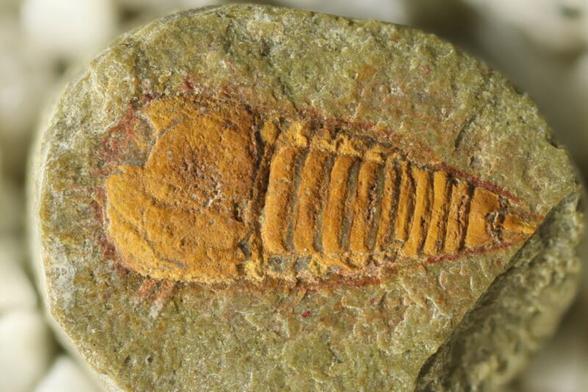
A fossil found in 1981 in Utah has recently been identified as a chelicerate--a relative of spiders and horseshoe crabs--and pushes the origin of that group back by 20 million years, from the Ordovician to the Cambrian.
Summary: https://www.eurekalert.org/news-releases/1121624
Original paper (not open access): https://www.nature.com/articles/s41586-026-10284-2
#Science #Paleontology #Arthropods #Chelicerates #Evolution
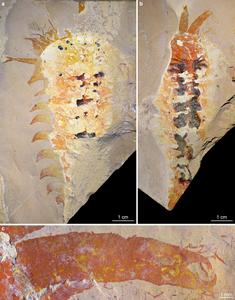
A 500-million-year-old clawed predator rewrites the origin of spiders and horseshoe crabs
Harvard researchers reveal the earliest known Chelicerata in a new study published in Nature. The 500-million-year-old fossil, named Megachelicerax cousteaui, provides unequivocal evidence of chelicera, a feature never before seen in Cambrian arthropods. The discovery pushes back the origin of chelicerates by at least 20 million years and proves their distinctive body plan emerged during the Cambrian explosion.

Arachnid evolution redefined: Whole-genome duplications and multiple land colonizations
A recent paper provides an updated perspective on the evolutionary history of chelicerates—a diverse and ecologically significant group of arthropods that includes spiders, scorpions, mites, and horseshoe crabs.
500 million-year-old #fossil is the earliest branch of the #spiders' lineage https://arstechnica.com/science/2024/07/earliest-known-ancestors-of-scorpions-were-tiny-sea-beasts/
Lower #Ordovician synziphosurine reveals early euchelicerate diversity and evolution https://www.nature.com/articles/s41467-024-48013-w
"Some of S. abundantis’ anatomical features allow for a deeper understanding of the early #evolution of #chelicerates and may even link other fossil forms, whose relationships are still highly debated, to this group"

500 million-year-old fossil is the earliest branch of the spider’s lineage
A local fossil collector in Morocco found the specimen decades ago.
#Discovery of the first ancestors of scorpions, spiders and horseshoe crabs https://phys.org/news/2024-05-discovery-ancestors-scorpions-spiders-horseshoe.html
Lower #Ordovician synziphosurine reveals early euchelicerate diversity and #evolution https://www.nature.com/articles/s41467-024-48013-w
"Measuring between 5 and 10 millimeters in size, it has been named #Setapedites abundantis. This animal makes it possible, for the first time, to trace the entire lineage of #chelicerates, from the appearance of the earliest #arthropods to modern #spiders, #scorpions and #HorseshoeCrabs"


Discovery of the first ancestors of scorpions, spiders and horseshoe crabs
Who were the earliest ancestors of scorpions, spiders and horseshoe crabs? A Ph.D. student from the University of Lausanne (Switzerland), with the support of a CNRS researcher, has identified a fossil that fills the gap between modern species and those from the Cambrian period (505 million years ago), solving a long paleontological mystery.
Living species of #DaddyLonglegs has two additional sets of underdeveloped eyes as embryos https://phys.org/news/2024-02-species-daddy-longlegs-additional-underdeveloped.html
#VestigialOrgans alter #fossil placements in an ancient group of terrestrial #chelicerates https://www.cell.com/current-biology/abstract/S0960-9822(24)00153-2
"While a fossilized specimen of a more ancient version of the #arachnid found in 2014 had an additional set of lateral eyes on the side of the head, the new study is the first to show evidence of more than one eye set in a living daddy longlegs species."

Living species of daddy longlegs has two additional sets of underdeveloped eyes as embryos
While some people may first associate daddy longlegs with, well, their long legs, researchers Guilherme Gainett and Prashant Sharma have been especially focused on the arachnids' eyes. In their paper published last week in the journal Current Biology, the researchers found that a living species of daddy longlegs has two additional sets of underdeveloped eyes as embryos, implying that the species diversified earlier in the evolutionary tree than scientists believed.
 RDN
RDN Inat Repost Bot
 CellBioNews
 Lukas VFN 🇪🇺