CW animal slaughter, butchery, meat cooking and consumption
https://en.wikipedia.org/wiki/Carnage_(2017_film)
#Vegan #Carnists
@lydiaconwell so true!
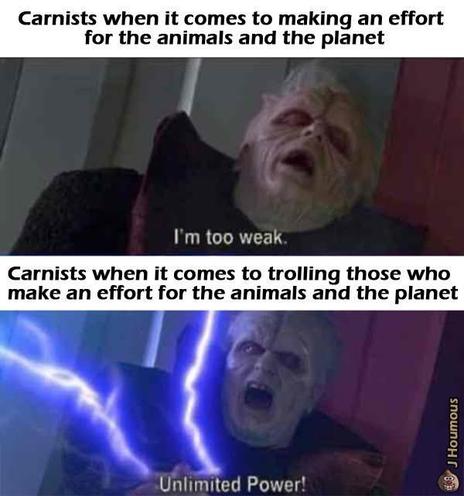
you know how #carnists like to joke how #vegans talk about #veganism all the time? but they don't realize they're doing the inverse when they casually talk about abusing animals: going #fishing, doing a #BBQ, #BurgerKing, #hunting, #leather, ...
(this also happens on the #left )
well, it's the same with #meta! and i've decided to be that "annoying fediverse person" who brings it up every time i hear »put it on #insta « or a #facebook event link is shared in a chat.
put it on peertube. like & share on masto. send a screenshot of that #fb post instead of guiding people towards #fascist so-me.
Background As a well-balanced vegan diet is associated with reduced diet-related health risks, it is in the interest of local authorities to develop appropriate public health interventions to promote such a diet. In order to do so, it is important to understand the psychological characteristics relating to a vegan diet, so that they can be taken into account in the development. This is why the present study explored the diet-related attitudes, perceptions and behaviors of German people who follow a vegan diet and how they differ from those of people who follow an omnivorous diet. Methods The data were collected via online questionnaire, using an internet panel. Without being representative of the population, age and gender of the vegan (n = 738) and omnivorous (n = 824) groups were balanced to ensure comparability in this regard. Statistical tests comprised univariate and multivariate analyses of variance, as well as t-tests and a Mann-Whitney-U-Test. Results The main motivations for following a vegan diet were ethical (47%), health (22%) and ecological reasons (14%). The most cited key experience that led to the decision to follow a vegan diet was watching documentaries (73%). 53% of respondents stated that other people had influenced their decision to adopt a vegan diet. Depending on the age of the children, up to 48% of the vegan group and up to 97% of the omnivorous group raise their children on their respective diet. The vegan group perceived significantly lower risks and greater benefits in their own diet (η2 = 0.014-0.159). More vegan respondents (86%) reported keeping actively informed on nutrition than did omnivorous respondents (64%), with both groups differing significantly in their perception of the usefulness of several information channels (η2 = 0.001-0.075). More vegan respondents (66%) reported taking vitamin B12 supplements than did omnivorous respondents (34%). Conclusion The findings are consistent with and build on existing research on cognitive and behavioral patterns related to a vegan diet, while at the same time yielding some additional insights. In particular, the results on significant differences in the risk-benefit perception of a vegan diet, as well as on motivations and influences regarding the decision to follow a vegan diet provide an important basis for the development of public health interventions and a foundation for further studies in this field.
“Canines though” is an argument often brought forth by #carnists. #CaninesThough
#GoVegan
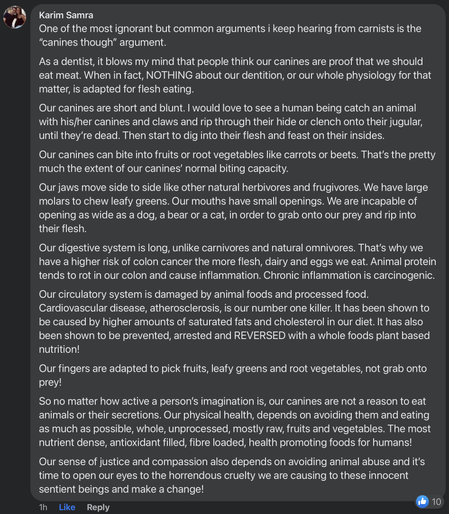
Quoting Karim Samra on FB:
❝One of the most ignorant but common arguments i keep hearing from carnists is the “canines though” argument.
As a dentist, it blows my mind that people think our canines are proof that we should eat meat. When in fact, NOTHING about our dentition, or our whole physiology for that matter, is adapted for flesh eating.
Our canines are short and blunt. I would love to see a human being catch an animal with his/her canines and claws and rip through their hide or clench onto their jugular, until they’re dead. Then start to dig into their flesh and feast on their insides.
Our canines can bite into fruits or root vegetables like carrots or beets. That’s the pretty much the extent of our canines’ normal biting capacity.
Our jaws move side to side like other natural herbivores and frugivores. We have large molars to chew leafy greens. Our mouths have small openings. […]❞