Dose makes the difference! #Candidaalbicans uses the toxin #candidalysin not only to cause infections but also to quietly colonize the mouth – too little fails, too much triggers immune defense.
#NatureMicrobiology
@LeibnizHKI
🗞️ Press release: https://shorturl.at/AzMAg
🧪Original paper: https://doi.org/10.1038/s41564-025-02122-4
picture credits: Erik Böhm, Leibniz-HKI
The first out of 4 publications honored with the 2024 medac Research Award uncovered how #Ece1 controls the release of #candidalysin in Candida albicans, enabling fungal infections.
Read more in @nature.portfolio
👉 https://www.nature.com/articles/s41564-024-01606-z

Secretion of the fungal toxin candidalysin is dependent on conserved precursor peptide sequences - Nature Microbiology
The Candida albicans toxin, candidalysin, is embedded in an unusual conserved precursor peptide sequence (Ece1). The precursor is not required to block premature pore-forming toxicity, but rather to prevent candidalysin auto-aggregation.

Insights into fungal toxin promise new treatment pathway for C. albicans infections
The toxin candidalysin of the yeast Candida albicans is incorporated into an unusual protein structure during an infection, the composition of which has so far been unknown to scientists. Researchers at the Leibniz-HKI have now succeeded in deciphering the function of this unusual arrangement.
The toxin #Candidalysin of the yeast Candida albicans is embedded in the unusual protein structure Ece1 during infections. Researchers from @LeibnizHKI have now decoded the structure, paving the way for #nanobody-based therapies against vaginal candidiasis.
👉 Full publications via https://doi.org/10.1038/s41564-024-01606-z and via https://journals.asm.org/doi/10.1128/mbio.03409-23
 Leibniz-HKI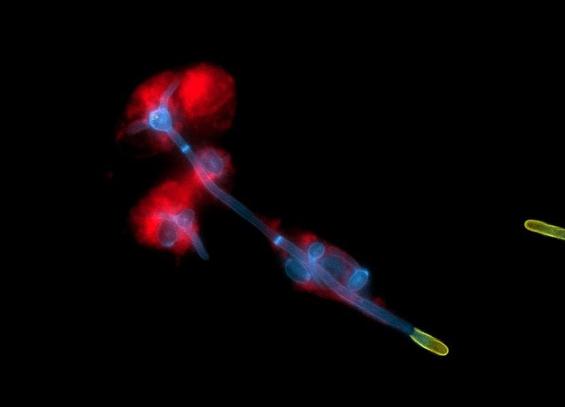
 CellBioNews