Season 7 Episode 2: Celebrating Robert Burns with Address to A Haggis
Every January, Tea Toast & Trivia celebrates the great Scottish poet and lyricist, Robert Burns. Widely regarded as the national poet of Scotland and celebrated worldwide, Burns is best known for his poetry written in the Scots language, with works such as “Auld Lang Syne,” “Address to a Haggis,” and “Tam O’ Shanter.” His poetry reflects themes of love, nature, and Scotland’s cultural heritage.
Robert Burns (Rebecca Budd Archives)
Haggis holds a special place in Scotland’s culinary and cultural heritage, embodying the spirit of an indomitable nation. This traditional dish, made primarily from sheep’s offal mixed with oats and spices, reflects the resourcefulness and frugality that characterized Scottish life, particularly in rural areas.
The deep connection between haggis and Scotland’s identity is further solidified by its association with Robert Burns and his poem, “Address to a Haggis”. He praises the haggis as the “great chieftain o’ the puddin’ race,” suggesting that it is a dish worthy of honour and respect—much like the Scottish people themselves.
Haggis has become synonymous with the festivities of Burns Suppers held worldwide each year, where friends and families gather to commemorate Burns’ life and works. The act of addressing and serving haggis during these events is steeped in tradition and serves as a joyous reminder of Scotland’s vibrant culture. It encourages the sharing of stories, music, and camaraderie.
Robert Burns Desk (Rebecca Budd Archives August 2014)
Come join me to celebrate Robert Burns with his iconic “Address to a Haggis”! The vivid imagery and spirited language invite us to join in the festivities of a Burns Supper and pay tribute to the enduring legacy of Scotland’s beloved national poet.
Celebrating Robert Burns with Address to A Haggis – Tea. Toast. & Trivia.
Address to a Haggis
Fair fa’ your honest, sonsie face,
Great chieftain o’ the puddin’-race!
Aboon them a’ ye tak your place,
Painch, tripe, or thairm:
Weel are ye wordy o’ a grace
As lang’s my arm.
The groaning trencher there ye fill,
Your hurdies like a distant hill,
Your pin wad help to mend a mill
In time o’ need,
While thro’ your pores the dews distil
Like amber bead.
His knife see rustic Labour dight,
An’ cut you up wi’ ready slight,
Trenching your gushing entrails bright,
Like onie ditch;
And then, O what a glorious sight,
Warm-reekin’, rich!
Then, horn for horn, they stretch an’ strive:
Deil tak the hindmost, on they drive,
Till a’ their weel-swall’d kytes belyve
Are bent like drums;
The auld Guidman, maist like to rive,
‘Bethankit’ hums.
Is there that owre his French ragout
Or olio that wad staw a sow,
Or fricassee wad make her spew
Wi’ perfect sconner,
Looks down wi’ sneering, scornfu’ view
On sic a dinner?
Poor devil! see him owre his trash,
As feckless as a wither’d rash,
His spindle shank a guid whip-lash,
His nieve a nit;
Thro’ bloody flood or field to dash,
O how unfit!
But mark the Rustic, haggis-fed,
The trembling earth resounds his tread.
Clap in his walie nieve a blade,
He’ll make it whissle;
An’ legs an’ arms, an’ heads will sned,
Like taps o’ thrissle.
Ye Pow’rs, wha mak mankind your care,
And dish them out their bill o’ fare,
Auld Scotland wants nae skinking ware
That jaups in luggies;
But, if ye wish her gratefu’ prayer,
Gie her a Haggis
Burns Cottage, Alloway, South Ayrshire, Scotland, Built by Robert Burns father, William Burness in 1757 (Rebecca Budd Archives August 2014)
National Trust of Scotland writes “It’s thought that Burns wrote the last verse whilst having dinner at a friend’s house. The poem celebrates the strength of the ‘ordinary’ working Scotsman (a haggis-fed Rustic) over those with more ‘continental’ tastes.”
#AddressToAHaggis #BurnsCottage #BurnsNight #BurnsSuppers #haggis #Poetry #RobertBurns #Scotland
 Undiscovered Scotland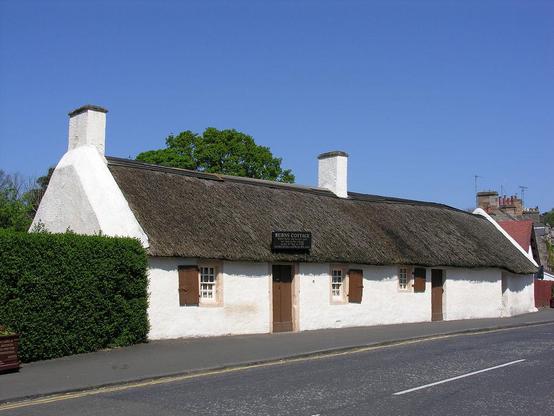
 Tea Toast & Trivia


 Craig1802
 Michael Docherty