From a Silent Math Error to Certificate Bypass: Uncovering an Integer Overflow in a TLS Parser
This article details an integer overflow vulnerability within a Transport Layer Security (TLS) parser. The flaw allowed attackers to bypass certificate checks due to improper validation of parsed values. When the server received maliciously crafted client hello messages containing excessively large extensions, it failed to handle the unexpected data size. As a result, an integer overflow occurred, leading to buffer overflows and arbitrary code execution. The researcher exploited this vulnerability by sending a specially crafted TLS handshake request with extended client hello payloads that contained large, incorrectly parsed values. By modifying the length of extension fields, they tricked the parser into interpreting non-existent data as valid, causing unintended execution of malicious code and certificate bypass. The exploit resulted in a high severity vulnerability (CVE-2018-0204) with a CVSS score of 9.8. The researcher was awarded $36,000 for their findings, and the vendor promptly released patches to address this issue. To prevent similar issues, developers should perform rigorous input validation and limit the size of parsed values during TLS handshake processing. Key lesson: Proper input validation is crucial in TLS parsing to avoid buffer overflows and other security vulnerabilities #BugBounty #Cryptography #TLS #IntegerOverflow #BufferOverFlow

https://medium.com/@HackerMD/from-a-silent-math-error-to-certificate-bypass-uncovering-an-integer-overflow-in-a-tls-parser-b73b86696f74?source=rss------bug_bounty-5

From a Silent Math Error to Certificate Bypass: Uncovering an Integer Overflow in a TLS Parser

Bug hunting isn’t always about popping XSS alerts or finding chained SSRFs. Sometimes, the most critical vulnerabilities are hidden deep…

Medium
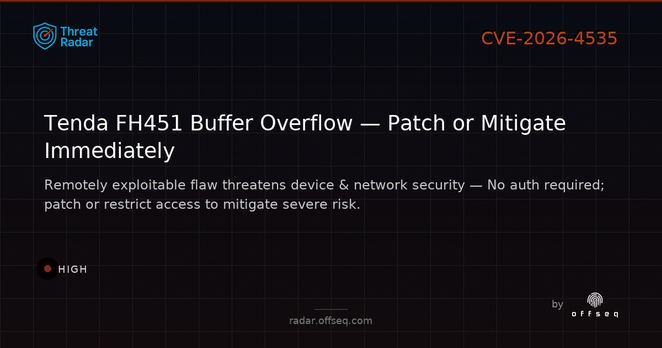
⚠️ HIGH severity: CVE-2026-4535 in Tenda FH451 (v1.0.0.9) — stack-based buffer overflow in /goform/WrlclientSet. Remote, unauthenticated code execution possible. Patch or mitigate now! https://radar.offseq.com/threat/cve-2026-4535-stack-based-buffer-overflow-in-tenda-8f2fc263 #OffSeq #vulnerability #IoT #bufferOverflow
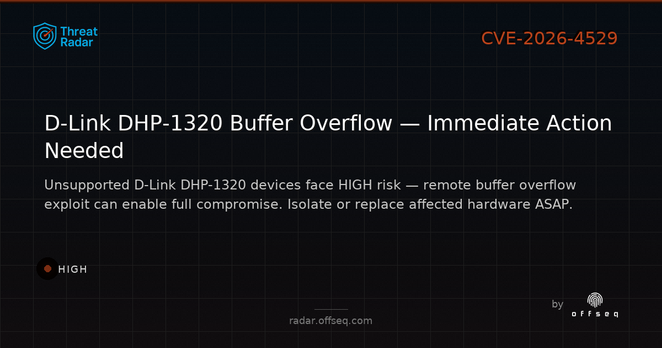
🚨 CVE-2026-4529: HIGH severity stack-based buffer overflow in D-Link DHP-1320 (1.00WWB04) via SOAP Handler. Public exploit out. Device is EOL, no patch — isolate or replace now! https://radar.offseq.com/threat/cve-2026-4529-stack-based-buffer-overflow-in-d-lin-7f100378 #OffSeq #Vulnerability #DLink #BufferOverflow #InfoSec
⚠️ CVE-2026-2086: HIGH-severity buffer overflow in UTT HiPER 810G (≤1.7.7-171114). Remote code execution possible, public exploit exists, no patch. Segment networks, disable remote mgmt, monitor for attacks. https://radar.offseq.com/threat/cve-2026-2086-buffer-overflow-in-utt-hiper-810g-43cb38da #OffSeq #UTT #Infosec #BufferOverflow
Krytyczna podatność (CVSS 9.8/10.0) w popularnym pakiecie do monitorowania urządzeń – Net-SNMP https://sekurak.pl/krytyczna-podatnosc-cvss-9-8-10-0-w-popularnym-pakiecie-do-monitorowania-urzadzen-net-snmp/ #Wbiegu #Bufferoverflow #DoS #Netsnmp #Podatno
Krytyczna podatność (CVSS 9.8/10.0) w popularnym pakiecie do monitorowania urządzeń – Net-SNMP

W popularnym pakiecie Net-SNMP, służącym do monitorowania i zarządzania urządzeniami sieciowymi wykryto krytyczną lukę bezpieczeństwa typu stack based buffer overflow. Podatność została znaleziona przez badacza bezpieczeństwa buddurid oraz zgłoszona w ramach programu Trend Micro Zero Day Initiative (ZDI). TLDR: Dla osób spotykających się z tym programem po raz pierwszy krótkie wyjaśnienie....

Sekurak

Krytyczna podatność (CVSS 9.8/10.0) w popularnym pakiecie do monitorowania urządzeń – Net-SNMP

W popularnym pakiecie Net-SNMP, służącym do monitorowania i zarządzania urządzeniami sieciowymi wykryto krytyczną lukę bezpieczeństwa typu stack based buffer overflow. Podatność została znaleziona przez badacza bezpieczeństwa buddurid oraz zgłoszona w ramach programu Trend Micro Zero Day Initiative (ZDI). TLDR: Dla osób spotykających się z tym programem po raz pierwszy krótkie wyjaśnienie....

#WBiegu #BufferOverflow #DoS #Podatność

https://sekurak.pl/krytyczna-podatnosc-cvss-9-8-10-0-w-popularnym-pakiecie-do-monitorowania-urzadzen-net-snmp/

Krytyczna podatność (CVSS 9.8/10.0) w popularnym pakiecie do monitorowania urządzeń – Net-SNMP

W popularnym pakiecie Net-SNMP, służącym do monitorowania i zarządzania urządzeniami sieciowymi wykryto krytyczną lukę bezpieczeństwa typu stack based buffer overflow. Podatność została znaleziona przez badacza bezpieczeństwa buddurid oraz zgłoszona w ramach programu Trend Micro Zero Day Initiative (ZDI). TLDR: Dla osób spotykających się z tym programem po raz pierwszy krótkie wyjaśnienie....

Sekurak

The SQL Slammer worm was the fastest spreading malware in Internet history. It exploited a buffer overflow vulnerability in Windows systems and could be transmitted and executed with minimal latency. Today, it is considered the precursor of ransomware and spyware attacks.

#SQLslammerWorm #computerWorms, #malware #bufferOverflow #vulnerabilities #cybersecurity #cyberattacks

https://negativepid.blog/the-sql-slammer-worm/

The SQL Slammer Worm - Negative PID

Have you ever wondered what the most destructive malware is? In January 2003, a computer worm became the fastest-spreading worm in Internet history, infecting

Negative PID
🚨 CVE-2025-14534: CRITICAL buffer overflow in UTT 进取 512W (≤3.1.7.7-171114). Remote, unauthenticated exploit — public code available. Isolate & restrict /goform/formNatStaticMap now! https://radar.offseq.com/threat/cve-2025-14534-buffer-overflow-in-utt-512w-46bf1244 #OffSeq #CVE #BufferOverflow #NetworkSecurity

The SQL Slammer worm was the fastest spreading malware in Internet history. It exploited a buffer overflow vulnerability in Windows systems and could be transmitted and executed with minimal latency. Today, it is considered the precursor of ransomware and spyware attacks.

#SQLslammerWorm #computerWorms, #malware #bufferOverflow #vulnerabilities #cybersecurity #cyberattacks

https://negativepid.blog/the-sql-slammer-worm/

The SQL Slammer Worm - Negative PID

Have you ever wondered what the most destructive malware is? In January 2003, a computer worm became the fastest-spreading worm in Internet history, infecting

Negative PID
⚠️ CVE-2025-14196 (HIGH, CVSS 8.7): Remote buffer overflow in H3C Magic B1 (≤100R004). Public exploit available, no patch. Isolate devices, restrict access, monitor for /goform/aspForm attacks. https://radar.offseq.com/threat/cve-2025-14196-buffer-overflow-in-h3c-magic-b1-e84401a0 #OffSeq #H3C #BufferOverflow #Vuln