A Faded Glory – Warren Street Shops – Canadian National Railway (1964-1982)

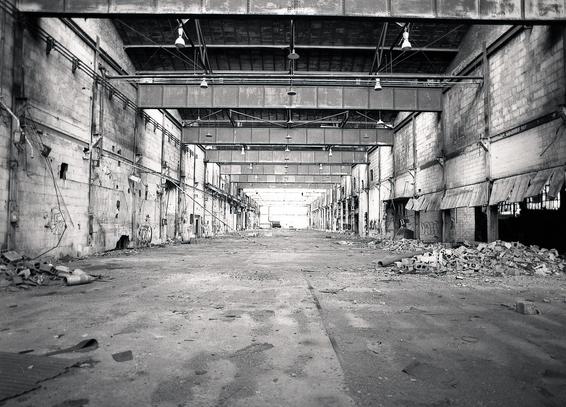
Sitting well outside of the two historical downtowns within the community of Fort Erie sits several lonely buildings and overgrown tracks. These small remains are left of what was once a massive railway yard that had existed since the earliest days of the railway in Fort Erie but is today a mere shadow.

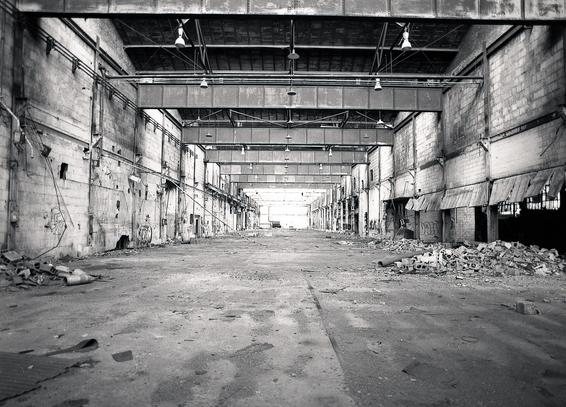
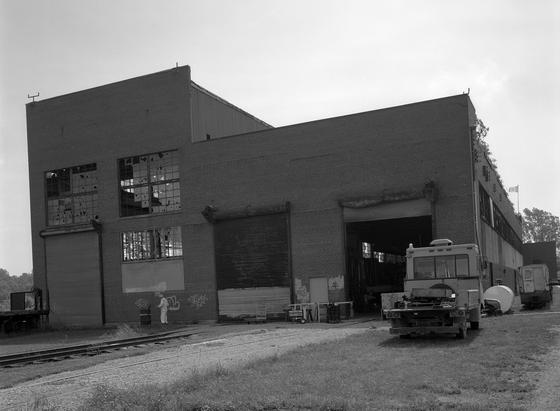
The Warren Street shops, I should have moved further back and used a longer lens.
Graflex Crown Graphic - Fuji Fujinon-W 1:5.6/125 - Ilford HP5+ @ ASA-200 - Pyrocat-HD (1+1+100) 9:00 @ 20C

The Buffalo & Lake Huron Railway saw inception as a means to provide railway access to the people of Buffalo, Brantford and Goderich; the railways two main terminuses were Fort Erie and Goderich, where cars would be loaded onto massive rail ferries to be floating to destinations across bodies of water, at Fort Erie that was Black Rock in Buffalo. But as I mentioned in a previous entry, railway ferries were slow and had limited space, and at Fort Erie, only the International serviced the Buffalo & Lake Huron line. A large marshalling yard had to be purchased and constructed to maintain their trains, manage traffic, conduct maintenance, and store and shunt cars. Located outside the town of Fort Erie, these yards would form the core of the Buffalo & Lake Huron railway yards. Here trains would arrive and road locomotives stored and maintained in engine houses, roundhouses and a turntable, while shunting locomotives moved the cars to and from the ferry docks at the end of Bertie Street. Grand Trunk continued to operate the yards when they took over the entire Buffalo & Lake Huron network in 1864. From these yards, Grand Trunk employees sent out warning messages in July 1866 of the invading Fenians. They ensured that the trains and the International were sent out of reach and used by the Irish-American invaders. In 1873 with the completion of the International Railway Bridge, Grand Trunk saw a resurgence in the use of the Fort Erie Yards. While they had their primary motive power shops in Stratford to maintain their locomotive fleet, Fort Erie's tracks were realigned to serve the new railway bridge and passenger stations in the new community of Bridgeburg. At the Fort Erie yards, more tracks were added to allow for storage and traffic control over the bridge and conduct maintenance on cars and locomotives travelling to and from the United States. By 1903 the Fort Erie or Warren Street Yards were the third-largest railway yards operated by Grand Trunk and directly affected the growth of both Bridgeburg and Fort Erie, providing several jobs for the surrounding area. By 1923 Canadian National had taken over operations at Warren Street.

You can still see the years of neglect in the Warren Shops.
Nikon D750 - AF-S Nikkor 28-70mm 1:2.8DOne of the smaller doors, probably to house a small switcher or maintenance vehicle.
Nikon D750 - AF-S Nikkor 28-70mm 1:2.8D

One of the earliest uses of diesel-electric power on Canadian rails came in the form of yard switchers in the 1930s; these were small and less powerful than the massive Northern, Mountain, and Pacific type steam locomotives that drove the trains across the main road lines. These early switchers would have found a great deal of work at the Warren Street Yards, but by the 1950s, road-switchers were starting to take over the work of steam locomotives. Desiel motive power required a different type of maintenance facility. By the end of the 1950s, Canadian National began constructing new garages at Warren Street to support their diesel locomotives that now operated across the International Railway Bridge. Rather than keep all the original Grand Trunk buildings, Canadian National would, in the 1960s, begin the demolition of older steam-centred maintenance and storage buildings at Warren Street. Instead, Canadian National would open a new diesel maintenance garage in 1964, known as the Warren Street Shops. Many of the employees would arrive from Stratford as the Motive Power shops there closed that same year. The new shops were far smaller than previous maintenance buildings, with most of the yard continuing to be used as a traffic marshalling yard. Thankfully, the new shops maintained a workforce of four hundred and could conduction regular repairs and overhauls of most diesel-electric locomotives and switchers being used by Canadian National. These include the GP7 and GP9 road-switchers, SW1200 switchers, and many others. However, a decade after opening, Canadian National announced in 1977 that it would begin to move operations across the river to Black Rock. Operations would slowly wind down starting in 1978, and some employees were relocated to larger Canadian National Yards out in Western Canada. The final train would roll out of Warren Street in 1989, and the location shut its doors.

Refueling towers for the D-E locomotives that operated here.
Nikon D750 - AF-S Nikkor 28-70mm 1:2.8DOne of the museum's rolling stock, a small locomotive that once served at the INCO facitilies in the area, probably Welland.
Nikon D750 - AF-S Nikkor 28-70mm 1:2.8D

Canadian National would begin a systematic demolition of all but two buildings and start pulling up tracks. They also parcelled off the yard and sold it to local businesses, one of the largest being a scrapyard. The once large yard was cut to a fraction of its original size as some trackage was required for cross-bridge traffic. Because the railroad had been a huge employer, many soon found themselves out of work and drove the area into a depression, but it also drove many to seek a way to preserve the area's rich railway heritage. The Niagara Railway Museum was the brainchild of Ken Jones Jr, who started collecting pieces of local railway history in 1994 and incorporated the museum two years later. Like any museum, first starting, they did not have a permanent home, and the collection was spread out across the member's homes and storage units. And it was not small pieces; they had also acquired rolling stock from boxcars to switcher units, even a snowplough. They would need to locate a home quickly or risk losing their work. In 2010 they signed a lease agreement on the Warren Street Shop, but it had sat unused for near four decades. During that time, even I had attempted to gain access to the building, but it had been recently resealed, but I had seen photos from inside from other urban explorers. Although today, near two decades later, the museum remains in operation and offers limited access to the Warren Street Shops. The folks behind the museum have done an amazing job and are still looking for any artefacts related to the railroad in Fort Erie items before the closure of the shops. You can check the location out; it is best to go on a weekend with volunteers present, and always make sure to ask before going onto the property.

#afadedglory #bridgeburg #buffalolakehuronrailway #canada #canadiannationalrailway #crowngraphic #forterie #grandtrunkrailway #ilfordhp5 #infrastruture #nikond750 #ontario #pyrocathd #railroad #railway #repair #shops #warrenstreetshops
A Faded Glory - Warren Street Shops - Canadian National Railway (1964-1982)

Sitting in a rather out of the way spot in the community of Fort Erie, an abandoned brick building with little in the way of ornamentation from the era of function over form, is the final structure of a once-massive yard.
Alex Luyckx | Blog

A Faded Glory – International Railway Bridge – Grand Trunk Railway (1873-Present)

The Niagara River has never been the easiest obstacle to navigate in Ontario, the main reasons being the current, the falls, and the gorge. Bridges were neither cheap nor easy to build but possible. The easiest means to get trains across the river were through the use of rail ferries. Steamships were designed to carry large numbers of cars, but the process was slow, bottlenecked the line, and there was also the tendency for ships to sink or get caught in the current and swept away.

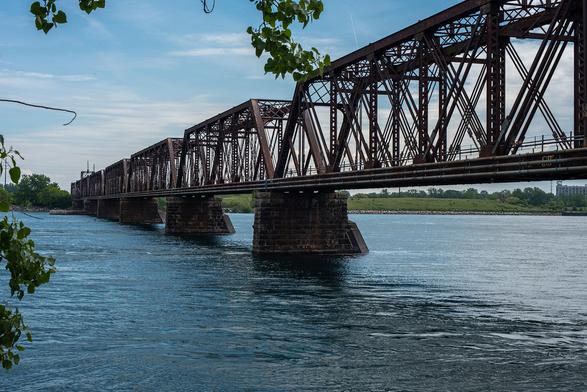
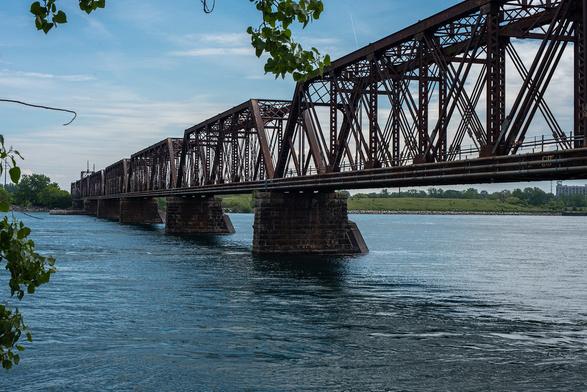
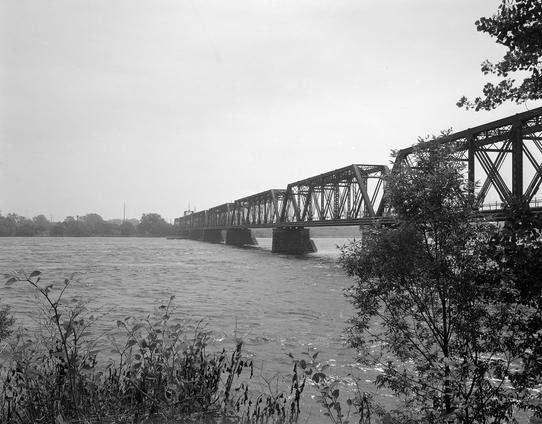
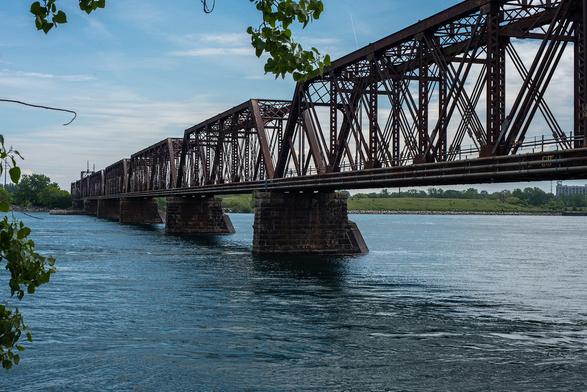
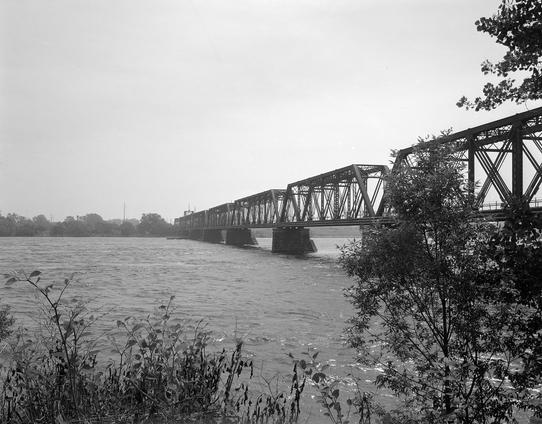
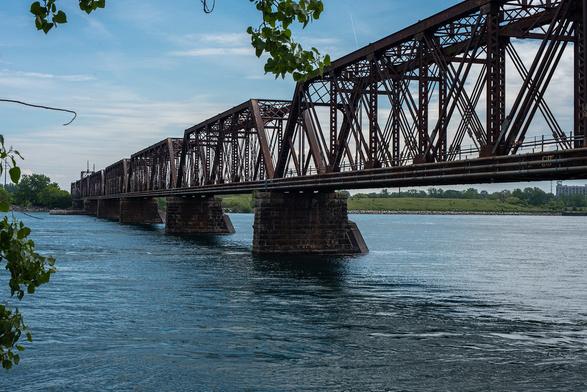
While the decking and trusses are not original, the piers date back to 1873.
Graflex Crown Graphic - Fuji Fujinon-W 1:5.6/125 - Ilford HP5+ @ ASA-200 - Pyrocat-HD (1+1+100) 9:00 @ 20C

All major operators initially used rail ferries, while Buffalo & Lake Huron had the easiest route between Fort Erie and Buffalo. With their line's terminus at Niagara Falls, Great Western Railway required rerouting the train to Queenston for loading and unloading. So they were one of the first to start planning a railway bridge. But Great Western wasn't planning any railway bridge; they aimed to build a suspension bridge. Working with William Hamilton Merritt, the bridge opened to traffic in 1855, supporting two levels, one for a single railway track and a second for foot and carriage traffic. When it opened, it was not only Canada's first but the world's first railway suspension bridge. The suspension wires were supported by four twenty-seven meter tall Egyptian inspired pillars, work being done by a young Scottish stonemason William Henderson. But above the falls, the Buffalo & Lake Huron Railway continued to use the rail ferry International but had planned by 1856 for their own bridge between Fort Erie and Black Rock. But having no real financial stability, the plans remained on paper. As Grand Trunk began to take on more operational control over Buffalo & Lake Huron, the new operator furthered plans. Grand Trunk had completed their first rail bridge over the Grafraxa River in Port Hope and their biggest bridge, the Victoria Bridge in Montreal, over the St. Lawerence River in 1860. By 1864 representatives of New York State and the Province of Canada signed an agreement to have a bridge completed between Fort Erie and Black Rock. When the American Civil War opened, the plans were shelved and remained that way in the serious dip in Anglo-American relations during and following the war. The Fenian Raids of 1866 did not help matters either. The International being requested by the Canadian Militia as an armed gunboat and a means to move troops by the Fenians. It remained safely in the middle of the river, refusing to move, having been ordered to stay put by Grand Trunk employees.

A bit more closer detail on the 1873 piers.
Nikon D750 - AF Nikkor 50mm 1:1.4DA memorial to Light Vessel 82, lost in a storm in 1913 showing the power of the Great Lakes and the Niagara River.
Nikon D300 - AF-S Nikkor 70-200mm 1:2.8G

Thankfully the relations warmed by the end of the decade, and plans were again coming together. In 1870, the Canadian Bridge Company and American Bridge Company chartered the International Bridge Company to construct the proposed bridge. C.S. Gzowski & Co. won the contract from International Bridge to complete the main piers and final assembly construction. At the same time, the bridge steel and sections went to Phoenix Iron Works in Pennsylvania. The bridge would span the shortest section of the river but far from ideal. At this point, the river depth stood at fourteen meters, and the current flowed at nineteen kilometres per hour. The continued damage from ice broke away from Lake Erie and flowed down to Niagara Falls that could prove dangerous to the piers. Construction began in 1871 with dredging three metres of gravel from the river bed. The eight piers that secured the bridge across the river were constructed from locally quarried limestone and designed to break up ice flows rather than have them dashed against them. Phoenix Ironworks constructed the bridge portions in twelve sections using a standard Baldwin Truss pattern. Each section was floating in, raised on special pontoons and secured in place. While the Canadian side of the bridge was fixed, the American side featured two swing sections. The sections were around Unity Island, allowing ships to still access the harbours at Black Rock and Buffalo. A single railway track crossed the bridge, and a separate section allowed for pedestrian traffic. During the construction, not a single life was lost, or the accident delayed the effort. When the bridge was completed, it had cost 1.5 million dollars and spanned 1113 metres. And railway traffic stood ready to make use of the new bridge when it opened on the 3rd of November 1873; present at the ceremony were Grand Trunk President Richard Potter and Internation Bridge Co-President Matthew Brydges. While Grand Trunk trains used the bridge without trouble, all other operators had to pay a fee at a dollar per car. While most operators had no issues paying the toll rather than spend the money needed to build their own bridge, Canadian Southern sued Grand Trunk.

To the left the Whirlpool Bridge and the right the MCR bridge, today only the Whirlpool bridge operates as it replaced the original Niagara Suspension Bridge.
Mamiya m645 - Mamiya-Sekor C 45mm 1:2.8 N - Ilford FP4+ @ ASA-100 - Kodak D-23 (Stock) 6:00 @ 20CThe ruins of the Curtis-Wright Factory, once a major part of the industrial hotbed of Black Rock where the Bridge terminated.
Pentax 645 - SMC Pentax A 645 35mm 1:3.5 - Kodak Tri-X 400 @ ASA-400 - Kodak HC-110 Dil. B 7:30 @ 20C

As the popularity of the railway increased, the need for larger bridges became obvious, and bridges with a single track across them were becoming obsolete. Grand Trunk completed a new bridge in 1897, the Whirlpool Bridge, to replace the original Niagara Suspension Bridge. And in 1900, the International Railway Bridge was revamped, removing the original bridge sections and replacing them with one that supported two tracks at the cost of the pedestrian walkway. Three years later, baseball player Ed Delany who had been removed from a train for being drunk, attempted to cross the bridge on foot, dying. While always a busy crossing, the busiest day of the bridge took place on the 10th of July 1916 when 264 trains crossed the bridge. Canadian National took over operations on the bridge in 1923 when Grand Trunk Railway was absorbed into the new company. In 1929, Michigan Central, which was now in complete control of Canadian Southern, completed their own bridge at Niagara Falls. Passenger services across the bridge dwindled with the final Canadian National Passenger train crossing in 1934. The Americans disabled one of the swing sections on their bridge in 1941. The bridge had spent a great deal of its operational life without closure, at least until 1993. Canadian National was forced to close the bridge due to emergency repairs to several of the support piers, which were still original to 1873; the repairs cost two million but ensured the continued use of the bridge. Further updates to the bridge decking took place in 2000. Today, the International Railway Bridge remains the oldest operational railway bridge in Ontario, far from the original. Its construction pre-dates many of the original bridges constructed by the Canadian Pacific through the Rockies. Many of the older Grand Trunk Bridges have been either totally replaced or modified far beyond the original to be considered original. It is also one of two operational railway bridges across the Niagara River, the 1897 Whirlpool Bridge as the Michigan Central bridge shut down in 2001. On average, the bridge sees fifteen trains daily crossing.

#afadedglory #blackrock #bridgeburg #buffalo #canada #canadianhistory #canadiannationalrailway #crowngraphic #forterie #grandtrunkrailway #ilfordhp5 #infrastruture #internationalrailwaybridge #kodakhc110 #kodaktrix400 #newyork #nikond750 #ontario #pentax645 #pyrocathd #railroad #railway #usa

A Faded Glory - International Railway Bridge - Grand Trunk Railway (1873-Present)

While not the first railway bridge across the Niagara River, the International Railway Bridge is Ontario's oldest continuously operated bridge.

Alex Luyckx | Blog

A Faded Glory – Bridgeburg B-1 – Grand Trunk Railway (1873-1975)

While there are certain stations out there with more interesting histories and stories that go along with them, others have simply done their job and then been disposed of. Oftentimes, that is with a demolition, which has resulted in the loss of many stations across Ontario. And the small community of Bridgeburg has lost a great many stations.

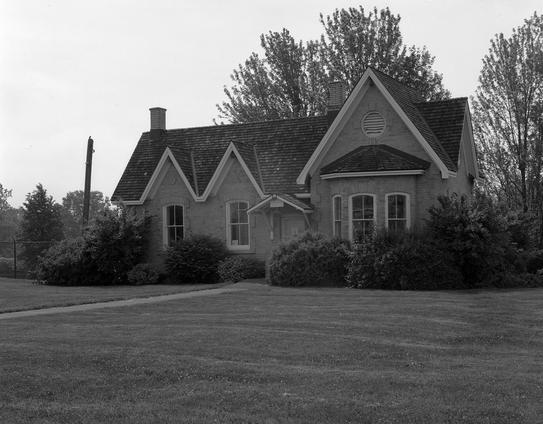
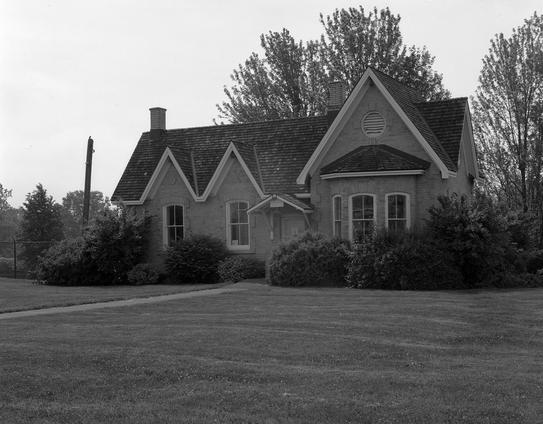
It is great to see that at least one station from the Bridgeburg area was salvaged.
Graflex Crown Graphic - Nikon Nikkor-W 1:5.6/180 - Ilford HP5+ @ ASA-200 - Pyrocat-HD (1+1+100) 9:00 @ 20C

Do not worry if you haven't heard of the community of Bridgeburg. The community owes its existence to the International Railway Bridge, which opened to traffic in 1873. The community's name has changed a few times before being absorbed into Fort Erie by the 1970s; it has been Victoria, International Bridge, and finally Bridgeburg. The small community flourished and would overtake nearby Fort Erie, with the railroad being the main focus for the community's economy. With three railroad operators using the International Railway Bridge, the town had three railway stations in the town proper to serve passengers. Grand Trunk having the main passenger station with Canadian Southern and eventually Toronto, Hamilton & Buffalo, both operating stations in Bridgeburg. These three stations were all located along Courtwright Street. Over the course of the history of passenger services across the bridge, these stations were replaced at least once, especially in the massive efforts to modernize railway services in Ontario that took place in the early 20th Century. Sadly none of these stations survived in any form, and most were demolished by the 1970s and 1980s.

In case you did not know what the station was for.
Nikon D750 - AF-S Nikkor 28-70mm 1:2.8DThe beautiful buff brick is something that many stations stopped using in the 20th Century.
Nikon D750 - AF-S Nikkor 28-70mm 1:2.8D

But one station did survive, known as B-1, or Bridgeburg B-1. The B-1 station opened at the same time as the International Railway Bridge in 1873. The station is located next to the bridge's Canadian entrance sitting on the berm above Niagara Blvd. It is unique in several ways for a railway station of its day. First of all, it did little in passenger service for the first part of its life, mainly for traffic and customs control along with toll collection for non-Grand Trunk trains driving over the bridge. Combined with its partner station in Black Rock, known as B-2, it acted to control traffic over the bridge in the early days with only a single track on the bridge that could ensure that trains would not fatally collide head-on. The second unique part of B-1 is that it is constructed in the Gothic Revival architectural style. At the same time, Grand Trunk did not use the Gothic Revival much in their station designs, having only built one in Woodstock under the Great Western name. Internally the station featured a station master and telegraph operator office, a small waiting area, and a ticket window. Canadian National would take over operations at the B-1 and B-2 stations in 1923, seeing the advantage of having dedicated traffic control points for either side of the bridge. B-1 would receive a railroad red paint job in the mid-century like many other Canadian National Stations.

The International Railway bridge, the sole reason for the B-1 station.
Nikon D750 - AF Nikkor 50mm 1:1.4DCN 6218 a Class U-2-g 4-8-4 Locomotive may have passed by B-1 many times.
Nikon D750 - AF-S Nikkor 28-70mm 1:2.8D

By 1980 most stations in Bridgeburg were gone, with only B-1 sitting next to the bridge and looking worse for wear. By this point, most yard operations had been moved from the Warren Street Yard to Black Rock. The need for keeping B-1 staffed was no longer important. The station itself was looking much worse for wear giving it was now over one hundred years old. The Fort Erie Railway Museum expressed an interest in saving the station rather than seeing the last surviving Bridgeburg station fall to the wrecking ball as all the other ones had. The old Michigan Central Station was last to fall in 1981. Canadian National was more than happy to sell the old station to Fort Erie for 1.25. Using extreme caution, the station was separated from its original foundation, then used a series of jacks and cribs to lift the station onto a railway flatbed, taken down the tracks to Central Avenue, loaded onto a truck and placed on a prepared foundation at the museum. The station was then repaired and restored. The architectural details were repaired and replaced with the red paint stripped to reveal the original yellow brick. Today the station remains at the museum along with a CN Locomotive, the Ridgeway Station and is used as the museum's gift shop. It should be noted that B-1's partner, B-2 remains in place as is a part of the still-active CN yard at Black Rock in Buffalo, New York.

#afadedglory #bridgeburg #bridgeburgb1 #canada #canadianhistory #canadiannationalrailway #crowngraphic #forterie #forterierailwaymuseum #grandtrunkrailway #ilfordhp5 #nikond750 #ontario #pyrocathd #railroad #railway

A Faded Glory - Bridgeburg B-1 - Grand Trunk Railway (1873-1975)

A small Gothic Revival station that once controlled a busy railway bridge and was the final station to serve the small community of Bridgeburg, Ontario.

Alex Luyckx | Blog

A Faded Glory – Bridgeburg B-1 – Grand Trunk Railway (1873-1975)

While there are certain stations out there with more interesting histories and stories that go along with them, others have simply done their job and then been disposed of. Oftentimes, that is with a demolition, which has resulted in the loss of many stations across Ontario. And the small community of Bridgeburg has lost a great many stations.

It is great to see that at least one station from the Bridgeburg area was salvaged.
Graflex Crown Graphic - Nikon Nikkor-W 1:5.6/180 - Ilford HP5+ @ ASA-200 - Pyrocat-HD (1+1+100) 9:00 @ 20C

Do not worry if you haven't heard of the community of Bridgeburg. The community owes its existence to the International Railway Bridge, which opened to traffic in 1873. The community's name has changed a few times before being absorbed into Fort Erie by the 1970s; it has been Victoria, International Bridge, and finally Bridgeburg. The small community flourished and would overtake nearby Fort Erie, with the railroad being the main focus for the community's economy. With three railroad operators using the International Railway Bridge, the town had three railway stations in the town proper to serve passengers. Grand Trunk having the main passenger station with Canadian Southern and eventually Toronto, Hamilton & Buffalo, both operating stations in Bridgeburg. These three stations were all located along Courtwright Street. Over the course of the history of passenger services across the bridge, these stations were replaced at least once, especially in the massive efforts to modernize railway services in Ontario that took place in the early 20th Century. Sadly none of these stations survived in any form, and most were demolished by the 1970s and 1980s.

In case you did not know what the station was for.
Nikon D750 - AF-S Nikkor 28-70mm 1:2.8DThe beautiful buff brick is something that many stations stopped using in the 20th Century.
Nikon D750 - AF-S Nikkor 28-70mm 1:2.8D

But one station did survive, known as B-1, or Bridgeburg B-1. The B-1 station opened at the same time as the International Railway Bridge in 1873. The station is located next to the bridge's Canadian entrance sitting on the berm above Niagara Blvd. It is unique in several ways for a railway station of its day. First of all, it did little in passenger service for the first part of its life, mainly for traffic and customs control along with toll collection for non-Grand Trunk trains driving over the bridge. Combined with its partner station in Black Rock, known as B-2, it acted to control traffic over the bridge in the early days with only a single track on the bridge that could ensure that trains would not fatally collide head-on. The second unique part of B-1 is that it is constructed in the Gothic Revival architectural style. At the same time, Grand Trunk did not use the Gothic Revival much in their station designs, having only built one in Woodstock under the Great Western name. Internally the station featured a station master and telegraph operator office, a small waiting area, and a ticket window. Canadian National would take over operations at the B-1 and B-2 stations in 1923, seeing the advantage of having dedicated traffic control points for either side of the bridge. B-1 would receive a railroad red paint job in the mid-century like many other Canadian National Stations.

The International Railway bridge, the sole reason for the B-1 station.
Nikon D750 - AF Nikkor 50mm 1:1.4DCN 6218 a Class U-2-g 4-8-4 Locomotive may have passed by B-1 many times.
Nikon D750 - AF-S Nikkor 28-70mm 1:2.8D

By 1980 most stations in Bridgeburg were gone, with only B-1 sitting next to the bridge and looking worse for wear. By this point, most yard operations had been moved from the Warren Street Yard to Black Rock. The need for keeping B-1 staffed was no longer important. The station itself was looking much worse for wear giving it was now over one hundred years old. The Fort Erie Railway Museum expressed an interest in saving the station rather than seeing the last surviving Bridgeburg station fall to the wrecking ball as all the other ones had. The old Michigan Central Station was last to fall in 1981. Canadian National was more than happy to sell the old station to Fort Erie for 1.25. Using extreme caution, the station was separated from its original foundation, then used a series of jacks and cribs to lift the station onto a railway flatbed, taken down the tracks to Central Avenue, loaded onto a truck and placed on a prepared foundation at the museum. The station was then repaired and restored. The architectural details were repaired and replaced with the red paint stripped to reveal the original yellow brick. Today the station remains at the museum along with a CN Locomotive, the Ridgeway Station and is used as the museum's gift shop. It should be noted that B-1's partner, B-2 remains in place as is a part of the still-active CN yard at Black Rock in Buffalo, New York.

#afadedglory #bridgeburg #bridgeburgb1 #canada #canadianhistory #canadiannationalrailway #crowngraphic #forterie #forterierailwaymuseum #grandtrunkrailway #ilfordhp5 #nikond750 #ontario #pyrocathd #railroad #railway

A Faded Glory - Bridgeburg B-1 - Grand Trunk Railway (1873-1975)

A small Gothic Revival station that once controlled a busy railway bridge and was the final station to serve the small community of Bridgeburg, Ontario.

Alex Luyckx | Blog

A Faded Glory – International Railway Bridge – Grand Trunk Railway (1873-Present)

The Niagara River has never been the easiest obstacle to navigate in Ontario, the main reasons being the current, the falls, and the gorge. Bridges were neither cheap nor easy to build but possible. The easiest means to get trains across the river were through the use of rail ferries. Steamships were designed to carry large numbers of cars, but the process was slow, bottlenecked the line, and there was also the tendency for ships to sink or get caught in the current and swept away.

While the decking and trusses are not original, the piers date back to 1873.
Graflex Crown Graphic - Fuji Fujinon-W 1:5.6/125 - Ilford HP5+ @ ASA-200 - Pyrocat-HD (1+1+100) 9:00 @ 20C

All major operators initially used rail ferries, while Buffalo & Lake Huron had the easiest route between Fort Erie and Buffalo. With their line's terminus at Niagara Falls, Great Western Railway required rerouting the train to Queenston for loading and unloading. So they were one of the first to start planning a railway bridge. But Great Western wasn't planning any railway bridge; they aimed to build a suspension bridge. Working with William Hamilton Merritt, the bridge opened to traffic in 1855, supporting two levels, one for a single railway track and a second for foot and carriage traffic. When it opened, it was not only Canada's first but the world's first railway suspension bridge. The suspension wires were supported by four twenty-seven meter tall Egyptian inspired pillars, work being done by a young Scottish stonemason William Henderson. But above the falls, the Buffalo & Lake Huron Railway continued to use the rail ferry International but had planned by 1856 for their own bridge between Fort Erie and Black Rock. But having no real financial stability, the plans remained on paper. As Grand Trunk began to take on more operational control over Buffalo & Lake Huron, the new operator furthered plans. Grand Trunk had completed their first rail bridge over the Grafraxa River in Port Hope and their biggest bridge, the Victoria Bridge in Montreal, over the St. Lawerence River in 1860. By 1864 representatives of New York State and the Province of Canada signed an agreement to have a bridge completed between Fort Erie and Black Rock. When the American Civil War opened, the plans were shelved and remained that way in the serious dip in Anglo-American relations during and following the war. The Fenian Raids of 1866 did not help matters either. The International being requested by the Canadian Militia as an armed gunboat and a means to move troops by the Fenians. It remained safely in the middle of the river, refusing to move, having been ordered to stay put by Grand Trunk employees.

A bit more closer detail on the 1873 piers.
Nikon D750 - AF Nikkor 50mm 1:1.4DA memorial to Light Vessel 82, lost in a storm in 1913 showing the power of the Great Lakes and the Niagara River.
Nikon D300 - AF-S Nikkor 70-200mm 1:2.8G

Thankfully the relations warmed by the end of the decade, and plans were again coming together. In 1870, the Canadian Bridge Company and American Bridge Company chartered the International Bridge Company to construct the proposed bridge. C.S. Gzowski & Co. won the contract from International Bridge to complete the main piers and final assembly construction. At the same time, the bridge steel and sections went to Phoenix Iron Works in Pennsylvania. The bridge would span the shortest section of the river but far from ideal. At this point, the river depth stood at fourteen meters, and the current flowed at nineteen kilometres per hour. The continued damage from ice broke away from Lake Erie and flowed down to Niagara Falls that could prove dangerous to the piers. Construction began in 1871 with dredging three metres of gravel from the river bed. The eight piers that secured the bridge across the river were constructed from locally quarried limestone and designed to break up ice flows rather than have them dashed against them. Phoenix Ironworks constructed the bridge portions in twelve sections using a standard Baldwin Truss pattern. Each section was floating in, raised on special pontoons and secured in place. While the Canadian side of the bridge was fixed, the American side featured two swing sections. The sections were around Unity Island, allowing ships to still access the harbours at Black Rock and Buffalo. A single railway track crossed the bridge, and a separate section allowed for pedestrian traffic. During the construction, not a single life was lost, or the accident delayed the effort. When the bridge was completed, it had cost 1.5 million dollars and spanned 1113 metres. And railway traffic stood ready to make use of the new bridge when it opened on the 3rd of November 1873; present at the ceremony were Grand Trunk President Richard Potter and Internation Bridge Co-President Matthew Brydges. While Grand Trunk trains used the bridge without trouble, all other operators had to pay a fee at a dollar per car. While most operators had no issues paying the toll rather than spend the money needed to build their own bridge, Canadian Southern sued Grand Trunk.

To the left the Whirlpool Bridge and the right the MCR bridge, today only the Whirlpool bridge operates as it replaced the original Niagara Suspension Bridge.
Mamiya m645 - Mamiya-Sekor C 45mm 1:2.8 N - Ilford FP4+ @ ASA-100 - Kodak D-23 (Stock) 6:00 @ 20CThe ruins of the Curtis-Wright Factory, once a major part of the industrial hotbed of Black Rock where the Bridge terminated.
Pentax 645 - SMC Pentax A 645 35mm 1:3.5 - Kodak Tri-X 400 @ ASA-400 - Kodak HC-110 Dil. B 7:30 @ 20C

As the popularity of the railway increased, the need for larger bridges became obvious, and bridges with a single track across them were becoming obsolete. Grand Trunk completed a new bridge in 1897, the Whirlpool Bridge, to replace the original Niagara Suspension Bridge. And in 1900, the International Railway Bridge was revamped, removing the original bridge sections and replacing them with one that supported two tracks at the cost of the pedestrian walkway. Three years later, baseball player Ed Delany who had been removed from a train for being drunk, attempted to cross the bridge on foot, dying. While always a busy crossing, the busiest day of the bridge took place on the 10th of July 1916 when 264 trains crossed the bridge. Canadian National took over operations on the bridge in 1923 when Grand Trunk Railway was absorbed into the new company. In 1929, Michigan Central, which was now in complete control of Canadian Southern, completed their own bridge at Niagara Falls. Passenger services across the bridge dwindled with the final Canadian National Passenger train crossing in 1934. The Americans disabled one of the swing sections on their bridge in 1941. The bridge had spent a great deal of its operational life without closure, at least until 1993. Canadian National was forced to close the bridge due to emergency repairs to several of the support piers, which were still original to 1873; the repairs cost two million but ensured the continued use of the bridge. Further updates to the bridge decking took place in 2000. Today, the International Railway Bridge remains the oldest operational railway bridge in Ontario, far from the original. Its construction pre-dates many of the original bridges constructed by the Canadian Pacific through the Rockies. Many of the older Grand Trunk Bridges have been either totally replaced or modified far beyond the original to be considered original. It is also one of two operational railway bridges across the Niagara River, the 1897 Whirlpool Bridge as the Michigan Central bridge shut down in 2001. On average, the bridge sees fifteen trains daily crossing.

#afadedglory #blackrock #bridgeburg #buffalo #canada #canadianhistory #canadiannationalrailway #crowngraphic #forterie #grandtrunkrailway #ilfordhp5 #infrastruture #internationalrailwaybridge #kodakhc110 #kodaktrix400 #newyork #nikond750 #ontario #pentax645 #pyrocathd #railroad #railway #usa

A Faded Glory - International Railway Bridge - Grand Trunk Railway (1873-Present)

While not the first railway bridge across the Niagara River, the International Railway Bridge is Ontario's oldest continuously operated bridge.

Alex Luyckx | Blog