🥳🎉 "TiDAR: Think in Diffusion, Talk in Autoregression"—because why just talk to yourself when you can overcomplicate #communication with a sprinkle of computational gobbledygook? Thanks to this paper, we can now awkwardly combine two processes that nobody asked for, giving a whole new meaning to "crossed wires" in the tech world. 🤷‍♂️💻
https://arxiv.org/abs/2511.08923 #TiDAR #ComputationalGobbledygook #CrossedWires #TechInnovation #Autoregression #HackerNews #ngated
TiDAR: Think in Diffusion, Talk in Autoregression

Diffusion language models hold the promise of fast parallel generation, while autoregressive (AR) models typically excel in quality due to their causal structure aligning naturally with language modeling. This raises a fundamental question: can we achieve a synergy with high throughput, higher GPU utilization, and AR level quality? Existing methods fail to effectively balance these two aspects, either prioritizing AR using a weaker model for sequential drafting (speculative decoding), leading to lower drafting efficiency, or using some form of left-to-right (AR-like) decoding logic for diffusion, which still suffers from quality degradation and forfeits its potential parallelizability. We introduce TiDAR, a sequence-level hybrid architecture that drafts tokens (Thinking) in Diffusion and samples final outputs (Talking) AutoRegressively - all within a single forward pass using specially designed structured attention masks. This design exploits the free GPU compute density, achieving a strong balance between drafting and verification capacity. Moreover, TiDAR is designed to be serving-friendly (low overhead) as a standalone model. We extensively evaluate TiDAR against AR models, speculative decoding, and diffusion variants across generative and likelihood tasks at 1.5B and 8B scales. Thanks to the parallel drafting and sampling as well as exact KV cache support, TiDAR outperforms speculative decoding in measured throughput and surpasses diffusion models like Dream and Llada in both efficiency and quality. Most notably, TiDAR is the first architecture to close the quality gap with AR models while delivering 4.71x to 5.91x more tokens per second.

arXiv.org
TiDAR: Think in Diffusion, Talk in Autoregression

Diffusion language models hold the promise of fast parallel generation, while autoregressive (AR) models typically excel in quality due to their causal structure aligning naturally with language modeling. This raises a fundamental question: can we achieve a synergy with high throughput, higher GPU utilization, and AR level quality? Existing methods fail to effectively balance these two aspects, either prioritizing AR using a weaker model for sequential drafting (speculative decoding), leading to lower drafting efficiency, or using some form of left-to-right (AR-like) decoding logic for diffusion, which still suffers from quality degradation and forfeits its potential parallelizability. We introduce TiDAR, a sequence-level hybrid architecture that drafts tokens (Thinking) in Diffusion and samples final outputs (Talking) AutoRegressively - all within a single forward pass using specially designed structured attention masks. This design exploits the free GPU compute density, achieving a strong balance between drafting and verification capacity. Moreover, TiDAR is designed to be serving-friendly (low overhead) as a standalone model. We extensively evaluate TiDAR against AR models, speculative decoding, and diffusion variants across generative and likelihood tasks at 1.5B and 8B scales. Thanks to the parallel drafting and sampling as well as exact KV cache support, TiDAR outperforms speculative decoding in measured throughput and surpasses diffusion models like Dream and Llada in both efficiency and quality. Most notably, TiDAR is the first architecture to close the quality gap with AR models while delivering 4.71x to 5.91x more tokens per second.

arXiv.org

#AI #GenerativeAI #LLMs #o1 #OpenAI #Autoregression: "In “Embers of Autoregression” McCoy et al. (2023), we showed that several large language models (LLMs) have some important limitations that are attributable to their origins in next-word prediction. Here we investigate whether these issues persist with o1, a new system from OpenAI that differs from previous LLMs in that it is optimized for reasoning. We find that o1 substantially outperforms previous LLMs in many cases, with particularly large improvements on rare variants of common tasks (e.g., forming acronyms from the second letter of each word in a list, rather than the first letter). Despite these quantitative improvements, however, o1 still displays the same qualitative trends that we observed in previous systems. Specifically, o1—like previous LLMs—is sensitive to the probability of examples and tasks, performing better and requiring fewer “thinking tokens” in high-probability settings than in low-probability ones. These results show that optimizing a language model for reasoning can mitigate but might not fully overcome the language model’s probability sensitivity."

https://arxiv.org/html/2410.01792v1

When a language model is optimized for reasoning, does it still show embers of autoregression? An analysis of OpenAI o1

Diffusion is spectral autoregression

A deep dive into spectral analysis of diffusion models of images, revealing how they implicitly perform a form of autoregression in the frequency domain.

Sander Dieleman

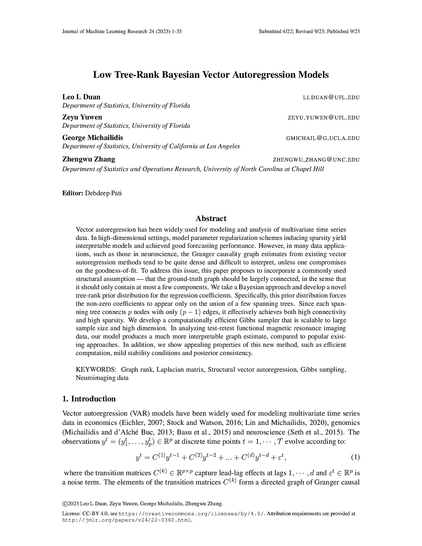
'Low Tree-Rank Bayesian Vector Autoregression Models', by Leo L Duan, Zeyu Yuwen, George Michailidis, Zhengwu Zhang.

http://jmlr.org/papers/v24/22-0360.html

#autoregression #gibbs #causality

Low Tree-Rank Bayesian Vector Autoregression Models