This is pretty cool - reptile found that can sense low frequency sound with the saccule: https://doi.org/10.1016/j.cub.2024.09.016
(I'll edit with a direct PDF link in a sec)

Hearing evolved in fishes, where the swim bladder as a big resonant cavity reached out to touch the vestibular organ and kinda vibrate it. That is only good for low frequencies, so to some degree the history of the evolution of audition has been a quest for higher frequencies - thinning out a tympanic membrane, the evolution of the inner ear by stealing jawbones, the enlargement of the brain case to close off the middle ears (our eustachian tubes are vestigial remnants of what used to be an "open passageway" from ear to ear).

Sound is a veridical readout of the matter that produces it, so different frequency ranges contain different kinds of information, and small things including textures and material composition are only audible with higher frequency ranges. Low freqs are important too, but especially with the transition to land, needing to handle the impedance mismatch between fluid filled bodies and open air makes an organ that can hear a wide range of frequencies challenging.

So the cochlea gets all the attention as the auditory organ because its one of the most remarkably precise and Scientifically Magical organs out there, but the vestibular system is cool too. It's basically a bag of saltwater and rocks and when you jangle your head around the rocks touch little hair cells and tell you you're moving.

Because of its torrid history the auditory system is sort of a clusterfuck, but these researchers found direct projections from the Saccule through to the auditory midbrain. They're sensitive to vibration (through a surface), not sound (through the air), but still go to auditory system, so while we have no idea what the perceptual reality is like, i dont think it is unfair to say that the geckos "hear vibration."


#Audition #Auditory #AuditoryNeuroscience #Neuroscience

Auditory pathway for detection of vibration in the tokay gecko

Otolithic endorgans such as the saccule were thought to be strictly vestibular in amniotes (reptiles, birds, and mammals), with little evidence suppor…

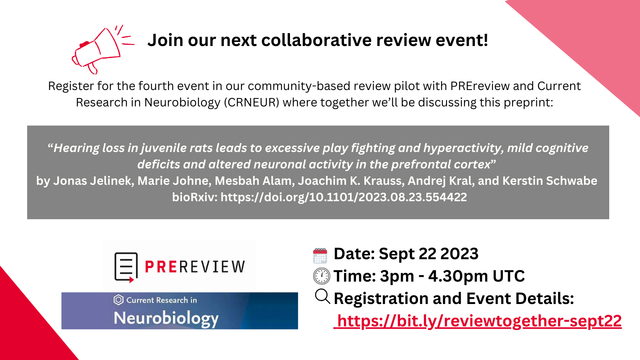
On the 19th of October we conducted a Live Review with Current Research in Neurobiology (#CRNEUR) reviewing this preprint: https://doi.org/10.1101/2023.08.23.554422
The review is now available to view and citable with DOI at: https://prereview.org/reviews/10064133 πŸ™Œ

#AuditoryNeuroscience #preprintpeerreview

A really well isolated IC neuron responding to speech stimuli #Neuroscience #AuditoryNeuroscience #SpeechInNoise #SpeechCoding #HiddenHearingLoss

πŸ“’The 4th event in our collaborative review pilot with Current Research in Neurobiology (#CRNEUR) has been rescheduled for Thurs Oct 19th at 14:00 UTC, we will be reviewing this preprint together: https://doi.org/10.1101/2023.08.23.554422

πŸ—“οΈ Date: Oct 19 2023
πŸ•‘ Time: 2pm UTC
✍️ Registration: https://bit.ly/reviewtogether-october19

#AuditoryNeuroscience

A reminder that we have the 4th in our series of community-based review pilots with #CRNEUR this Friday 22nd Sept at 15:00 - 16:30 UTC where we will be reviewing: https://doi.org/10.1101/2023.08.23.554422

Register to review together: https://bit.ly/reviewtogether-sept22

#AuditoryNeuroscience

πŸ“’ Calling all researchers, academics, and neuroscience enthusiasts!
Be a part of an innovative collaborative review process.
Register for the 4th event in our community-based review pilot with #CRNEUR examining this #preprint: https://doi.org/10.1101/2023.02.05.527176

πŸ“† Date: Sept 22 2023
πŸ• Time: 3pm UTC
πŸ” Registration: https://bit.ly/reviewtogether-sept22

Read more about the pilot here: https://content.prereview.org/prereview-and-crneur-pilot/

#AuditoryNeuroscience

So, I’m not a vision researcher, but #Futurama that is not where the visual cortex is. Fry needed to wear a Vision Pro or something with the back strap to be near it. #Pedant

#Neuroscience #Audiology #AuditoryNeuroscience #Research #Science #NoiseExposure #SpeechInNoise #HiddenHearingLoss

πŸ“’ THIS FRIDAYπŸ“’

Call to #AuditoryNeuroscience folks, especially ECRs, to join us for our next collaborative review run w/ #CRNEUR

πŸ—“οΈ July 28, 15:00 UTC
πŸ”—Register: http://bit.ly/reviewtogether-July28
πŸ“°#preprint: https://doi.org/10.1101/2023.0

Welcome! You are invited to join a meeting: PREreview and CRNEUR Community-Based Review Pilot 3. After registering, you will receive a confirmation email about joining the meeting.

PREreview and Current Research in Neurobiology (CRNEUR) are collaborating to host 5 open, collaborative, and interactive review events styled after PREreview Live-streamed Preprint Journal Clubs. These are topic-centered, interactive online calls in which participants are guided to provide constructive feedback to a preprint. We are hosting the third event of this pilot on July 28th at 15:00 UTC - check your local time here: https://www.timeanddate.com/worldclock/converter.html?iso=20230728T150000&p1=1440. Together we’ll be discussing this preprint: β€œA sparse code for natural sound context in auditory cortex” by Mateo LΓ³pez Espejo and Stephen V. David - bioRxiv: https://doi.org/10.1101/2023.06.14.544866 Please ensure you read the preprint prior to the event. The event will last 90 minutes and will yield a review based on the collaborative notes participants will be jointly taking during the call. The review will be shared and published on PREreview.org under CC BY 4.0 licence. Participants will have the option to sign the final review using their real name (via their ORCID iD) or via a pseudonym provided by the PREreview account. The CRNEUR editorial team will consider the review as an addition to their standard journal workflow protocol. For more information please read our blog post: https://content.prereview.org/prereview-and-crneur-pilot/ or email us at [email protected]. Feel free to share this opportunity with colleagues.

Zoom

@kanoldlab

Interesting! And nice to see you on the fediverse. #Auditory #auditoryNeuroscience

πŸ“’ Call to #AuditoryNeuroscience folks, especially ECRs, to join us for our next collaborative review event run w/ CRNEUR

πŸ—“οΈ July 28 @ 15:00 UTC
πŸ”— Register: http://bit.ly/reviewtogether-July28
πŸ“° #preprint https://doi.org/10.1101/2023.06.14.544866

Welcome! You are invited to join a meeting: PREreview and CRNEUR Community-Based Review Pilot 3. After registering, you will receive a confirmation email about joining the meeting.

PREreview and Current Research in Neurobiology (CRNEUR) are collaborating to host 5 open, collaborative, and interactive review events styled after PREreview Live-streamed Preprint Journal Clubs. These are topic-centered, interactive online calls in which participants are guided to provide constructive feedback to a preprint. We are hosting the third event of this pilot on July 28th at 15:00 UTC - check your local time here: https://www.timeanddate.com/worldclock/converter.html?iso=20230728T150000&p1=1440. Together we’ll be discussing this preprint: β€œA sparse code for natural sound context in auditory cortex” by Mateo LΓ³pez Espejo and Stephen V. David - bioRxiv: https://doi.org/10.1101/2023.06.14.544866 Please ensure you read the preprint prior to the event. The event will last 90 minutes and will yield a review based on the collaborative notes participants will be jointly taking during the call. The review will be shared and published on PREreview.org under CC BY 4.0 licence. Participants will have the option to sign the final review using their real name (via their ORCID iD) or via a pseudonym provided by the PREreview account. The CRNEUR editorial team will consider the review as an addition to their standard journal workflow protocol. For more information please read our blog post: https://content.prereview.org/prereview-and-crneur-pilot/ or email us at [email protected]. Feel free to share this opportunity with colleagues.

Zoom