¡Este es un resultado realmente interesante! [1]

Sabíamos que el cometa 3I/ATLAS era un objeto interestelar debido a su órbita, pero gracias a precisas mediciones realizadas con ALMA por un equipo dirigido por un estudiante de doctorado (Luis E. Salazar Manzano [2] de la Universidad de Michigan), y supervisado por la profesora asistente chilena Teresa Paneque-Carreño [3], realmente muestran que su química no tiene que ver con la de nuestro sistema solar.

En particular, el equipo descubrió que 3I/ATLAS contiene *al menos 30 veces* la proporción de agua semipesada* que se encuentra en los cometas de nuestro propio Sistema Solar, lo que indica claramente una historia química diferente.

Los procesos químicos que conducen al enriquecimiento de HDO generalmente requieren ambientes más fríos que unos 30 Kelvin, lo que significa que el sistema solar en el que se originó 3I/ATLAS era más frío que el nuestro.

Y esto se pudo encontrar porque ALMA puede observar cometas justo después de su perihelio, y aunque bastante cerca del sol, es observable con un radiotelescopio.

*El agua semipesada [4] es agua hecha con un átomo del isótopo más común de hidrógeno (protio, o sólo un protón), un átomo de deuterio (el siguiente isótopo más común de hidrógeno, que contiene un protón y una neurona) y oxígeno. A veces se le llama HDO, con D para Deuterium, o ¹H²HO. Compare con el agua pesada, que está hecha de dos átomos de Deuterio y Oxígeno, o D2O (o ²H2O).

#ALMA #AtacamaLargeMillimeterArray #AtacamaLargeMillimeterSubmilimeterArray #Comet3IATLAS #FormacionSistemaSolar #ObjetosInterestelares
[1] https://www.almaobservatory.org/en/press-releases/alma-reveals-interestelar-comet-3i-atlas-formed-in-a-a-colder-world-than-our-own/
[2] https://lsa.umich.edu/astro/people/graduate-students/lesamz.html
[3] https://terepaneque.com/info_english/
[4] https://en.wikipedia.org/wiki/Semiheavy_water
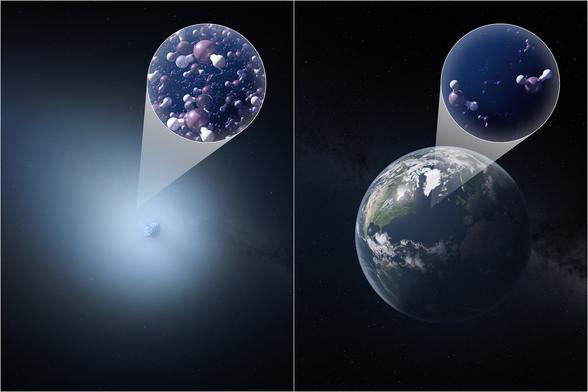
This is a really interesting result [1]! We knew Comet 3I/ATLAS was an interstellar object because of its orbit, but the precise measurements done with ALMA by a team lead by a Ph.D. student (Luis E. Salazar Manzano from the University of Michigan), and supervised by Chilean assistant professor Teresa Paneque-Carreño [3], really show that its chemistry does not belong in our solar system.

In particular, the team found that 3I/ATLAS contains *at least 30 times* the proportion of semi-heavy water* found in comets from our own Solar System, which clearly indicates a different chemical history. The chemical processes leading to the enrichment of HDO usually require environments colder than about 30 Kelvin, which means the solar system in which 3I/ATLAS originated was colder than ours.

And this could be found because ALMA could observe the comet right after its perihelion, quite close to the sun, but observable with a radio telecope!

*Semi-heavy water [4] is water made with one atom of the most common isotope of hydrogen (protium), one atom of Deuterium (the next most common isotope of hydrogen, containing one proton and one neuron), and oxygen. It is sometimes called HDO, with D standing for Deuterium, or ¹H²HO. Compare with heavy water, which is made of two atoms of Deuterium and Oxygen, or D₂O (or ²H₂O).

#ALMA #AtacamaLargeMillimeterArray #AtacamaLargeMillimeterSubmillimeterArray #Comet3IATLAS #SolarSystemFormation #InterstellarObjects

[1] https://www.almaobservatory.org/en/press-releases/alma-reveals-interstellar-comet-3i-atlas-formed-in-a-far-colder-world-than-our-own/
[2] https://lsa.umich.edu/astro/people/graduate-students/lesamz.html
[3] https://terepaneque.com/info_english/
[4] https://en.wikipedia.org/wiki/Semiheavy_water
ALMA Reveals Interstellar Comet 3I/ATLAS Formed in a Far Colder World Than Our Own | ALMA Observatory

First-ever measurement of deuterated water in an interstellar object shows its home system formed under extreme conditions New observations from the Atacama Large Millimeter/submillimeter Array (ALMA) have yielded the first-ever measurement of deuterated water — also known as semi-heavy water — in an interstellar object. The discovery reveals that the interstellar comet 3I/ATLAS contains at...

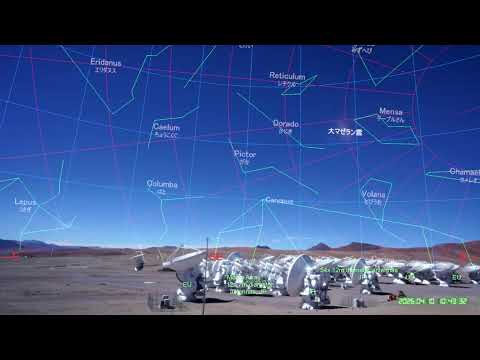
And they also have a nice feature with a second feed in which they overlay the sky coordinates and constellations over the live image!

https://youtube.com/live/1VyAARHQqDA?feature=share

That one also has relaxing musing, so give it a try…

#ALMA #AtacamaLargeMillimeterSubmillimeterArray #AtacamaLargeMillimeterArray #LiveStreaming #TelescopeMonitoringVideoFeed #AsahiAstroLive #StarMap #StarChart #RelaxingMusic

ALMA, Chile Star Chart

YouTube

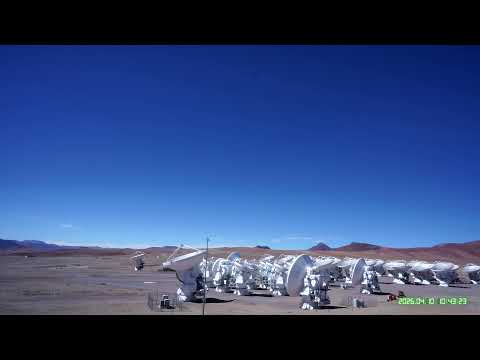
Great! I just discovered that colleagues from NAOJ have partnered with Asahi Astro LIVE so that you can now watch on YouTube the ALMA camera feed looking at the ALMA Compact Array and surrounding antennas… on certain days you will be able to see our transporters, Otto and Lore!

And on windy weather, you can see the vibration on the camera…

https://www.youtube.com/watch?v=Zdy0AxaVYvI

#ALMA #AtacamaLargeMillimeterSubmillimeterArray #AtacamaLargeMillimeterArray #LiveStreaming #TelescopeMonitoringVideoFeed # #AsahiAstroLive

The Atacama Large Millimeter/submillimeter Array (ALMA) and Starry sky LIVE, Chile

YouTube
ALMA Observatory on Instagram: "🙌🏻Comenzamos el ¡Puertas Abiertas ESO-ALMA 2026! Celebrando el Día de la Astronomía en Chile, con actividades junto a alumnos de los colegios @liceovalentinletelierrecoleta @colegio_cach @liceo1javieracarrera @sanjosedelafamilia . 🙌🏻ESO-ALMA Open House 2026! Celebrating Astronomy Day in Chile, together with students from schools in Santiago."

1,095 likes, 14 comments - alma.observatory on March 20, 2026: "🙌🏻Comenzamos el ¡Puertas Abiertas ESO-ALMA 2026! Celebrando el Día de la Astronomía en Chile, con actividades junto a alumnos de los colegios @liceovalentinletelierrecoleta @colegio_cach @liceo1javieracarrera @sanjosedelafamilia . 🙌🏻ESO-ALMA Open House 2026! Celebrating Astronomy Day in Chile, together with students from schools in Santiago.".

Instagram

This is a very cool result, and an extremely interesting application of current ALMA Observatory capabilities, in particular its long baselines to get higher spatial resolution (i.e., how small are our pixels in the X and Y dimension). But to achieve it, the team had to make very detailed adjustments to the correlation and observation setups so that all those molecules could be observed during several observation runs, within the constraints of our current system.

With the Wideband Sensitivity Upgrade (WSU), many of those molecules will be able to be observed in many less observing setups, thanks to our wider bandwidth, but also with more detail in the spectral dimension (for each individual "pixel") thanks to our new correlators. So the number of spectral setups will be reduced, and the total observing time will be also reduced, allowing for more interesting science to happen!

That's the promise of the WSU, and we're working hard to fulfill it!

#ALMA #AtacamaLargeMillimeterArray #AtacamaLargeMillimeterSubmillimiterArray #WSU #WidebandSensitivityUpgrade

https://www.almaobservatory.org/en/press-releases/alma-reveals-57-faces-of-a-dying-star/

Teams using our ALMA Observatory have been able to clearly show how magnetism has a pre-eminent role in young star accretion and growth!

The best part is that the lead scientist for that paper is our colleague Paulo Cortés, who apart from doing notable science is also responsible for the scientific acceptance of ALMA software releases!

https://www.almaobservatory.org/en/press-releases/astronomers-spot-magnetically-guided-streamer-funneling-star-building-material-into-newborn-system-in-perseus/

#ALMA #AtacamaLargeMillimeterArray #AtacamaLargeMillimeterSubmillimeterArray #YoungStars #StarFormation #Magnetism #CosmicMagnetism

Astronomers Spot Magnetically-Guided Streamer Funneling Star-Building Material into Newborn System in Perseus | ALMA Observatory

New ALMA observations reveal spiral-shaped gas streamer guided by magnetic fields in a star-forming nursery Highlights A team of astronomers led by Paulo Cortes, a scientist with the U.S. National Science Foundation National Radio Astronomy Observatory and the Joint ALMA Observatory, has made a groundbreaking discovery about how young star systems grow. Using the powerful...

We have updated our website to communicate the status and the future benefits of ALMA's Wideband Sensitivity Upgrade in our site for scientists:

https://www.almaobservatory.org/en/scientists/alma-2030-wsu/wsu-program/

#ALMA #AtacamaLargeMillimeterArray #AtacamaLargeMillimeterSubmillimeterArray #WSU #WidebandSensitivityUpgrade

WSU Program | ALMA Observatory

When is heavy water (i.e., that formed with deuterium instead of simple hydrogen) formed in the universe? Very early into protoplanetary system formation, it seems!

«Our detection indisputably demonstrates that the water seen in this planet-forming disk must be older than the central star and formed at the earliest stages of star and planet formation,” shares Margot Leemker, lead author on this paper, and a postdoc with the Department of Physics, University of Milan, Italy. “This presents a major breakthrough in understanding the journey of water through planet formation, and how this water made its way to our Solar System, and possibly Earth, through similar processes.”»

https://www.almaobservatory.org/en/press-releases/first-ever-detection-of-heavy-water-in-a-planet-forming-disk/

#ALMA #AtacamaLargeMillimeterSubmillimeterArray #AtacamaLargeMillimeterArray #PlanetFormation #PlanetSystemFormation #GalacticWater #GalacticHeavyWater #HeavyWater #D2O

First-ever Detection of “Heavy Water” in a Planet-forming Disk | ALMA Observatory

New ALMA data traces water found in comets, and planet formation, back to the dawn of the cosmos Highlights: Astronomers using the Atacama Large Millimeter/submillimeter Array (ALMA) have made a first-ever detection of doubly deuterated water (D₂O, or “heavy water”) in a planet-forming disk around V883 Ori, a young star. This means that the water...

A group led by Fujimoto-san et al have uncovered a primordial galaxy, just 930 million years after the Big Bang (z=6.072). The galaxy is composed of at least 15 dense, star-forming clumps embedded within a rotating disk like a "Cosmic Grape". These clumps, with sizes ranging from 10 to 60 parsecs, dominate 70% of the galaxy's UV light, and are reshaping our understanding of early galactic structure formation. More than 100 hours of joint ALMA and JWST observations were made, amplified by gravitational lensing, making this one of the most studies early galaxies.

More information on https://www.almaobservatory.org/en/press-releases/alma-and-james-webb-space-telescope-shed-light-on-cosmic-grapes/

#ALMA #AtacamaLargeMillimeterArray #AtacamaLargeMillimeterSubmillimeterArray #JWST #GalaxyEvolution #OriginOfGalaxies #EarlyUniverse #PrimordialGalaxies #GrapeLikeGalaxies

ALMA and James Webb Space Telescope Shed Light on "Cosmic Grapes" | ALMA Observatory

ALMA and JWST observations unveil unexpected details of rapid growth in a faint, newborn