Weekly Update from the Open Journal of Astrophysics – 02/05/2026

Here we are, on schedule, with another update of activity at the Open Journal of Astrophysics. Since the last update we have published a further seven papers, bringing the number in Volume 9 (2026) to 94 and the total so far published by OJAp up to 542. I checked the corresponding update for last year (on 3rd May 2025), and we’ve had an increase from 54 to 94 in papers published (about 74%) between the first four months of 2025 and the first four months of 2026.

I will continue to include the posts made on our Mastodon account (on Fediscience) to encourage you to visit it. Mastodon is a really excellent service, and a more than adequate replacement for X/Twitter (which nobody should be using); these announcements also show the DOI for each paper.

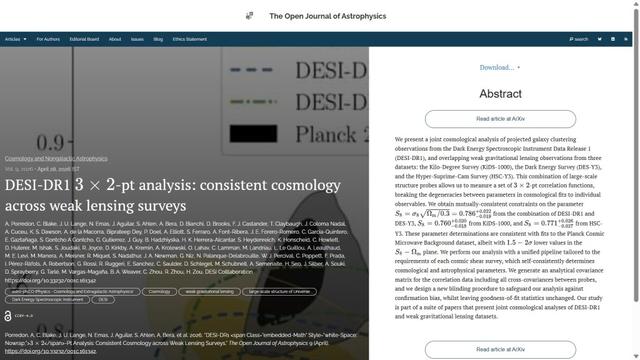
The first paper to report this week is “DESI-DR1 3 × 2-pt analysis: consistent cosmology across weak lensing surveys” by Anna Porredon (CIEMAT, Madrid, Spain) and 72 others (DESI Colllaboration). This paper was published on Tuesday 28th April in the folder Cosmology and Nongalactic Astrophysics. This paper presents a joint cosmological analysis of galaxy clustering and gravitational lensing observations, providing consistent constraints on cosmological parameters. The analysis also introduces a new blinding procedure to prevent confirmation bias. See this post for news of an important DESI milestone.

The overlay for this paper is here

You can find the officially accepted version on arXiv here and the announcement on Fediverse here:

https://fediscience.org/@OJ_Astro/116480407578621011

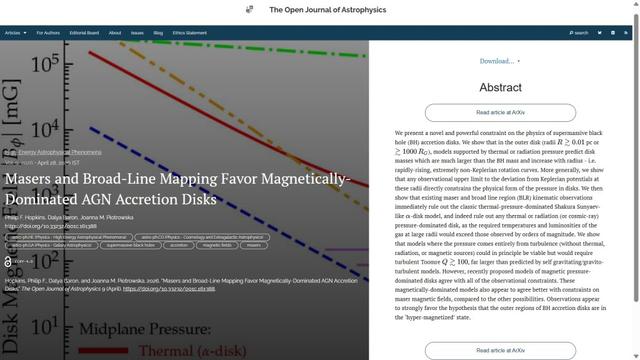
The second paper for this week, also published on Tuesday 28th April but in the folder High-Energy Astrophysical Phenomena is “Masers and Broad-Line Mapping Favor Magnetically-Dominated AGN Accretion Disks” by Philip F. Hopkins (Caltech, USA), Dalya Baron (Stanford U., USA) and Joanna M. Piotrowska (Caltech). This one presents a new constraint on supermassive black hole accretion disks physics, suggesting that outer regions are likely in a ‘hyper-magnetized’ state, as thermal or radiation pressure models appear inconsistent.

The overlay for this one is here:

The official version of the paper can be found on arXiv here and the Fediverse announcement here:

https://fediscience.org/@OJ_Astro/116480505354195181

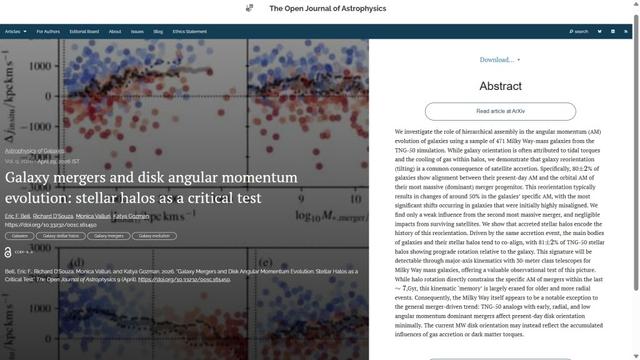
Next one up, the third paper of the week, is “Galaxy mergers and disk angular momentum evolution: stellar halos as a critical test” by Eric F. Bell (U. Michigan, Ann Arbor, USA), Richard D’Souza (Vatican Observatory), Monica Valluri & Katya Gozman (U. Michigan). This was published on Wednesday 29th April in the folder Astrophysics of Galaxies. The paper argues that satellite accretion impacts the angular momentum evolution of galaxies, often causing significant reorientation. This process is detectable in Milky Way-mass galaxies so the idea is testable observationally.

The overlay for this one is here:

The final, accepted version can be found on arXiv here and the Mastodon announcement is here:

https://fediscience.org/@OJ_Astro/116486649450860283

The fourth paper this week, published on Thursday April 30th, is “Time-Dilation Methods for Extreme Multiscale Timestepping Problems” by Philip F. Hopkins and Elias R. Most (Caltech, USA). This paper is in the folder Instrumentation and Methods for Astrophysics: it presents a new method for astrophysical simulations that modulates time evolution with a variable dilation/stretch factor, improving efficiency and accuracy in modeling processes across different scales.

The overlay is here:

The finally accepted version of this paper can be found here and the Mastodon announcement follows:

https://fediscience.org/@OJ_Astro/116492226856595031

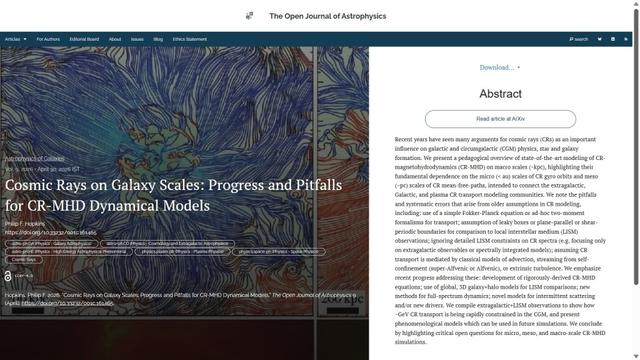
The fifth article of this week was also published on Thursday 30th April, but in the folder Astrophysics of Galaxies. The title is “Cosmic Rays on Galaxy Scales: Progress and Pitfalls for CR-MHD Dynamical Models” and the author is Philip F. Hopkins (Caltech, USA) who has three papers featured this week. The paper presents an overview of cosmic ray (CR) modeling, highlighting its influence on galactic physics and star formation. It addresses previous modeling errors and presents new methods for full-spectrum dynamics.

The overlay is here:

You can find the authorized version of this paper on arXiv here and the Fediverse announcement is here:

https://fediscience.org/@OJ_Astro/116492282488422075

The sixth paper of the week is “Baryonification III: An accurate analytical model for the dispersion measure probability density function of fast radio bursts” by MohammadReza Torkamani (Universität Bonn, Germany) and 8 others based in Germany, Switzerland, UK and Sweden. This article was also published on Thursday April 30th in the folder Cosmology and Nongalactic Astrophysics. It presents a framework for predicting dispersion measures of fast radio bursts using the baryonification model, providing a cost-effective alternative to hydrodynamical simulations. The model’s accuracy is validated through full numerical simulations. The overlay is here:

You can find the officially-accepted version on arXiv here and the Mastodon announcement here:

https://fediscience.org/@OJ_Astro/116492403170125062

Seventh and finally for this week we have “The stellar and dark matter distributions in early-type galaxies measured by stacked weak gravitational lensing” by Momoka Fujikawa and Masamune Oguri (Chiba University, Japan). This study uses weak gravitational lensing to investigate stellar mass and dark matter density in red galaxies, suggesting a stronger feedback effect than current simulations predict. This was published on Friday 1st May 2026 in the folder Astrophysics of Galaxies. The overlay is here:

You can find the officially-accepted version on arXiv here and the Fediverse announcement is here:

https://fediscience.org/@OJ_Astro/116497987401632687

And that concludes this week’s update. I’ll do another one at the end of next week. Will Vol. 9 have reached a hundred by then?

P.S. Just a reminder that, thanks to the efforts of a member of our Editorial Board, the Open Journal of Astrophysics now has a Wikipedia page.

#32PtAnalysis #ActiveGalacticNuclei #AGN #arXiv250907104v2 #arXiv251009756v2 #arXiv251209342v2 #arXiv251215960v3 #arXiv260106253v2 #arXiv260118784v2 #arXiv260424965v1 #AstrophysicsOfGalaxies #baryonification #ComputationalAstrophysics #cosmicRays #CosmologyAndNonGalacticAstrophysics #DarkEnergySpectroscopicInstrument #DESI #DiamondOpenAccess #DiamondOpenAccessPublishing #DispersionMeasures #fastRadioBursts #galacticCosmicRays #galaxyEvolution #galaxyFormation #galaxyMergers #HighEnergyAstrophysicalPhenomena #InstrumentationAndMethodsForAstrophysics #magnetohydrodynamics #masers #MilkyWay #OpenAccess #OpenAccessPublishing #SolarAndStellarAstrophysics #SolarCorona #supermassiveBlackHoles #VeraCRubinObservatory #weakGravitationalLensing #wikipedia

Weekly Update from the Open Journal of Astrophysics – 25/04/2026

So here we are again, on a Saturday morning, with another update of activity at the Open Journal of Astrophysics. Since the last update we have published a further five papers, bringing the number in Volume 9 (2026) to 87 and the total so far published by OJAp up to 535.

I will continue to include the posts made on our Mastodon account (on Fediscience) to encourage you to visit it. Mastodon is a really excellent service, and a more than adequate replacement for X/Twitter (which nobody should be using); these announcements also show the DOI for each paper.

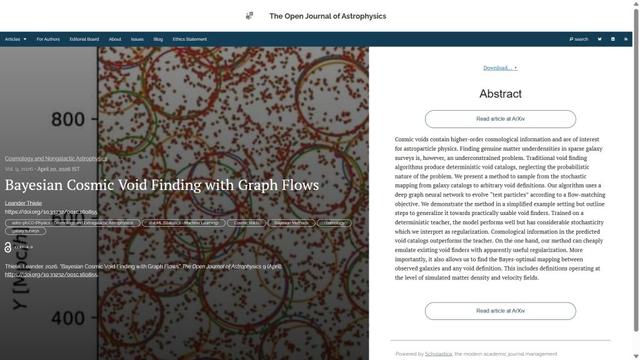
The first paper to report this week is “Bayesian Cosmic Void Finding with Graph Flows” by Leander Thiele (U. Tokyo, Japan). This was published on Monday 20th April in the folder Cosmology and Nongalactic Astrophysics. The paper presents a method using a deep graph neural network to identify cosmic voids in sparse galaxy surveys, improving upon traditional deterministic algorithms by considering the problem’s probabilistic nature. The overlay is here:

You can find the officially accepted version on arXiv here and the announcement on Fediverse here:

https://fediscience.org/@OJ_Astro/116435864086025246

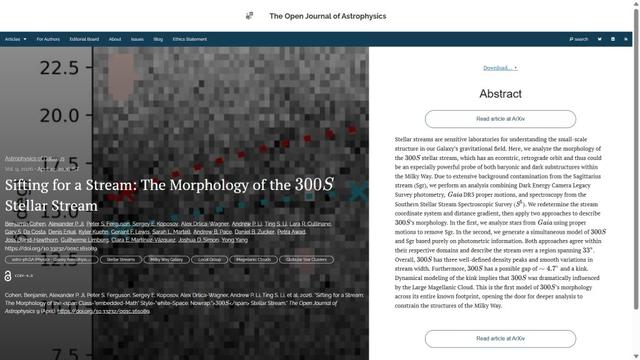
The second paper for this week, published on Wednesday 22nd April in the folder Astrophysics of Galaxies, is “Sifting for a Stream: The Morphology of the 300S Stellar Stream” by Benjamin Cohen (U. Chicago, USA) and 20 others distributed around the world. This study analyzes the morphology of the $300S$ stellar stream, revealing three density peaks, a possible gap, and a kink, suggesting significant influence from the Large Magellanic Cloud on its structure.

The overlay for this one is here:

The official version of the paper can be found on arXiv here and the Fediverse announcement here:

https://fediscience.org/@OJ_Astro/116447005556180402

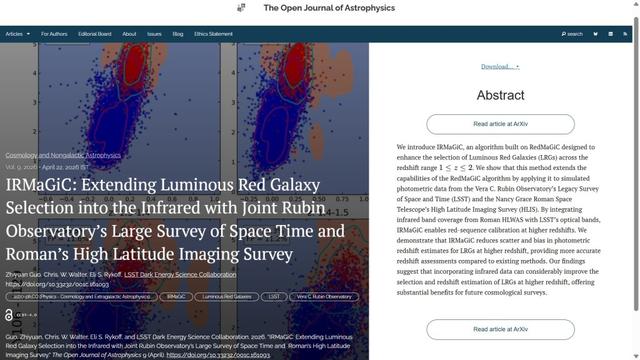
Next one up, the third paper of the week, is “IRMaGiC: Extending Luminous Red Galaxy Selection into the Infrared with Joint Rubin Observatory’s Large Survey of Space Time and Roman’s High Latitude Imaging Survey” by Zhiyuan Guo & Chris. W. Walter (Duke U., USA) and Eli S. Rykoff (Stanford U., USA) on behalf of the LSST Dark Energy Science Collaboration. This was published on Wednesday April 22nd in the folder Cosmology and Nongalactic Astrophysics. The paper introduces IRMaGiC, an algorithm that improves the selection and redshift estimation of Luminous Red Galaxies (LRGs) by incorporating infrared data, enhancing future cosmological surveys.

The overlay for this one is here:

The final, accepted version can be found on arXiv here and the Mastodon announcement is here:

https://fediscience.org/@OJ_Astro/116447067337351283

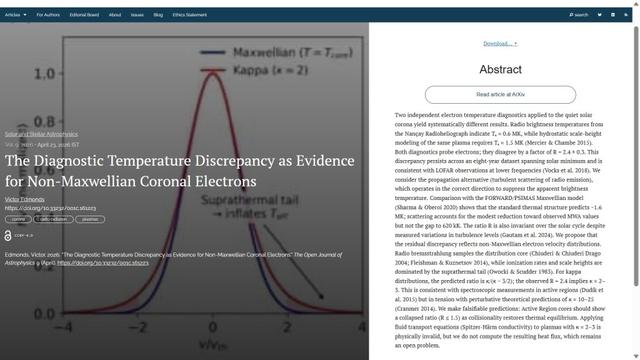
The fourth paper this week, published on Thursday April 23rd, is “The Diagnostic Temperature Discrepancy as Evidence for Non-Maxwellian Coronal Electrons” by Victor Edmonds (Final Stop Consulting, USA). This paper, in the folder Solar and Stellar Astrophysics, presents two methods of measuring electron temperature in the quiet solar corona yielding different results, suggesting non-Maxwellian electron velocity distributions may be responsible for the discrepancy.

The overlay is here:

The finally accepted version of this paper can be found here and the Mastodon announcement follows:

https://fediscience.org/@OJ_Astro/116452775389963618

The fifth and final paper for this week was published on Friday 24th April in the folder Astrophysics of Galaxies. The title is “Galaxy evolution in the post-merger regime. IV – The long-term effect of mergers on galactic stellar mass growth and distribution” by Sara L. Ellison (U. Victoria, Canada) and Leonardo Ferreira (Universidade Federal do Rio Grande, Brazil). This study uses a large sample of post-merger galaxies to demonstrate that galaxy mergers trigger significant and extended stellar mass growth in their central regions, independent of stellar population modelling.

The overlay is here:

You can find the authorized version of this paper on arXiv here and the Fediverse announcement is here:

https://fediscience.org/@OJ_Astro/116458316824739014

The overlay for this one is here:

You can find the officially-accepted version on arXiv here and the Mastodon announcement here:

https://fediscience.org/@OJ_Astro/116458316824739014

And that concludes this week’s update. I’ll do another one at the end of next week.

P.S. Thanks to the efforts of a member of our Editorial Board, the Open Journal of Astrophysics now has a Wikipedia page.

#300SStellarStream #arXiv250621410v2 #arXiv251121512v2 #arXiv260114554v2 #arXiv260214630v2 #arXiv260310040v3 #AstrophysicsOfGalaxies #BayesianMethods #CosmicVoids #CosmologyAndNonGalacticAstrophysics #DiamondOpenAccess #DiamondOpenAccessPublishing #EarthAndPlanetaryAstrophysics #GAIA #galaxyEvolution #galaxyFormation #galaxyMergers #InstrumentationAndMethodsForAstrophysics #IntergalacticMedium #IRMaGiC #LargeMagellanicCloud #LSST #LSSTDarkEnergyScienceCollaboration #MilkyWay #OpenAccess #OpenAccessPublishing #SolarAndStellarAstrophysics #SolarCorona #VeraCRubinObservatory #wikipedia
Why do some galaxies suddenly stop forming stars? Explore the cosmic mystery behind star formation shutdowns, uncovering clues about dark matter, gas depletion, and galactic evolution.
#CosmicMystery #GalaxyEvolution #StarFormation #UniverseSecrets
https://www.scientificworldinfo.com/2026/04/why-do-some-galaxies-stop-forming-stars-suddenly.html
Why Do Some Galaxies Stop Forming Stars Suddenly? Cosmic Mystery Unlocked

Galaxies can suddenly stop forming stars when their gas supply is disrupted or exhausted. Powerful black hole eruptions, supernova winds, or...

Blogger

COSMIC FOSSILS: NEW 'SPACE ARCHAEOLOGY' UNRAVELS GALAXY'S LONG STORY

Learn how scientists use 'extragalactic archaeology' to study the chemical makeup of gas in galaxy NGC 1365 to understand its 12-billion-year growth history.

#SpaceArchaeology, #GalaxyEvolution, #NGC1365, #Astronomy, #Extragalactic

https://newsletter.tf/space-archaeology-ngc-1365-galaxy-growth-story/

Scientists can now study galaxy history using chemical 'fingerprints' in gas. This is like finding ancient clues in space to see how galaxies like NGC 1365 grew over billions of years.

#SpaceArchaeology, #GalaxyEvolution, #NGC1365, #Astronomy, #Extragalactic
https://newsletter.tf/space-archaeology-ngc-1365-galaxy-growth-story/

New Space Archaeology Method Shows How NGC 1365 Galaxy Grew Over 12 Billion Years

Learn how scientists use 'extragalactic archaeology' to study the chemical makeup of gas in galaxy NGC 1365 to understand its 12-billion-year growth history.

NewsletterTF
La “green valley” galactique, ce stade où les galaxies ralentissent leurs étoiles, est confrontée aux simulations IllustrisTNG et EAGLE pour comprendre l’arrêt des naissances stellaires. https://arxiv.org/abs/2512.22268 #Space #Science #Innovation #Astrophysics #GalaxyEvolution #AGNFeedback #Cosmo2025
Quenching pathways in the green valley at low redshift: confronting SDSS AGN hosts with IllustrisTNG and EAGLE

We compare low-redshift ($z<0.1$) BPT-selected pure optical AGN hosts in SDSS DR7 to colour-selected "green-valley" analogue central galaxies in IllustrisTNG100 and EAGLE Ref-L0100N1504. To reduce cross-dataset systematics, we define the green valley internally using $(g-r)$ percentiles: for galaxies with $\log_{10}(M_\star/M_\odot)>10$, we select the 75th-95th percentiles (SDSS observed-frame fibre colours; simulations rest-frame synthetic colours within 30 kpc). SDSS hosts are linked to the MPA-JHU catalogue for stellar masses and aperture-corrected total SFRs. TNG green-valley centrals are almost entirely quenched, with a sharp pile-up at the imposed SFR floor and median $\log_{10}\mathrm{sSFR}\simeq-14.85$ ($\sim$3.5 dex below SDSS). EAGLE instead produces a broad, continuous distribution with median $\log_{10}\mathrm{sSFR}\simeq-11.71$ and substantial overlap with SDSS, robust to varying the lower percentile between 60 and 90. At fixed mass, TNG yields higher green-valley occupancy fractions (reaching $\gtrsim60$ per cent near $M_\star\sim10^{11}M_\odot$) than EAGLE (20-40 per cent). A simple forward model of nebular line ratios places EAGLE analogues across the star-forming and composite loci in the BPT plane, while TNG analogues concentrate in a LINER-like, low-sSFR regime. We infer that TNG's kinetic mode drives an efficient, near-binary shutdown of star formation, whereas EAGLE's stochastic thermal feedback supports a slower decline more consistent with local AGN hosts. All catalogues and analysis scripts are publicly released.

arXiv.org

A group led by Fujimoto-san et al have uncovered a primordial galaxy, just 930 million years after the Big Bang (z=6.072). The galaxy is composed of at least 15 dense, star-forming clumps embedded within a rotating disk like a "Cosmic Grape". These clumps, with sizes ranging from 10 to 60 parsecs, dominate 70% of the galaxy's UV light, and are reshaping our understanding of early galactic structure formation. More than 100 hours of joint ALMA and JWST observations were made, amplified by gravitational lensing, making this one of the most studies early galaxies.

More information on https://www.almaobservatory.org/en/press-releases/alma-and-james-webb-space-telescope-shed-light-on-cosmic-grapes/

#ALMA #AtacamaLargeMillimeterArray #AtacamaLargeMillimeterSubmillimeterArray #JWST #GalaxyEvolution #OriginOfGalaxies #EarlyUniverse #PrimordialGalaxies #GrapeLikeGalaxies

ALMA and James Webb Space Telescope Shed Light on "Cosmic Grapes" | ALMA Observatory

ALMA and JWST observations unveil unexpected details of rapid growth in a faint, newborn

The James Webb Space Telescope has captured a mysterious, never-before-seen formation nicknamed the Infinity Galaxy. This unique structure may provide clues about galaxy evolution in the early universe. Scientists are now studying its composition, structure, and impact on cosmological theories.

#spacediscovery #astronomy #jameswebbspacetelescope #infinitygalaxy #galaxyevolution

Indian-origin scientist Dr. Ragadeepika Pucha at the University of Utah, has made a groundbreaking discovery in the study of black holes. Using data from the Dark KNOW MORE...https://blogzine2025.blogspot.com/2025/03/laser-focused-la-salle-green-spikers.html?m=1
#BlackHole #SpaceScience BlackHoleDiscovery #Astrophysics
#GalaxyEvolution #Galaxy #DwarfGalaxies #TEDTalks #TEDxGateway #IndianScientist
Laser Focused La Salle: Green Spikers Secure Back-to-Back Wins Against UE Red Warriors

 Laser Focused La Salle: Green Spikers Secure Back-to-Back Wins Against UE Red Warriors In a display of sheer determination and skill, the D...

Blogger