 Jesper Agdakx 🔸
goodreads.com/book/show/125125680-grading-for-growth
This book opens with an excellent argument for why traditional grading systems used at most universities suck, and then spends the rest of its pages explaining the what and why and how of alternative grading methods, specifically standards-based grading and specification grading. The whole picture is centered around the "four pillars of alternative grading", which are (1) clearly defined standards, (2) helpful feedback, (3) marks indicate progress towards meeting a standard, and (4) reassessment without penalty (but not without limitations).
You probably won't get much out of this book if you don't teach in higher education, but if you do (and you're using traditional grading) then there is a lot here to learn. I really appreciated how it uses lots (and I mean *lots*) of real-world examples of many different courses that use alternative grading across a variety of disciplines and contexts. I particularly appreciated the chapter on large courses, though I kind of disagree that 100 students really counts as large (I teach a course for 250 students and it's one of the smaller courses in the program). The authors are not afraid of really going into the nitty-gritty details of how to apply these ideas, which is best exemplified by the very concrete workbook for alternative grading in chapter 12. While it can easily be skipped if you're just interested in the general ideas, I do like its inclusion for those who need that extra push to bring it into practice. The frequent reminders to keep things as simple as possible and not strive for perfection were also very welcome.
Despite my love for the ideas in this book and all the inspirational examples in it, it does have a few flaws:
1. It is primarily focused on two rather similar grading techniques (standards-based and specification grading) but onlu touches on ungrading in a few places and leaves out others like mastery grading completely.
2. Despite the inclusion of examples from all over the world, most of the book is still very US-centric, which is especially visible in its focus on using letter grades, but also other things like the assumption that universities use semesters rather than trimesters or quarters or the idea that you can change a class syllabus while it is already running (here it is viewed as close to a legal contract that should be fixed well before the start of the academic year).
3. As I mentioned before, despite the chapter on teaching large classes I feel like a lot of the practical detailed advice in the book does not really apply to this setting (or at least it is not obvious to me how to apply it). Just as an example, with 250 students it is simply impossible to give everyone a chance to do a reassessment during office hours.
4. The book completely fails to discuss the use of LLMs by students which is somewhat understandable since it was published in 2023, but has quickly become perhaps the biggest challenge for any approach to grading. Hopefully a new edition or follow-up book could address this challenge.
Despite these shortcomings, I consider this book (and especially the first four chapters) essential reading if you're doing any kind of teaching in higher education.
#HigherEducation #AlternativeGrading #BookReview
This book opens with an excellent argument for why traditional grading systems used at most universities suck, and then spends the rest of its pages explaining the what and why and how of alternative grading methods, specifically standards-based grading and specification grading. The whole picture is centered around the "four pillars of alternative grading", which are (1) clearly defined standards, (2) helpful feedback, (3) marks indicate progress towards meeting a standard, and (4) reassessment without penalty (but not without limitations).
You probably won't get much out of this book if you don't teach in higher education, but if you do (and you're using traditional grading) then there is a lot here to learn. I really appreciated how it uses lots (and I mean *lots*) of real-world examples of many different courses that use alternative grading across a variety of disciplines and contexts. I particularly appreciated the chapter on large courses, though I kind of disagree that 100 students really counts as large (I teach a course for 250 students and it's one of the smaller courses in the program). The authors are not afraid of really going into the nitty-gritty details of how to apply these ideas, which is best exemplified by the very concrete workbook for alternative grading in chapter 12. While it can easily be skipped if you're just interested in the general ideas, I do like its inclusion for those who need that extra push to bring it into practice. The frequent reminders to keep things as simple as possible and not strive for perfection were also very welcome.
Despite my love for the ideas in this book and all the inspirational examples in it, it does have a few flaws:
1. It is primarily focused on two rather similar grading techniques (standards-based and specification grading) but onlu touches on ungrading in a few places and leaves out others like mastery grading completely.
2. Despite the inclusion of examples from all over the world, most of the book is still very US-centric, which is especially visible in its focus on using letter grades, but also other things like the assumption that universities use semesters rather than trimesters or quarters or the idea that you can change a class syllabus while it is already running (here it is viewed as close to a legal contract that should be fixed well before the start of the academic year).
3. As I mentioned before, despite the chapter on teaching large classes I feel like a lot of the practical detailed advice in the book does not really apply to this setting (or at least it is not obvious to me how to apply it). Just as an example, with 250 students it is simply impossible to give everyone a chance to do a reassessment during office hours.
4. The book completely fails to discuss the use of LLMs by students which is somewhat understandable since it was published in 2023, but has quickly become perhaps the biggest challenge for any approach to grading. Hopefully a new edition or follow-up book could address this challenge.
Despite these shortcomings, I consider this book (and especially the first four chapters) essential reading if you're doing any kind of teaching in higher education.
#HigherEducation #AlternativeGrading #BookReview

 Brian
Brian 



 Joshua Grochow
 John A Ireland
 Robert Talbert
 Tai
Tai Joshua Bowman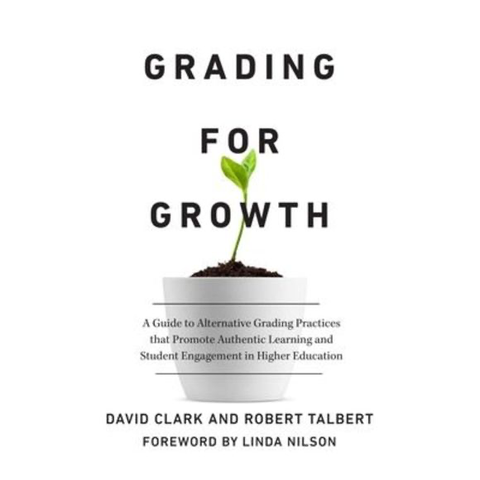


 Steven Clontz