Indian Head Research farm closing due to federal cutbacks | The-14

Federal cutbacks will close the historic Indian Head Research Farm, ending 138 years of agricultural research and threatening jobs and rural livelihoods. Canada

The-14 Pictures
#FoSSNet Conference, Lund, 9-11 June 2026. Submit an abstract to our session in Stream2: Do we have all the necessary elements for transformation by innovation? https://fossnet.eu/conference/lundconference2026/ #AKIS #agresearch #agriculture_research #agrifood #transformation @scifoodhealth.bsky.social
FoSSNet Lund 2026 - Second European Food Systems Science Conference - FoSSNet

The second FoSSNet Conference will take place from 9 to 11 June 2026, in Lund. Click below to know how you can participate.

FoSSNet

And finally the Prime Minister’s Science award.
And it goes to Dr Linda Johnson for AgResearch - so bloody exciting for us, as we stare down the barrel of our CRI merger!

She has done a tweak of epichloe fungus living symbiotically in ryegrass, keeping its pest-repelling qualities whilst also enhancing sheep health.

And she’s SO positive about the work of scientists.

#agresearch

#Landscape2024 conference, organized by @ZALF_leibniz, is happening 17-19 September in Berlin.

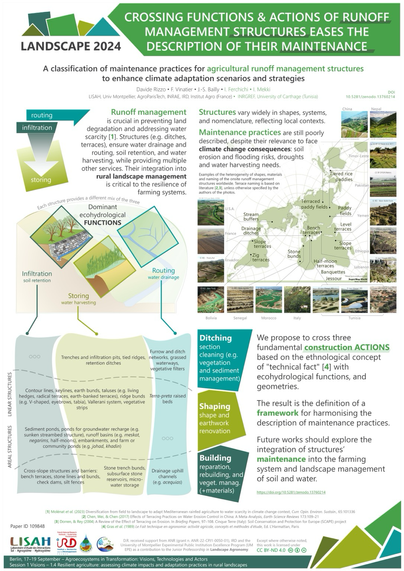
I'm presenting #LISAH (France) and #INRGREF (Tunisia) collaborative research on integrating maintenance of runoff management structures into farming system research and #LandscapeAgronomy

Our work aims to advance climate-adaptive agriculture.

Poster available here: https://zenodo.org/records/13760214

#AgResearch #ClimateAdaptation

A classification of maintenance practices for agricultural runoff management structures to enhance climate adaptation scenarios and strategies

Runoff management is crucial in preventing land degradation and addressing water scarcity. In particular, agricultural runoff management structures, such as ditches and terraces, ensure water drainage and routing, soil retention, and water harvesting, while providing multiple other services. Therefore, their integration into rural landscape management is critical to the resilience of agricultural systems. The abundant knowledge about structure design and abandonment consequences recognises maintenance's relevance, although these practices are still poorly described. Moreover, climate change further exacerbates the challenges. On the one hand, erratic weather patterns amplify soil erosion and flooding risks; on the other hand, droughts intensify structure fragility while increasing water harvesting needs. Indeed, the available literature is limited to maintenance barriers, such as farmers' restrained access to finance, infrastructure, and technical expertise, especially in top-down projects that overlook local and traditional knowledge. Altogether, climate adaptation scenarios often neglect the inclusion of maintenance practices and strategies due to the scarce available knowledge. This presentation proposes a classification framework integrating runoff management structures and their maintenance into farming practice systems and landscape management. Structures vary widely in shapes, systems, and nomenclature, reflecting local contexts. Adopting the ethnological concept of "technical fact", we grouped structures based on construction actions: ditching, shaping, and building. This facilitates the agronomic identification of the key practices for their in-field maintenance: (a) section cleaning (e.g. vegetation and sediment control), (b) shape renovation, and (c) structure repair. The framework also accounts for the structure's hydrological and ecological connectivity, thus integrating off-site effects and management. Considering the ecological, social, and technological interdependencies at the landscape level enables the multi-level assessment of the consequences of rainfall partitioning between runoff and infiltration and the related implications for landscape resilience to climate change.

Zenodo