How to make powerful LLMs understand graphs and their structure?🕸️ With Graph Language Models!
They take a pre-trained LLM and fit it with the ability to process graphs. Watch if you're curious!👇
📺 https://youtu.be/JcHeaONGbmQ
(Hint: it's about position embeddings, as the author explained at #ACL2024 🔴)
Are LLMs any good at self-referential statements such as “This sentence has 5 words”?
We recorded the #ACL2024 poster presentation of the paper „I am a Strange Dataset: Metalinguistic Tests for Language Models” by Tristan Thrush, Jared Moore, Miguel Monares, Christopher Potts, Douwe Kiela.
Here’s what it’s all about! 👇
📺 https://youtu.be/m_nEIsQBh_c
At the ACL, we recorded the poster presentation of the paper challenging Noam Chomsky's claim about LLMs! 🫢
📺 https://youtu.be/8lU6dGqR26s
This paper, entitled “Mission: Impossible language models”, won an #ACL2024 best paper award.
Congrats to @JulieKallini @isabelpapad @rljfutrell @kmahowald @ChrisGPotts ! 👏
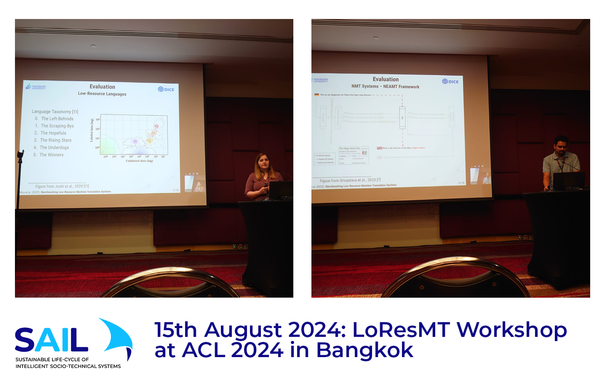
Greetings to Bangkok🇹🇭, where our SAIL members Ana Silva and Nikit Srivastava presented “Benchmarking Low-Resource Machine Translation Systems” at the #LoResMT workshop at @aclmeeting today.👏🤩 Would you like to take a look at the paper?👀⬇️
📚🔎"Benchmarking Low-Resource Machine Translation Systems" by Ana Silva, Nikit Srivastava, Tatiana Moteu Ngoli, Michael Röder, Diego Moussallem and Axel Ngonga can be found here: https://aclanthology.org/2024.loresmt-1.18/
Ana Silva, Nikit Srivastava, Tatiana Moteu Ngoli, Michael Röder, Diego Moussallem, Axel-Cyrille Ngonga Ngomo. Proceedings of the The Seventh Workshop on Technologies for Machine Translation of Low-Resource Languages (LoResMT 2024). 2024.
I’m in Bangkok for #ACL2024 and will talk about Legal NLP:
On Monday I present our corpus and paper AGB-DE (https://arxiv.org/abs/2406.06809) at the third poster session.
On Thursday I will talk about teaching NLP in Law School as part of the Workshop on Teaching NLP.
If you’re at ACL and interested in Legal NLP (or NLP 4 Social Good, Teaching NLP, Disagreement and Perspectivism, other cool applications or just want to have a chat) stop by!
Legal tasks and datasets are often used as benchmarks for the capabilities of language models. However, openly available annotated datasets are rare. In this paper, we introduce AGB-DE, a corpus of 3,764 clauses from German consumer contracts that have been annotated and legally assessed by legal experts. Together with the data, we present a first baseline for the task of detecting potentially void clauses, comparing the performance of an SVM baseline with three fine-tuned open language models and the performance of GPT-3.5. Our results show the challenging nature of the task, with no approach exceeding an F1-score of 0.54. While the fine-tuned models often performed better with regard to precision, GPT-3.5 outperformed the other approaches with regard to recall. An analysis of the errors indicates that one of the main challenges could be the correct interpretation of complex clauses, rather than the decision boundaries of what is permissible and what is not.
Do you want to know how incremental models process local ambiguities?
In our #ACL2024 paper, we show dynamics of representation updates in restart incremental processing and how information for ambiguity resolution is encoded in the update.
Paper: https://arxiv.org/abs/2402.13113
Check out our work in poster session 4 - Tuesday at 10:30-12:00. Looking forward to see you there! 🇹🇭
Incremental models that process sentences one token at a time will sometimes encounter points where more than one interpretation is possible. Causal models are forced to output one interpretation and continue, whereas models that can revise may edit their previous output as the ambiguity is resolved. In this work, we look at how restart-incremental Transformers build and update internal states, in an effort to shed light on what processes cause revisions not viable in autoregressive models. We propose an interpretable way to analyse the incremental states, showing that their sequential structure encodes information on the garden path effect and its resolution. Our method brings insights on various bidirectional encoders for contextualised meaning representation and dependency parsing, contributing to show their advantage over causal models when it comes to revisions.