Why publish your research data in a proper repository like Zenodo, not a on a fancy institutional website?

I was looking to access the UN Peace Missions Mandate dataset for some analysis. When I checked https://www.peacemissions.info it was gone. Timed out.

I have no idea if it's temporarily down or down forever or what has happened.

It's not accessible elsewhere as far as I can tell, so the analysis is not happening.

#Data #Zenodo #ReproducibleResearch

Now on #Zenodo Gold War: The Petrodollar Order, a Gold-Anchored Bloc, and the “Death of the Yen” Narrative.

🔗https://doi.org/10.5281/zenodo.19252827
#Gold #Petrodollar #Yen

Gold War: The Petrodollar Order, a Gold-Anchored Bloc, and the "Death of the Yen" Narrative

This paper introduces a conceptual framework for understanding current tensions in the internationalmonetary system as a “Gold War”: a structural conflict between a dollar-centred petrodollar order andan emerging gold-anchored bloc. Within this framework, it revisits the popular “death of the yen”narrative and argues that it is, at best, incomplete and, at worst, misleading.Using gold as a cross-currency yardstick, the paper organises a set of stylised facts about the postBretton Woods period. All major fiat currencies, including the dollar and the yen, have been losingpurchasing power against gold over the long run, but not at the same pace. Measured in gold ratherthan in dollars, oil has become cheaper over time, especially over the past two decades. Thiscompresses the gold value of oil exports for traditional petrodollar producers, while favouring actorsthat accumulate gold and secure energy at low gold-equivalent prices. At the same time, Japan’spublic-sector balance sheet combines record gross public debt with large public assets, extensivecentral-bank holdings of government bonds, a strong net international investment position, and a verylarge stock of external assets.Against this background, the paper revisits the “cage” developed in earlier work on Japanese goldprices and electricity tariffs: a configuration in which the yen is squeezed between externalbenchmarks (gold, oil) and internal survival costs (energy, food). It argues that the key systemic risk isnot that the yen is uniquely doomed as a “dying currency”, but that the cumulative pressures ofenergy, food, and demographics could eventually force Japan to liquidate foreign assets, includingU.S. Treasuries, to secure essential imports. Such a forced retreat would not be a local event; it woulddirectly destabilise the petrodollar regime by removing one of its most important long-term creditors.The aim of this paper is primarily conceptual. It organises a set of stylised facts about gold, oil, majorcurrencies, and national balance sheets into a coherent “Gold War” framework, rather than attemptinga full econometric treatment. More detailed empirical testing is left for future work. 

Zenodo

Now on #Zenodo: A Three-Axis Model of Media Evaluation in International Conflict — competing standards of “peace”.
Case note: the U.S. strike on Iran (March 2026).

🔗https://doi.org/10.5281/zenodo.19233609
#Peace #InternationalRelations

A Three-Axis Model of Media Evaluation in International Conflict: Procedure, Outcome, and Order as Competing Standards of "Peace" (Case Note: U.S. Strike on Iran, March 2026)

This paper proposes a three-axis model for analysing how major media evaluate internationalconflict: Procedure, Outcome, and Order. The model explains why coverage often privilegesprocedural legitimacy and short-term friction while under-reporting long-horizon stabilisationeffects when force is used to “fix” a new order. Two historical patterns are used to ground themodel—(i) order-formation by decisive force (Qin unification) and (ii) negotiated peacebecoming feasible after force clarifies constraints (Richard I and Saladin). A case note on theU.S. strike on Iran (March 2026) illustrates how alliance behaviour and deterrence signals areinterpreted differently under the three axes. The paper closes by defining “peace” not asprocedural quietness but as the sustainable fixation of order, and asks what standards shouldgovern that definition. 

Zenodo

*2 new EOSC FIDELIS/EDEN related #Zenodo #digipres contributions*

"Transparent, Referenceable, Integrated, Preservation Planning - TRIPP"
Brief Working Paper by L'Hours et al, which builds on source terminology created/referenced by FIDELIS & EDEN for a organisational preservation planning implementation https://doi.org/10.5281/zenodo.19052099

"FIDELIS TTRAM-Crosswalk from Core Preservation Processes to Activities and Functions."
Mapping between FIDELIS TTRAM and EDEN CPPs
https://doi.org/10.5281/zenodo.19051622

Transparent, Referenceable, Integrated, Preservation Planning - TRIPP

This brief working paper proposes that any organisational entity that looks after data and/or metadata should take an approach that integrates retention, curation and preservation planning, and shares a transparent and referenceable (i.e. structured, persistently identified, resolvable) set of supporting information.  The text uses source terminology created or referenced by the FIDELIS Project (incluidng high level activities and functions) and the EDEN Project (including detailed core preservation processes). 

Zenodo

*2 new #RDAVP26 related additions to the #zenodo #digipres community*

"Certification Pathways: From Self-Assessment to Recertification" - Slidedeck from #RDAVP26 Certification IG session including brief preservations from Astromat, CSC and Immport on their certification experiences
https://doi.org/10.5281/zenodo.19208517

"Unlock TDRs via the TRUST Principles" Slidedeck from #RDAVP26 TRUST WG session, including brief use case presentations from CARE, EOSC EDEN and DRI
https://doi.org/10.5281/zenodo.19208691

Certification Pathways: From Self-Assessment to Recertification

The RDA/WDS Certification of Digital Repositories Interest Group offers a look at the entire lifecycle of repository certification to help repositories see and learn from others who have been through this process. Words of wisdom from a whole host of repositories will be shared, including: Newly certified repositories Repositories that were unable to be certified Repositories that were recently recertified Institutions that purposely chose not to recertify  Repositories that only perform self-assessments Their presentation at RDA VP26 consisted of: Overview of IG  Presentation from: Newly certified repositories  Kerstin Lehnert, Astromat  Repositories that were unable to be certified Johan Kylander, CSC – IT Center for Science Ltd.  Repositories that were recently recertified Dawei Lin, Immport Discussion Institutions that purposely chose not to recertify Repositories that only perform self-assessments 

Zenodo

Aufzeichnung zum Zoom-Meeting im Februar: webtrees – Neue Funktionen

Neue Funktionen im Genealogieprogramm webtrees waren das Thema beim Zoom-Meeting des Vereins für Computergenealogie (CompGen) im Februar. Am 19. Februar 2026 referierten Bernd Schwendinger, Hermann Hartenthaler, Markus Hemprich und Peter Schulz über verschiedene Erweiterungsmodule für webtrees. Jetzt ist das Video online und die Aufzeichnung kann in den CompGen-Forschungstipps noch einmal angeschaut werden. YouTube stellt auch eine Transkription zur Verfügung, so dass man im Inhalt suchen […]

https://www.compgen.de/2026/03/aufzeichnung-zum-zoom-meeting-im-februar-webtrees-neue-funktionen/

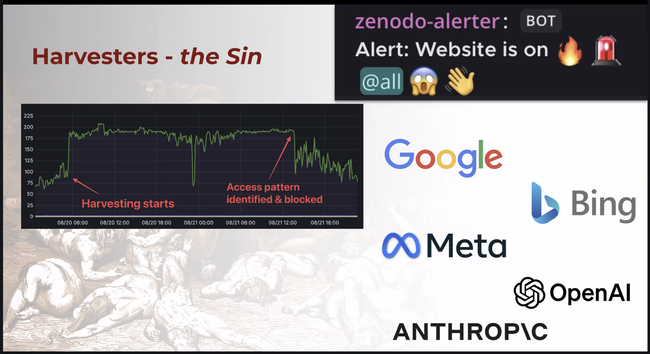
In a similar vein, I get a 403 forbidden error trying to access #Zenodo, which explicitly states that

>Access to this resource has been blocked due to unusual traffic from your network.

Fuck you, AI scrapers!!!!

EDIT: it appears that #Zenodo isn't actually blocking IPs! Instead they block particular agent strings. Moving from a privacy-minded browser such as #LibreOffice to Safari, I can access Zenodo. This also warants an expletive in my book!

Source: https://hci.social/@RaphaelWimmer/116221299444374085

Raphael Wimmer (@[email protected])

Attached: 1 image PSA: If Zenodo.org currently blocks you "due to unusual traffic from your network", it's not actually the network that it at fault. Instead, it seems that they check whether the Chrome version in the user agent string is >143. If not, you get this error message. Solution: upgrade browser. #zenodo

🌱 hci.social

PSA: If Zenodo.org currently blocks you "due to unusual traffic from your network", it's not actually the network that it at fault.

Instead, it seems that they check whether the Chrome version in the user agent string is >143. If not, you get this error message.

Solution: upgrade browser.

#zenodo

I created the first release of the Digital Literacy #crowdsourced book, with the first two parts complete. #GitHub releases will also be archived on #Zenodo and assigned a DOI. Please feel free to comment or contribute.

#OpenSource #freebooks #books #digitalliteracy #free

https://openhandbook.org/books/ohc-001-digital-literacy/

Digital Literacy – Open Handbook Commons

A Practical Guide to Using Technology Wisely

Open Handbook Commons
Over the past days I released the core papers of the #CRTI framework on #Zenodo. Together they outline a system grammar for detecting when complex adaptive systems move from resilience to singularization.🖖