RE: https://social.sciences.re/@TheMetaNews/116459109768327092

#PublierLaScience Très bon article pour faire le point sur l'indexation des revues dans le #WebOfScience et sur l' #impactfactor. Avec qq exemples de revues très prolixes (25 000 articles en 1 an!).. ou qui se citent elles-mêmes à 93%...

RE: https://fediscience.org/@petersuber/116449403699717242

Excellent move. #WebOfScience #WoS has monopolized the numeric evaluation of researchers and journals #JCR. Of course, their analyses help bureaucrats to evaluate our output, but the concept of using these numbers as the only reference is not always positive for diverse and original science. BTW: you can find article-level citations also in #CrossRef, there is #ORCID, and #Scimago #SJR. If you want to create your CV with ORCID/CrossRef cites (free): <https://codeberg.org/LabABI/ORCID-to-CV>

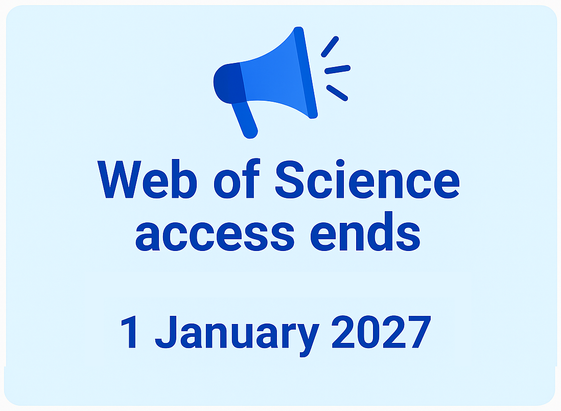
Update. "The University of Groningen (UG) and the University Medical Centre Groningen (UMCG) will cancel their licence for the #WebOfScience database with effect from 1 January 2027."

#Clarivate #Netherlands #WOS

📢 Please note: access to Web of Science for staff and students of the UMCG & University Groningen will end on 1 Jan 2027!

Reason: costs, overlap with other databases, and our commitment to open & transparent research.

🔗 https://www.rug.nl/library/news/20260420-end-web-of-science
#WebOfScience #OpenResearch #UMCG #UG #AcademicLibraries

I'm starting to hate academic databases and how they save bibliographic data.

#WebOfScience and #Scopus, sincerely, fuck you both.

And now #Clarivate #WebOfScience says:

"Roaming Access Expiration Notice
Your roaming access to the Web of Science has expired. You are in a free session of the Web of Science and the functionality may be limited. To gain full access to the Web of Science you will need to renew your roaming access by signing in to Web of Science at your institution."

They really like to snoop don't they?

#Clarivate wants me to review 7 publications added to my #WebOfScience profile, so tried to log in. Figured I'd login via my #OrcidID, but Clarivate want permissions to:

* Add/update your research activities (works, affiliations, etc.)
* Add/update information about you (country, keywords, etc.)
* Read your information with visibility set to Trusted parties

None of those are acceptable to me, denied. Signed in with Google - all they get that way is read access to my name, profile picture and email address.

The ‘Big Three’ of Scientific Information: A comparative bibliometric review of Web of Science, Scopus, and OpenAlex – InfoDoc MicroVeille

📢 Participez à l’enquête sur les usages du Web of Science à l’Université de Lorraine !

Dans le cadre d’une étude sur les alternatives ouvertes et gratuites comme OpenAlex, le service Bibliométrie de l’Université de Lorraine souhaite recueillir les retours de tout le personnel sur l’utilisation actuelle du Web of Science.

Cette initiative s’inscrit dans la continuité des engagements de l’Université de Lorraine en faveur de l’ouverture des informations de recherche, notamment via la Déclaration de Barcelone signée en novembre 2024. Elle fait écho aux récentes décisions de Sorbonne Université et du CNRS de se désabonner du Web of Science (dès janvier 2026 pour ce dernier).

Vos réponses permettront de proposer un accompagnement sur mesure.

🕒 Temps estimé : 3 minutes
⏳ Date limite : 13 février 2026
🔗 Je participe à l’enquête : https://enquetes.univ-lorraine.fr/index.php/567673?lang=fr
💡 Pour aller plus loin : Découvrez OpenAlex lors d’un atelier en ligne d’1h !
📅 Inscription : https://rdv.univ-lorraine.fr/ateliersbu/science-ouverte/

#Bibliométrie #OpenAlex #WebOfScience
Enquête sur les usages actuels du Web of Science

@vardi indexing and metadata is still in the hands of the big publishers (#scopus and #webofscience, for instance). We need to double down on open alternatives (such as #dblp). It would have been a positive surprise if #ACM would have led the way here, but obviously they decided to go in a different direction.