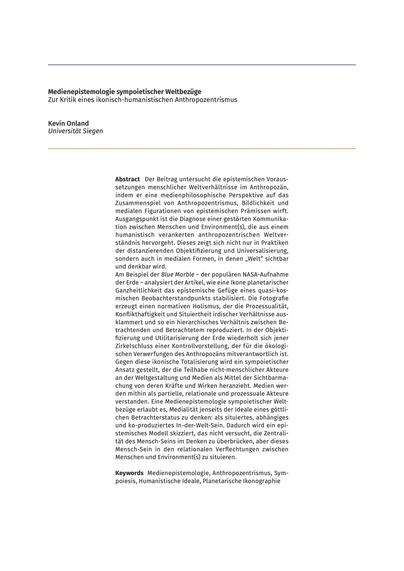
📄 Neue Ausgabe in unser Working Paper Series da: No. 40 beschäftigt sich mit dem Verhältnis zwischen Mensch und Umwelt im Anthropozän.
🎤 Kevin Onland: Medienepistemologie sympoietischer Weltbezüge: Zur Kritik eines ikonisch-humanistischen Anthropozentrismus
🔗 Open Access: https://dspace.ub.uni-siegen.de/handle/ubsi/9108
#SFB1187 #WorkingPaper #MedienderKooperation #OpenAccess #MediaStudies #Medienphilosophie #Anthropozän #BlueMarble
Mein neues
#WorkingPaper zum
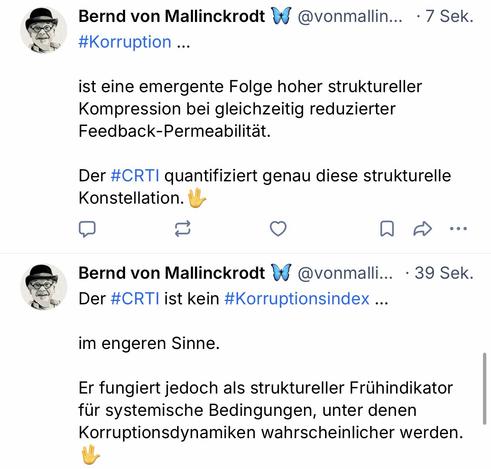
#CRTI …
formalisiert diesen Zusammenhang im
#CRTI-Framework als strukturellen Frühindikator für systemische Fragilität …
doi.org/10.5281/zeno... 🖖
📄 Neue Ausgabe in unser Working Paper Series da: No. 39 beschäftigt sich mit der Plattformisierung der Drohnenkriegsführung im Ukrainekrieg
🎤 Hendrik Bender und Max Kanderske: The Amazon of Drone Warfare
🔗 Open Access: https://lnkd.in/e9xCEYUT
#SFB1187 #WorkingPaper #MedienderKooperation #OpenAccess #Platforms #DroneWarfare #Ukraine #PlatformStudies #FPVDrone #Gamification
Organisationen scheitern selten an Chaos …
sondern an zu viel Ordnung …
Mein neues
#WorkingPaper modelliert „Singularisierung“ als nichtlinearen Attraktor unter Effizienzdruck und Volatilität. 🖖
A Nonlinear Systems-Theoretica...A Nonlinear Systems-Theoretical Model of Organizational Singularization under Volatility
This preprint introduces the Integrations-Resonance Model (IRM) as a nonlinear systems-theoretical framework for analyzing organizational singularization under conditions of volatility and efficiency pressure. Singularization is conceptualized not as chaos or inevitable decline, but as a restrictive attractor state emerging from the interaction of four structural variables: Strategic Reserve (R), Feedback Permeability (F), Efficiency/Exploitation (E), and an endogenous Self-Reference Index (N) representing escalation dynamics. The model formalizes these interactions through coupled nonlinear differential equations with stochastic perturbations. A central contribution is the identification of “False Efficiency”: as feedback permeability declines, perceived short-term capacity increases due to reduced friction, masking structural blindness. Singularization occurs when reserve and feedback permeability fall below critical thresholds over sustained time windows (Lock-in condition). IRM rejects teleological decline assumptions and instead describes probabilistic phase transitions between adaptive resonance, singularization, and volatility-induced collapse. The framework integrates second-order cybernetics, organizational systems theory, psychological escalation mechanisms, and computational system dynamics. The model is presented as a qualitative simulation framework intended for theoretical clarification and structural diagnosis. It does not claim deterministic prediction but provides a formal vocabulary for analyzing systemic fragility, hyper-stability, and metastable organizational states. systems theory nonlinear dynamics organizational resilience singularization attractor dynamics feedback permeability strategic reserve volatility computational social science second-order cybernetics
Im
#KI-Zeitalter skalieren Produktivität und Kapitalrenditen exponentiell, während unsere institutionellen Feedback-Mechanismen linear bleiben …
genau diese Asymmetrie erzeugt strukturelle Instabilität.
In meinem neuen
#WorkingPaper auf
#Zenodo →
doi.org/10.5281/zeno... 🖖
📄 New Working Paper veröffentlicht
🎤 Bina Elisabeth Mohn: "Prototyp 'Bundle Explorer: Berühren' Zur praxeologischen Konturierung semantischer Felder am Beispiel eines kamera-ethnographischen Forschungstools"
🔗 im Open Access: https://dspace.ub.uni-siegen.de/handle/ubsi/8743
#SFB1187 #WorkingPaper #MedienderKooperation #OpenAccess #Praxeologie #Wittgenstein, #KameraEthnographie #Digitalisierung
📄 New Working Paper published
🎤 Luciana Serrano: "Research with/in Communities Fissures and Practices for an Anthropology Otherwise“
🔗 https://dspace.ub.uni-siegen.de/handle/ubsi/7225
This paper pushes for a reframing of Anthropology as a collaborative and situated practice grounded in relationships rather than extraction.
#SFB1187 #WorkingPaper #MedienderKooperation #OpenAccess #Anthropology #Raja #Decolonization
Kennt Ihr bereits die letzten beiden Veröffentlichungen unserer 4Memory Working Paper Serie?
Nr. 8: "Blue Paper: Technische Spezifikationen für den NFDI4Memory Data Space"
🌐 Zum Paper: https://zenodo.org/records/16614629
Nr. 9: "Nachnutzung von Forschungsdaten in Studium und Lehre: Sammlung von Lehrszenarien in der geschichtswissenschaftlichen Lehre"
🌐 https://zenodo.org/records/16812354
#NFDI4Memory #WorkingPaper #DigitalHistory #DataSpace #DataLiteracy #FDM
@esciences @fiz_karlsruhe & @LandesarchivBW
Blue Paper: Technische Spezifikationen für den NFDI4Memory Data Space
In diesem Blue Paper werden das Konzept und das technische Grundgerüst des NFDI4Memory Data Space beschrieben. Der NFDI4Memory Data Space wird als digitales Ökosystem aus Datenquellen und Diensten die zentrale Infrastruktur des Konsortiums bilden und es Wissenschaftler:innen ermöglichen, über Fach- und Repositoriengrenzen hinweg Quellen und zugehörige Daten zu finden und mit ihnen sowohl auf herkömmliche Weise als auch mit Methoden der „Digital Humanities“ zu arbeiten. Technisch handelt es sich um ein Framework aus Application Programming Interfaces (APIs) und einem Knowledge Graph auf Basis der NFDI4Memory Ontology MemO. Der Fokus des Blue Papers liegt auf der technischen Spezifikation der verschiedenen APIs – etwa für Suche, Download und Konvertierung bzw. Transformation von Daten. Die Zielgruppe dieses Blue Papers sind Betreibende von Datenquellen und Key Services der NFDI4Memory-Community, welche sich an den NFDI4Memory Data Space anbinden und ihre Daten und Services dort auffindbar und (nach-)nutzbar machen möchten.
Wir haben ein neues
#WorkingPaper veröffentlicht:
Inderst, Rudolf T. & Daniel Meis (2025) Schlachtfeld Berlin. Orte der deutschen Demokratiegeschichte im digitalen Spielraum : Über die Konzeption einer ludonarrativen und diskursanalytischen Monografie zu ausgewählten Shooter-Titeln.
#Gamestudies Schlachtfeld Berlin. Orte der...Schlachtfeld Berlin. Orte der deutschen Demokratiegeschichte im digitalen Spielraum : Über die Konzeption einer ludonarrativen und diskursanalytischen Monografie zu ausgewählten Shooter-Titeln (Battlefield Berlin. Places of German Democratic History in the Digital Play Space : On the Conception of a Ludonarrative and Discourse-Analytical Monograph on Selected Shooter Titles) - Hochschule Neu-Ulm
Dive deeper into this groundbreaking framework and rethink how religion speaks. Metaphor Papers article:
🔗 https://omp.ub.rub.de/index.php/metaphorpapers/catalog/book/282
3/3
#metaphorpapers #workingpaper
Metaphors of Religion: A Conceptual Framework
| Metaphor Papers
 Media of Cooperation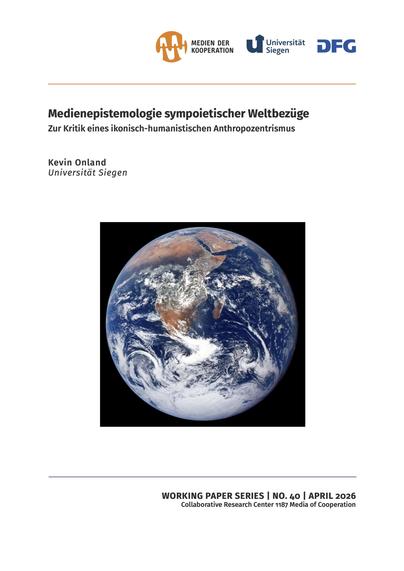
 Bernd von Mallinckrodt 🦋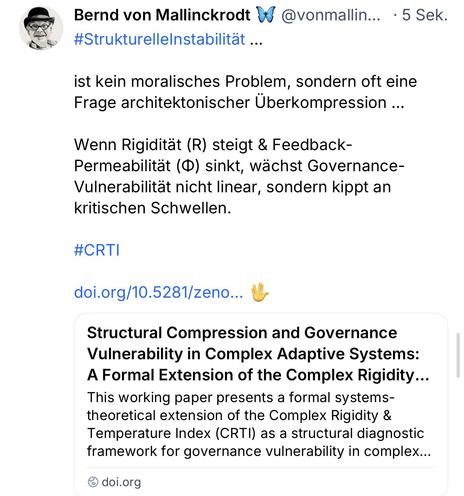




 NFDI4Memory
 Rudolf Thomas INDERST (he|him)
 SFB 1475