#architecture #architecturephotography #art #photography #photooftheday #picoftheday #amsterdam #netherlands #urban #urbanphotography #urbanlandscape #brutalism
Architectuur in Rotterdam.
Markthal van architect Winy Maas (MVRDV).
#grotemarkt #rotterdam #rotterdamcentrum #winymaas #architect #architectuur #architectuurfotografie #RalphKleingeldPhotography
Architectuur in Rotterdam.
Markthal van architect Winy Maas (MVRDV).
#grotemarkt #rotterdam #rotterdamcentrum #winymaas #architect #architectuur #architectuurfotografie #RalphKleingeldPhotography
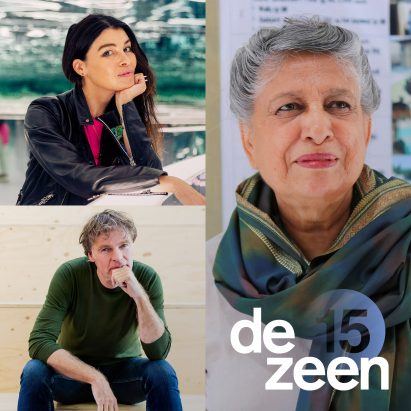
The first week of the Dezeen 15 digital festival celebrating Dezeen's 15th birthday saw Yasmeen Lari call for "a new activism among architects" and Winy Maas state "it's okay to lose a commission" if the client resists sustainable proposals.
The festival will see a total of 15 creatives present ideas for how to change the world over the next 15 years. Running from 1 to 19 November, it will feature a different manifesto and live interview each weekday. See the line-up here.
Read on for some of the highlights so far:
Es Devlin calls for "code of conduct" for designers
Day one: artist and designer Es Devlin kicked off the three-week festival by speaking live from the COP26 climate conference in Glasgow.
Her manifesto, written especially for Dezeen 15, called for trees to replace cars in cities by 2036.
She also called for architects and designers to sign "a code of conduct" similar to the Hippocratic Oath signed by doctors promising "to do no harm to the planet as they practice."
"I've observed in my colleagues that there is already a burgeoning sense that this is the way we want to practice," she said in a live video interview with Dezeen editor-in-chief Marcus Fairs.
"I don't think we want the burden of having done harm on our conscience."
Winy Maas says "it's okay to lose a commission"
Day two: delivering sustainable buildings sometimes means losing work to rivals, according to architect Winy Maas, whose Dezeen 15 manifesto imagines the Earth covered in an inhabitable biostructure called The Sponge.
The MVRDV co-founder said that architects should strive to use part of their project budgets to explore ways of making buildings less damaging to the environment.
Saying "the client doesn't want it" is no excuse for designing unsustainable buildings, he argued in a live interview from MVRDV's office in Rotterdam.
"And sometimes it's also okay to lose a competition or to lose a commission because you cannot fulfil that," he added.
Maas gave the example of the competition to design a new headquarters for Russian fossil-fuel giant Gazprom. MVRDV proposed a timber building that would partially offset emissions caused by Gazprom's natural gas.
"The funny thing is that we went to the last two [in the competition] and then were killed by some of the leadership in Russia on this matter," he added.
Buying new clothes "not the solution" says Amber Slooten
Day three: Amber Slooten of digital fashion brand The Fabricant predicted that technologies including the metaverse, blockchain and NFTs will create a level playing field for designers around the world.
"In this future, a kid in Dakar stands as much chance as a kid in Paris" of becoming a successful designer, she wrote in her Dezeen 15 manifesto.
She added that the rise of digital fashion – which involves selling virtual garments for avatars that represent people in the virtual world – could help reduce the wastefulness of the physical fashion industry.
"This system we have right now is basically set up for failure because of all of the waste that is there," she said in a live interview from her studio in Amsterdam.
"Brands sit on millions of pieces of clothing that haven't sold because it's not trendy any more," she added.
"We know that fashion is a very polluting industry and buying new clothes is not the solution for a sustainable future."
Cave Bureau proposes "a new decolonial infrastructure"
Day four: Kenyan architect Cave Bureau has used its research into caves, which the firm describes as "the root of architecture", to formulate a proposal for a new form of urbanism designed to heal the trauma of colonialism.
The Maasai Cow Corridor would allow tribespeople to safely herd their cattle through Nairobi, helping restore ancient rights that began to be eroded during the colonial era.
"We look at an architecture for an age of trauma, resistance and healing, which has its roots in our deep past," said Cave Bureau's Kabage Karanja and Stella Mutegi in a live interview from their studio in Nairobi.
"With the Maasai Cow Corridor, we're imagining a new decolonial infrastructure."
"Do away with the colonial mindset" says Yasmeen Lari
Day five: Pakistani architect Yasmeen Lari called for "a new activism" towards zero-carbon architecture in her manifesto.
Explaining her approach to "barefoot social architecture" in a live interview from her studio in Karachi, she called for an end to the era of egotistical architecture.
"We must develop a framework for a change direction in architecture," she said. "We need to do away with the prevalent colonial mindset and the desire to create imposing megastructures."
The post Dezeen 15 festival highlights include Es Devlin calling for "code of conduct" for architects and designers appeared first on Dezeen.
#dezeen15festival #all #architecture #design #sustainabledesign #winymaas #esdevlin #sustainablearchitecture #yasmeenlari
The first week of the Dezeen 15 festival celebrating Dezeen's 15th birthday saw Yasmeen Lari call for "a new activism among architects" and Winy Maas state "it's okay to lose a commission" if the client resists sustainable proposals.
Architect Winy Maas proposes covering the entire planet with an inhabitable biostructure
Speaking live from Rotterdam on day two of the Dezeen 15 digital festival, Winy Maas of MVRDV will describe his vision for a new layer on the Earth's surface that will allow both humans and nature to thrive. Watch live at 4:30pm London time today.
Maas will explain his concept of The Sponge, which he proposes in a manifesto written for Dezeen's 15th birthday festival.
This would take the waste generated by humans during the Anthropocene era and turn it into an inhabitable biostructure.
"The idea of the Anthropocene has captured people’s imagination in recent years – the idea that humans have created a new layer in the geology of the Earth," Maas wrote in his manifesto.
"What if we started to think of these new geological layers as a design challenge?"
[
Read:
"What if we create a new layer on the Earth that incorporates growing human habitation and consumption?" asks Winy Maas
](https://www.dezeen.com/2021/11/02/the-sponge-winy-maas-manifesto-dezeen-15/)
"Instead of waiting for a result of human habitation, what if we create a new layer on the Earth that incorporates growing human habitation and consumption, while acknowledging humanity’s current dominance, balancing its effects and combining that with natural development?" he added.
Dutch architect Winy Maas is co-founder and director of Rotterdam studio MVRDV and head of The Why Factory, a research laboratory and think tank he co-founded with the Faculty of Architecture at Delft University of Technology.
Dezeen 15 is a three-week digital festival celebrating Dezeen's 15th birthday. Each workday, a different architect or designer will present a manifesto setting out an idea that could change the world over the next 15 years.
Click here for details of all 15 contributors.
_The portrait of Maas is byBarbra Verbij. _
The post Architect Winy Maas proposes covering the entire planet with an inhabitable biostructure appeared first on Dezeen.
#dezeen15festival #all #talks #videos #winymaas #livestreams
In his manifesto for the Dezeen 15 digital festival, architect Winy Maas of MVRDV proposes covering the planet with a new inhabitable geological layer called The Sponge.
Constructed from the detritus of the Anthropocene era, The Sponge would be a giant, multilayered biostructure capable of nurturing both people and planet.
The Dezeen 15 festival features 15 manifestos presenting ideas that could change the world over the next 15 years. Each contributor will also take part in a live video interview.
See the line-up of contributors here and watch the video interview with Maas live on Dezeen later today.
The Sponge: Towards a dendrocene
Earth. Our home. For the infinite future, I hope. Earth contains all known life in the universe, as far as we are aware.
But our home is threatened: climate breakdown, population growth, deforestation, pollution, income and wealth disparities, lack of pure water, health problems, the enormous reduction of biodiversity – just to name a few – are accelerating tremendously.
We know that. And yet still we need to repeat it. These challenges demand action and, maybe more than ever, imagination. And somehow, architecture and urban design are better tools for this than we think.
French surrealist poet Paul Éluard once wrote that "there is another world and it is in this one". The idea of the Anthropocene has captured people's imagination in recent years – the idea that humans have created a new layer in the geology of the Earth.
What if we started to think of these new geological layers as a design challenge?
What if we started to think of these new geological layers as a design challenge? Instead of waiting for a result of human habitation, what if we create a new layer on the Earth that incorporates growing human habitation and consumption while acknowledging humanity's current dominance, balancing its effects and combining that with natural development?
OK. Let's picture ourselves in a completely biological, three-dimensional substance – let's call it a city for now – that spans across borders. A substance that is porous for access, openness, and views. For water management, for growth, adaptability, and the unknown. For shadow that allows it to protect itself against climate change. That cools down instead of warming up. A substance that makes greenery, energy, food, life, biodiversity. That consists of self-growing, self-evaluating and self-learning bio-techniques that enable it to adapt over time. A sponge-like matter that enables us to solve our world's crises.
The Sponge is first and foremost about density. Where there are the most people, The Sponge reaches its maximum thickness – its maximum three-dimensionality. Unlike our current cities, which rely mostly on the ground level for horizontal movement, The Sponge is interconnected at many levels upwards and downwards, eating ourselves into the earth, allowing it to reach population densities we haven't seen anywhere before.
Public spaces, parks, farms and forests, transit, routes through the city – these things can all be found equally as easily at a height as they can on the ground. The latest technologies intensify the needed agricultural production into multi-storey mixed food forests. These reduce the demand for agricultural land and shorten the transportation distance from farm to fork. The plants capture, store, and evaporate enough water to regulate the environment of The Sponge.
For the next 15 years, every small step towards something like The Sponge will be a victory.
The Sponge can grow and can be dismantled or can dismantle itself. It can be formed where needed. Adapting itself to demand, and to any location.
The Sponge overcomes borders. It is premised on porosity and accessibility. It makes boundaries and borders absurd. It demonstrates the superiority of biology, adaptability, freedom, cooperation and sharing. Without borders, and with easy, ecological, yet super-fast transit, people can move more freely than ever before. This creates a sustainable capacity for our planet.
The question posed for this article was to present the idea that will have the biggest impact on the world in the coming 15 years. At this point, probably some readers are reading with incredulity. Do I expect us all to live in a global megastructure city by 2036?
Much as I would like to say yes, I do not. Maybe by 2136, I hope. Yet it is one of my deepest held beliefs that ideas, even as-yet-unrealised ideas, can deeply impact our world.
And sometimes big dreams, no matter how unachievable they might seem, can have a bigger effect than small, easily-achieved goals. For the next 15 years, every small step towards something like The Sponge will be a victory.
Above: Winy Maas photographed by Barbra Verbij. Main and first image: visuals of From Now to Then: Library of Speculations by The Why Factory
Dutch architect Winy Maas is co-founder and director of Rotterdam studioMVRDV and head of The Why Factory, a research laboratory and think tank he co-founded with the Faculty of Architecture at Delft University of Technology.
Find out more about Winy Maas ›
The post "What if we create a new layer on the Earth that incorporates growing human habitation and consumption?" asks Winy Maas appeared first on Dezeen.