Hey, another Open at Intel podcast just dropped, this time on the latest Phippy and Friends guide all about #WebAssemby. I chatted with Karen Chu and Matt Butcher, creators of the new "Phippy's Field Guide to Wasm" about the series and creative process behind it, as well as the basics of WebAssembly. Check it out!
And please subscribe to get all the episodes in your favorite player. I am biased, but there are some REALLY good ones coming.
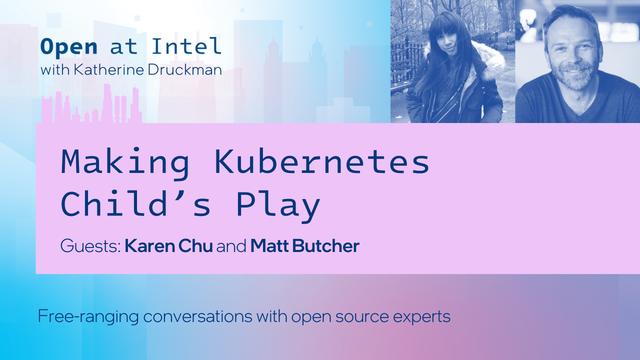
Join Katherine Druckman as she dives into the whimsical world of Kubernetes with Karen Chu and Matt Butcher, the creative minds behind the "Illustrated Children's Guide to Kubernetes." Discover how a playful presentation with stuffed animals evolved into a beloved book series simplifying complex tech concepts. Listen as they introduce their latest character's adventure into the speedy realm of WebAssembly (Wasm). From the origins of Phippy the giraffe to their shared love of Drupal, this episode is a delightful journey through the intersection of technology, creativity, and community. Don't miss out on this fun-filled tech talk! Resources: Fermyon Presents: Phippy’s Field Guide to Wasm Phippy & Friends Guests: Karen Chu is the Head of Community at Fermyon, where she’s building the community around the next wave of cloud computing. As a long time open source contributor in the cloud native ecosystem, she spent her previous life at Microsoft Azure focused on creating inclusive and welcoming spaces around Kubernetes, Helm, Brigade, DeisLabs, the Cloud Native Computing Foundation (CNCF), andthensome. Together with Matt Butcher, she created The Illustrated Children’s Guide to Kubernetes book series. When she’s not connecting dots in the community, you can find her pursuing photography, making ceramics, cooking, and sipping on chai in NYC. Matt Butcher is co-founder and CEO of Fermyon, the serverless WebAssembly in the cloud company. He is one of the original creators of Helm, Brigade, CNAB, OAM, Glide, and Krustlet. He has written or co-written many books, including Learning Helm and Go in Practice. He is a co-creator of the Illustrated Children’s Guide to Kubernetes series. These days, he works mostly on WebAssembly projects such as Spin, Fermyon Cloud and Bartholomew. He holds a Ph.D. in Philosophy. He lives in Colorado, where he drinks lots of coffee.
@deadprogram thanks for opening the issue for me on #wazero GitHub 🙏🏽I feel stupid not doing it myself in the first place 😬
Btw I was able to resolve syscall part in some changes to wazero (moving freebds part to own file) and some socket parts, but now it fails on sockets for unidentified net.TCPListners. Still can't understand why it can't compile those if I can import in my app, a lot to learn on how compilers and #tinygo / #go internals are working 🥹
@mnemonicoverload Hmm... I'm sure someone has built a #Forth on top of #WebAssemby. I'd be curious to see how something like that interacts with #javascript and to #DOM.
I bet it would be fast.
To run in #WebAssemby, our #LVGL App needs the LVGL Library ... Let's compile the library to WebAssembly
Article: https://lupyuen.codeberg.page/articles/lvgl3.html?4#lvgl-app-in-webassembly
Firefox 58 débarque le 23 janvier avec de nouveaux gains de performance, grâce à la compilation en streaming et un nouveau compilateur à deux niveaux
Il y a deux mois, Mozilla a lancé ce qui est sans doute la meilleure version de Firefox jamais développée, en termes de nouveautés introduites et gain de performance : Firefox 57 (Quantum). Avec cette version, Firefox est devenu plus rapide que six mois auparavant et est allé jusqu'à défier Google Chrome, non seulement au niveau de la performance, mais encore en ce qui concerne l'utilisation de la mémoire. Les tests de Mozilla montraient en effet que sur de nombreuses machines (en particulier ce...