
🌡️ How has Calgary’s April temperature varied over the years?

Using hourly data from the CALGARY INTL weather station (METAR archive, 2009–2025), I analysed how April air-temperature distributions shift from year to year.

Each panel shows the probability density of all measurements for that month, with the red dashed line marking the arithmetic mean.

This work is part of my ongoing, data-driven examination of local climate behaviour using R.
Follow #ClimateOfCalgary for more.

#RStats #DataVisualization #OpenData #ClimateData #WeatherAnalysis #Calgary #DataScience #Environment #Alberta #Canada #METAR #AviationWeather #UrbanClimate #ggplot2 #YYC

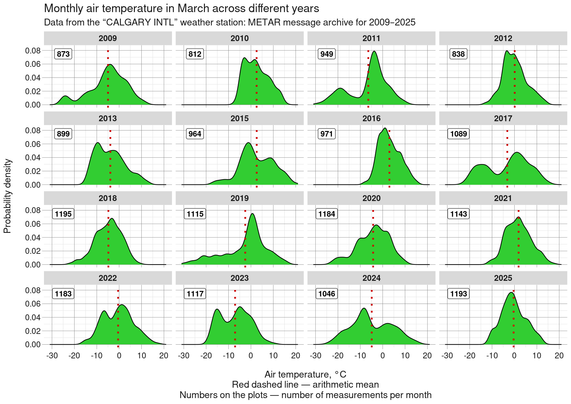
🌡️ How has Calgary’s March temperature varied over the years?

Using hourly data from the CALGARY INTL weather station (METAR archive, 2009–2025), I examined how March air-temperature distributions change from year to year.

Each panel shows the probability density of all measurements for that month — with the red dashed line indicating the arithmetic mean.

This analysis is part of my ongoing, data-driven exploration of local climate behaviour using R.
Follow #ClimateOfCalgary for upcoming posts.

#RStats #DataVisualization #OpenData #ClimateData #WeatherAnalysis #Calgary #DataScience #Environment #Alberta #Canada #METAR #AviationWeather #UrbanClimate #ggplot2

🌡️ How has Calgary’s February temperature changed over the years?

Using hourly data from the CALGARY INTL weather station (METAR archive, 2009–2025), I looked at how February air-temperature distributions evolve from year to year.

Each panel shows the probability density of all measurements for that month — with the red dashed line marking the arithmetic mean.

This work is part of my ongoing, data-driven exploration of local climate patterns with R.
Follow #ClimateOfCalgary for more.

#RStats #DataVisualization #OpenData #ClimateData #WeatherAnalysis #Calgary #DataScience #Environment #Alberta #Canada #METAR #AviationWeather #UrbanClimate #ggplot2

🌡️ How has Calgary’s January temperature varied over the years?

Using hourly data from the CALGARY INTL weather station (METAR archive, 2009–2025), I examined how January air-temperature distributions change from year to year.

Each panel shows the probability density of all measurements for that month — with the red dashed line marking the arithmetic mean.

This is part of my ongoing, data-driven look at local climate behaviour using the R programming language.
Follow #ClimateOfCalgary if you're interested in more.

#Rstats #DataVisualization #OpenData #ClimateData #WeatherAnalysis #Calgary #DataScience #Environment #Alberta #Canada #METAR #AviationWeather #UrbanClimate

A small result from analyzing a long series of meteorological observations for Calgary.

The openair package makes it surprisingly straightforward to combine space–time interpolation and visualization within a single workflow, even for large datasets.

Here are the sectoral (wind direction × wind speed) mean air temperatures for Calgary.

What’s striking is how clearly the seasonal patterns emerge:
– a cold north-east sector in winter;
– a warm southern and southwestern sector in summer;
– transitional zones in spring and autumn;
– a strong Chinook influence from the southwest.

The polar format works exceptionally well here — the structure of the local climate becomes obvious at a glance, without the need for long tables or detailed descriptions.

Follow the #ClimateOfCalgary hashtag.

#Rstats #DataVisualization #OpenData #ClimateData #WeatherAnalysis #Calgary #DataScience #Environment #Research #Alberta #Canada #UrbanHealth #METAR #AviationWeather #Meteorology #DataAnalysis #WindRose #Chinook #WindDirection

🌡️ How has Calgary’s June and July temperature changed over the years?

Using data from the Calgary International Airport meteostation (METAR archive, 2009–2025), I analyzed the monthly air temperature distributions for June.
Each panel shows the probability density of hourly temperature readings — with the red dashed line marking the arithmetic mean.

The work is part of my ongoing data-driven exploration of local climate trends using the R programming language. Follow the #ClimateOfCalgary hashtag.

📊 It’s not just about numbers — it’s about seeing how the “shape” of weather evolves.

#ClimateOfCalgary #Rstats #DataVisualization #OpenData #ClimateData #WeatherAnalysis #Calgary #DataScience #Environment #Research #Alberta #Canada #UrbanHealth #METAR #AviationWeather