Playful Martian Dust Devils

The Martian atmosphere lacks the density to support tornado storm systems, but vortices are nevertheless a frequent occurrence. As sun-warmed gases rise, neighboring air rushes in, bringing with it any twisted shred of vorticity it carries. Just as an ice skater pulling her arms in spins faster, the gases spin up, forming a dust devil.

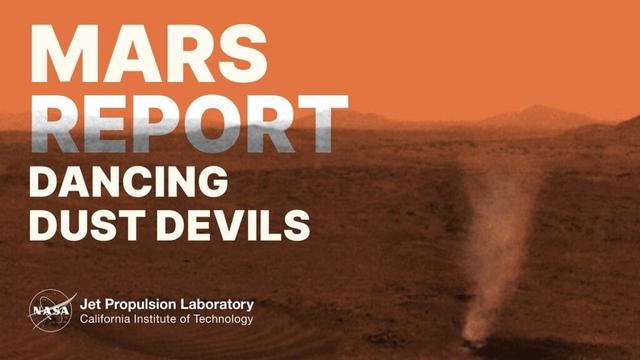
In this recent footage from the Perseverance Rover, four dust devils move across the landscape. In the foreground, a tiny one meets up with a big 64-meter dust devil, getting swallowed up in the process. It’s hard to see the details of their crossing, but you can see other vortices meeting and reconnecting here. (Video and image credit: NASA/JPL-Caltech/LANL/CNES/CNRS/INTA-CSIC/Space Science Institute/ISAE-Supaero/University of Arizona; via Gizmodo)

#atmosphericScience #conservationOfAngularMomentum #dustDevils #fluidDynamics #Mars #physics #science #vorticity

Perseverance Rover Witnesses One Martian Dust Devil Eating Another

The six-wheeled explorer recently captured several Red Planet mini-twisters spinning on the rim of Jezero Crater.

NASA Jet Propulsion Laboratory (JPL)

First spotted by humanity in 1664, Jupiter‘s Great Red Spot is a seemingly endless storm. Strictly speaking, there is debate as to whether observations prior to 1831 were of the same storm, but there’s no denying that the storm has raged unabated since regular observations began in the first half of the nineteenth century. Despite its longevity, the Great Red Spot is not unchanging. Overall, its major axis is shrinking, making the storm more circular over time. The storm also has a 90-day cycle in which its size, shape, and brightness vary, as seen below. Researchers note that the changes are relatively subtle — at least to the eye — but now that they’ve been identified, it may be possible to use amateur astronomers’ data to track these variations more closely. (Image credits: GRS – K. Gill/NASA, snapshots – A. Simon et al.; research credit: A. Simon et al.; via Gizmodo)

Over a 90 day cycle, Jupiter’s Great Red Spot oscillates in size, shape, and other characteristics.

https://fyfluiddynamics.com/2024/10/the-great-red-spots-cycle/

#anticyclone #atmosphericScience #fluidDynamics #Jupiter #physics #planetaryScience #science #vorticity

Great Red Spot - Wikipedia

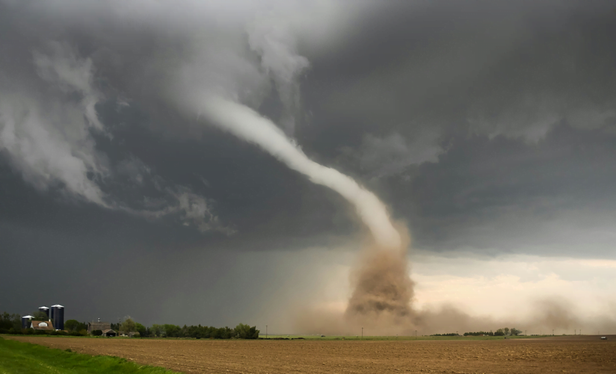
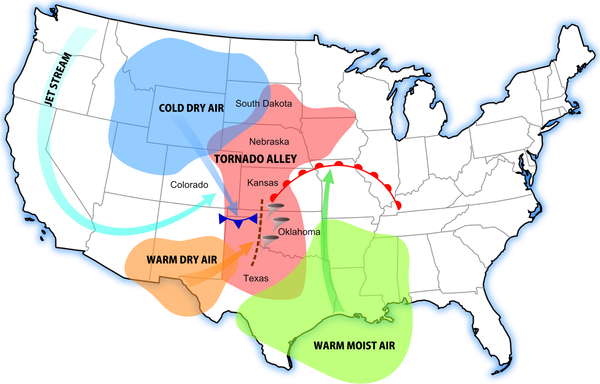
Growing up in northwest Arkansas, I spent my share of summer nights sheltering from tornadoes. Central North America — colloquially known as Tornado Alley — is especially prone to violent thunderstorms and accompanying tornadoes. That’s due, in part, to two geographical features: the Rocky Mountains and the Gulf of Mexico. Trade winds hitting the eastern slope of the Rockies get turned northward, imparting a counterclockwise vorticity. At the same time, warm moist air carried from the Gulf feeds into the atmosphere, creating perfect conditions for powerful thunderstorms. By this logic, though, South America should see lots of tornadoes, too, courtesy of the Andes Mountains and the moist environs of the Amazon Basin. To understand why South America doesn’t have a Tornado Alley, researchers used global weather models to investigate alternate North and South Americas.

They found that smoothness is a key ingredient for the upstream, moisture-generating region. Compared to the Amazon, the Gulf of Mexico is incredibly flat. With a flat Gulf, tornadoes abounded in North America, but their numbers dropped once that area was roughened to mimic the Amazon. The opposite held true, too: a smoothed-out Amazon Basin resulted in more simulated South American tornadoes.

For those in Tornado Alley, the results don’t offer much hope for mitigating our summer storms — we can’t exactly roughen the ocean. But the study does sound a word for warning for South America; the smoother the Amazon region becomes — due to mass deforestation — the more likely tornadoes become in parts of South America. (Image credit: G. Johnson; research credit: F. Li et al.; via Physics World)

https://fyfluiddynamics.com/2024/08/why-tornado-alley-is-north-american/

#atmosphericScience #CFD #computationalFluidDynamics #fluidDynamics #meteorology #physics #science #surfaceRoughness #thunderstorm #tornado #vorticity

Tornado Alley - Wikipedia

New publication by alumnus of the @hanseias Martin Obligado et al.: "Debris-induced consequences on #turbulence and #vorticity in solar #photovoltaic module-generated array wakes", in: Journal of Renewable and Sustainable Energy https://pubs.aip.org/aip/jrse/article-abstract/16/3/033501/3295189/Debris-induced-consequences-on-turbulence-and?redirectedFrom=fulltext

Weekend #Plankton #Factoid 🦐🦠
Today: #zooplankton and #turbulence. While marine #copepod effects are documented, little work has been done on turbulence and #cladocerans, which dominate freshwater systems - and notoriously poor swimmers.

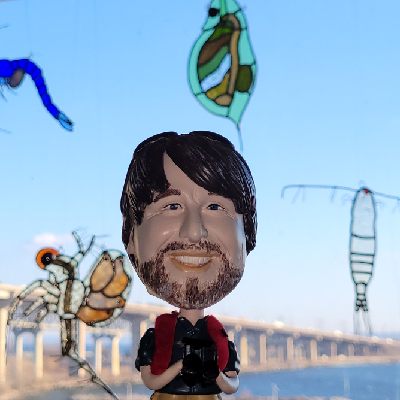
MSc student, Luc Goulet, focused on #vorticity (rotation), very relevant to lakes and rivers. Using rotating cylinders, he found speeds where it interferes with #Daphnia ability to orient and feed, so relevant to their ecology. #science

https://aslopubs.onlinelibrary.wiley.com/doi/full/10.1002/lno.12590

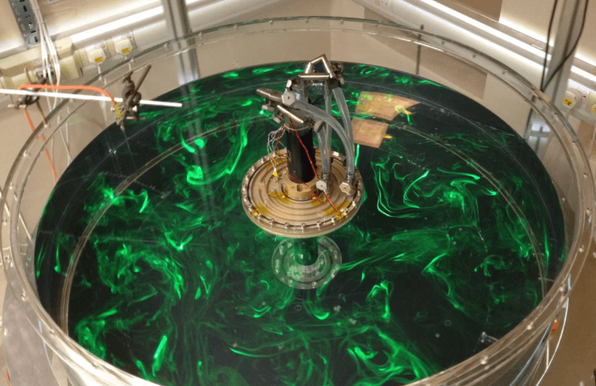
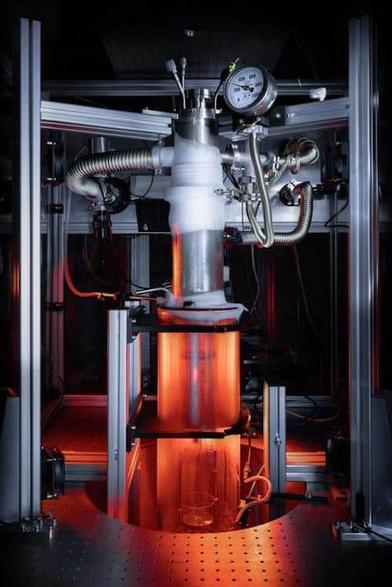
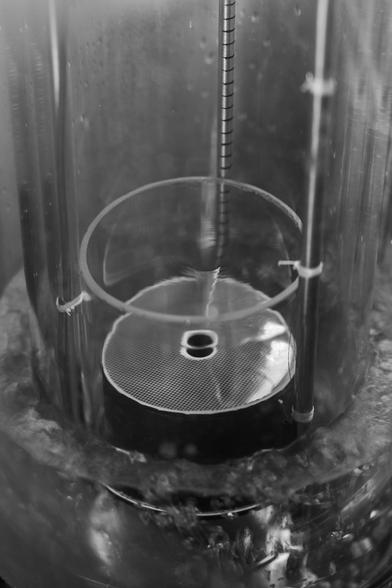
Massive black holes drag and warp the spacetime around them in extreme ways. Observing these effects firsthand is practically impossible, so physicists look for laboratory-sized analogs that behave similarly. Fluids offer one such avenue, since fluid dynamics mimics gravity if the fluid viscosity is low enough. To chase that near-zero viscosity, experimentalists turned to superfluid helium, a version of liquid helium near absolute zero that flows with virtually no viscosity. At these temperatures, vorticity in the helium shows up as quantized vortices. Normally, these tiny individual vortices repel one another, but a spinning propeller — much like the blades of a blender — draws tens of thousands of these vortices together into a giant quantum vortex.

Here superfluid helium whirls in a quantum vortex.

With that much concentrated vorticity, the team saw interactions between waves and the vortex surface that directly mirrored those seen in black holes. In particular, they detail bound states and black-hole-like ringdown phenomena. Now that the apparatus is up and running, they hope to delve deeper into the mechanics of their faux-black holes. (Image credit: L. Solidoro; research credit: P. Švančara et al.; via Physics World)

https://fyfluiddynamics.com/2024/05/black-holes-in-a-blender/

#astrophysics #blackHole #fluidDynamics #physics #quantumVortex #science #superfluid #superfluidHelium #vortices #vorticity

Binary black hole - Wikipedia

Аn Outstanding Soviet and Russian Theoretical Physicist Isaac Markovich Khalatnikov Died – Expertum Group

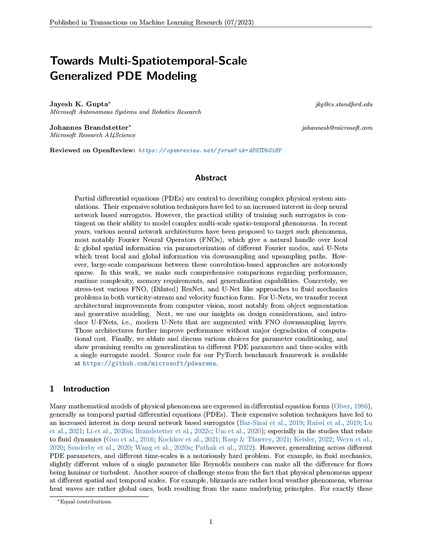
Towards Multi-spatiotemporal-scale Generalized PDE Modeling

Jayesh K Gupta, Johannes Brandstetter

Action editor: Vikas Sindhwani.

https://openreview.net/forum?id=dPSTDbGtBY

#vorticity #convolution #deep

Towards Multi-spatiotemporal-scale Generalized PDE Modeling

Partial differential equations (PDEs) are central to describing complex physical system simulations. Their expensive solution techniques have led to an increased interest in deep neural network...

OpenReview

Towards Multi-spatiotemporal-scale Generalized PDE Modeling

https://openreview.net/forum?id=dPSTDbGtBY

#vorticity #convolution #deep

Towards Multi-spatiotemporal-scale Generalized PDE Modeling

Partial differential equations (PDEs) are central to describing complex physical system simulations. Their expensive solution techniques have led to an increased interest in deep neural network...

OpenReview
I know, I know, we have LaTeX support, but I'm a fountain pen guy. #Vorticity #Poloidal #Toroidal