Finding Values on the Unit Circle! (Sine, cosine) #maths #calculus #unitcircle #trigonometry

A quick way to find values on the unit circle in the first quadrant!In this video I show how to sketch the values corresponding to 0, pi/6, pi/4, pi/3, and pi/2 on the unit circle.Using those values I show how to evaluate sine and cosine.This is useful info for those of you in precalculus or calculus!

https://authorjonathandavid.com/precalculus/finding-values-on-the-unit-circle-sine-cosine-maths-calculus-unitcircle-trigonometry/

Finding Values on the Unit Circle! (Sine, cosine) #maths #calculus #unitcircle #trigonometry - Author Jonathan David

A quick way to find values on the unit circle in the first quadrant!In this video I show how to sketch the values corresponding to 0, pi/6, pi/4, pi/3, and pi/2 on the unit circle.Using those values I show how to evaluate sine and cosine.This is useful info for those of you in precalculus or […]

Author Jonathan David
Unit Circle

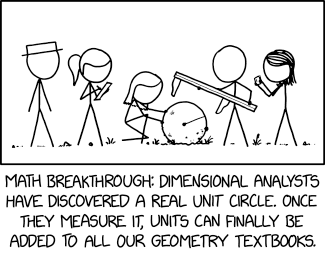
xkcd
Trigonometry Basics Cheat Sheet

Trigonometry Basics for Exam1

Cheatography
Spotted Tau-hee

Digital art of spotted tau-hee bird for tau day

Fractal Kitty

This is a short, animated visual proof demonstrating Jordan’s inequality, which is an equality providing upper and lower bounds for the sine function over the interval [0, pi/2].

Jordan’s Inequality Visual Proof

#Theorem #VisualProof #Algebra #animation #circle #inequality #jordanInequality #Math #MathematicalVisualProofs #Mathematics #nowWatching #unitCircle #YouTube

Jordan's Inequality Visual Proof

YouTube

Seen on TBBBS:

1. Consider a random #polynomial with degree "n"

\[
P(z) = a_n z^n + ... + a_1 z + a_0
\]

where the coefficients are random complex Gaussian numbers.

Choose the degree "n" large.

2. Compute the #complex roots and plot them.

3. Wonder why they concentrate on the #UnitCircle

From here:

https://twitter.com/i/status/1600132699800289280

adad8m🦞 on Twitter

“1. Consider a random #polynomial with degree "n" P(z) = a_n*z^n + ... + a_1*z + a_0 where the coefficients are random complex Gaussian numbers. Choose the degree "n" large. 2. Compute the complex roots and plot them. 3. Wonder why they concentrate on the unit circle 😍 #maths”

Twitter