https://brevitymag.com/nonfiction/solstice/

Usually classified as memoir, Joanne Lozar Glenn's "Solstice" could also be appreciated as short fiction.

In any case, it's an affecting piece of writing that takes minutes to read but will stay with you for days, weeks, months...

Image: Joanne Lozar Glenn -- https://muffin.wow-womenonwriting.com

#USLiterature #Nonfiction #Memoir #Solstice #JoanneLozarGlenn

One of my greatest pleasures recently has been discovering the writing of Dawn Powell.

I've just finished her 1942 novel "A Time To Be Born", which combines both her first hand understanding of the journalistic and literary New York of her time with a midwesterner's skeptical amusement at metropolitan self advancement and snobbery.

The novel also provides insights into American women's distinctive struggles with ambition, competition, and love in the opening years of the Second World War.

#Books #Fiction #DawnPowell #USLiterature #20thCenturyLiterature #LiteratureInEnglish #Novel

https://marissavivian.substack.com/p/hidden-voices-004-dawn-powell

Hidden Voices 004: Dawn Powell

A Missing Voice That Hits Close To Home.

The Feminine Prose

James Baldwin's "Giovanni's Room" impressed me both for its exploration of love, sex, and sexual identity and for the skill with which the author has the narrative unfold; I was gripped from beginning to end.

Although the protagonist is white, I know that some critics believe that the theme of race is obliquely present by virtue of the salience of various kinds of minority identity throughout the novel.

Quite aside from it being a "good read", I would recommend it to anybody interested in the literary treatment of bisexuality.

Expatriation also figures as an important theme. These words hit home with this migrant:

>> You don't have a home until you leave it and then, when you have left it, you never can go back. <<

"Home", of course, can be more than a geographical location.

#Books #GiovannisRoom #JamesBaldwin #Fiction #AmericanLiterature #USLiterature #AfricanAmericanLiterature #QueerFiction #LiteratureInEnglish #Sexuality #Bisexuality #20thCenturyLiterature #1950s #Homosexuality #Gay #Expatriates #Migrants

I read some of Baldwin's essays a while ago, but I'm a mite embarrassed to say that I have only just finished my first Baldwin novel, "Go Tell It on the Mountain".

Did I love it? No.

Did I admire it? Yes, there is some powerful writing there. I was particularly impressed by Baldwin';s ability to encompass both African American vernacular and elevated biblical cadences without ever descending into hokiness. The psychological insight and narrative organization shown in the account of Esther's liaison with Gabriel struck me as brilliant.

The book also interested me as a document of midcentury US culture -- a social history approach that I'm sure Baldwin would have despised as reductive and unliterary!

I wonder if I might enjoy "Giovanni's Room" more, in part because I want to explore sexual rather than spiritual identity.

Image: James Baldwin at the Albert Memorial in 1969 -- Allen Warren -- Wikimedia Commons -- https://creativecommons.org/licenses/by-sa/3.0/

#Literature #JamesBaldwin #USLiterature #AfricanAmericanLiterature #Books #Fiction #Novel

https://harpers.org/archive/2026/01/in-the-aftermath-of-victory-vince-passaro/

Cowley " would be involved with just about everything and everybody of literary consequence during those years. That is not hyperbole; a list would include Faulkner, Hemingway, Fitzgerald, Kerouac, and Cheever, as well as John Dos Passos, Ezra Pound, Hart Crane, Eugene O’Neill, E. E. Cummings, Ken Kesey, Thornton Wilder, Edmund Wilson, Archibald MacLeish, Alfred Kazin, Mary McCarthy, Lionel Trilling, James T. Farrell, Alexander Calder, Dwight Macdonald, Dawn Powell, John Updike, Kenneth Burke, Allen Tate, Conrad Aiken, Marianne Moore, Van Wyck Brooks, Wallace Stegner, Larry McMurtry, Dorothy Day, Mike Gold, Robert Penn Warren, John Berryman, Saul Bellow, and Eudora Welty."

#USLiterature #AmericanLiterature #MalcolmCowley #GeraldHoward #TheInsider #20thCenturyLiterature #Books

In the Aftermath of Victory, by Vince Passaro

Malcolm Cowley and the dream of the American canon

Harper's Magazine

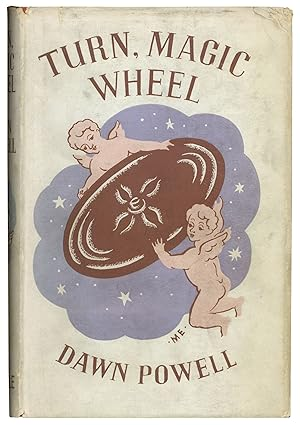
What a delight it was to read Dawn Powell's 1936 "Turn, Magic Wheel", in which urbane literary satire intertwines with an acute account of the deceptions and self-deceptions of love and marriage!

I found Powell's wit and style especially refreshing after having recently waded through the self important verbosity of Thomas Wolfe's "Look Homeward, Angel".

#Books #DawnPowell #TurnMagicWheel #AmericanLiterature #USLiterature #Novel #Satire #NewYorkLiterature ##20thCenturyLiterature #Thirties #1930s

Thomas Wolfe -- Look Homeward, Angel

It's not often that I have to take a break from a book, but I needed three days off from page after page of purple prose about people neither pleasant nor entertaining nor interesting.

Wolfe's 1929 Bildungsroman, a coming of age in North Carolina novel, was once thought to put Wolfe on a level with Hemingway or Faulkner.

Not many critics would hold him in such esteem today; I believe this revaluation is well deserved. Wolfe never used one word when he could cram in ten, preferably with much "poetic" diction and overuse of alliteration. Not every writer has to write the stripped down prose of Hemingway, not every darling has to be murdered, but an editorial slaughter would have been welcome here.* Wolfe also lacks the insight and imagination exercised by Faulkner with regard to race in the South.

Getting to the last of the 500 plus pages of wordy self indulgence this afternoon felt like the end of an ordeal.

Am I being unfair? Wolfe is sometimes described as an author best appreciated by young men. I admit that I might well have been impressed had I read him as an adolescent; I'm glad I did not, as the book might have done irreparable damage to my prose style.

#Books #ThomasWolfe #LookHomewardAngel #USLiterature #AmericanLiterature #20thCenturyLiterature #NorthCarolina #Bildungsroman

@girlbandgeek

I don't want to flood your inbox, but I did want to thank you again for the Barbara Kingsolver recommendation.

I have just finished "The Bean Trees", which made a delightfully refreshing contrast to the last novel by a US author I read, Elmore Leonard's "Out of Sight"; see my comments on Leonard here: https://c.im/@jemmesedi/115323499218156545

Even though "The Bean Trees" was published 37 years ago in 1988 -- the year that Trump really started Trumping -- I was pleasantly reminded as I read it of how the USA is so much more than the simplistic caricature of a country presented by MAGA. The book conveys a vivid sense of various US places - Kentucky, Oklahoma, Arizona -- and the diversity of these places' inhabitants. I also found it refreshing to read a novel steeped in progressive values that was without a trace of the graduate seminar room or East/West coast hipsterism. I liked the way that Kingsolver incorporated surprises in the narrative and humour too; I laughed out loud at times. All in all, an enjoyable but also thought provoking read.

I think I'm going to put "The Poisonwood Bible" on my TBR list.

Thanks again - should I be thanking Dawn too?

#BarbaraKingsolver #Books #USLiterature #AmericanLiterature #TheBeanTrees #Fiction #Novels #LiteratureInEnglish

Jonathan Emmesedi (@[email protected])

Attached: 1 image I recently read a couple of Elmore Leonard crime novels -- "Riding the Rap" and "Out of Sight". I don't read that much contemporary fiction, nor do I have a deep background in crime fiction as a genre, so you'll have to make do with the remarks of a relatively ill informed reader. I can see why Leonard is a both popular and respected writer. He knows how to structure a gripping narrative, and his dialogue rings true. On a more critical note, I can imagine these two novels providing future students of US culture with material for a study of the anxieties and aspirations of middle class white men in an America seemingly riven with disorder. In "Riding the Rap", Leonard's background as a writer of westerns comes across; the US marshal protagonist brings order to a lawless frontier by acting on his own initiative rather than a mere agent of a federal bureaucracy. Here though, the frontier is no longer in the west, but in Florida, and the threatening nonwhite others are no longer American Indians but a Puerto Rican hitman and a Black Bahamian immigrant who, as part of his assimilation to Black America, adopted an Islamic name. Leonard's depiction of racial attitudes intersects with his representation of socioeconomic class distinctions. The two nonwhite criminals act for a while as henchmen to a drink and drug addled wealthy white playboy, whose kidnapping plan drives the plot forward. His exploitation of his senile mother's wealth and the revelation of her ugly racist attitudes point to the class and status tensions that exist between a decadent white upper class and the Appalachian coalmining heritage of the US marshal protagonist. These racial and white populist themes recur in "Out of Sight", where middle aged, middle class, white bank robbers are contrasted with African American home invaders, the latter being characterized by their cruelty, treachery, idleness, lust, and greed. In both novels the middle aged male protagonist beds a much younger female character; some readers might find these glimpses of the fantasy life of ageing men unintentionally ludicrous. I think I'll reserve final judgment on Leonard until I've read another of his books. "Swag" is supposed to be good, but neither my local second bookstore nor my libraries have it available at the moment, and I don't want to pay full price for it. #Books #ElmoreLeonard #USLiterature #CrimeFiction #RidingTheRap #OutOfSight #Race #Racism #Populism #USCulture

C.IM

I recently read a couple of Elmore Leonard crime novels -- "Riding the Rap" and "Out of Sight".

I don't read that much contemporary fiction, nor do I have a deep background in crime fiction as a genre, so you'll have to make do with the remarks of a relatively ill informed reader.

I can see why Leonard is a both popular and respected writer. He knows how to structure a gripping narrative, and his dialogue rings true.

On a more critical note, I can imagine these two novels providing future students of US culture with material for a study of the anxieties and aspirations of middle class white men in an America seemingly riven with disorder.

In "Riding the Rap", Leonard's background as a writer of westerns comes across; the US marshal protagonist brings order to a lawless frontier by acting on his own initiative rather than a mere agent of a federal bureaucracy. Here though, the frontier is no longer in the west, but in Florida, and the threatening nonwhite others are no longer American Indians but a Puerto Rican hitman and a Black Bahamian immigrant who, as part of his assimilation to Black America, adopted an Islamic name.

Leonard's depiction of racial attitudes intersects with his representation of socioeconomic class distinctions. The two nonwhite criminals act for a while as henchmen to a drink and drug addled wealthy white playboy, whose kidnapping plan drives the plot forward. His exploitation of his senile mother's wealth and the revelation of her ugly racist attitudes point to the class and status tensions that exist between a decadent white upper class and the Appalachian coalmining heritage of the US marshal protagonist.

These racial and white populist themes recur in "Out of Sight", where middle aged, middle class, white bank robbers are contrasted with African American home invaders, the latter being characterized by their cruelty, treachery, idleness, lust, and greed.

In both novels the middle aged male protagonist beds a much younger female character; some readers might find these glimpses of the fantasy life of ageing men unintentionally ludicrous.

I think I'll reserve final judgment on Leonard until I've read another of his books. "Swag" is supposed to be good, but neither my local second bookstore nor my libraries have it available at the moment, and I don't want to pay full price for it.

#Books #ElmoreLeonard #USLiterature #CrimeFiction #RidingTheRap #OutOfSight #Race #Racism #Populism #USCulture

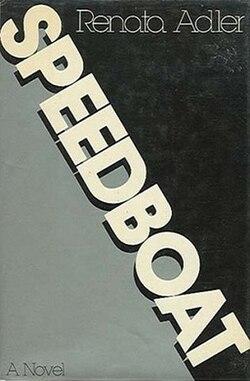
Renata Adler's 1976 novel "Speedboat" enjoys a cult following amongst MFA types.

I'm not an MFA type myself, but I thought I should give it a try.

If you're looking for a gripping story, this is not the book for you. It's virtually plotless, being composed of a series of episodes, observations, and micronarratives in the life of a young NYC based journalist. Certain characters recur, but the chronology is left unclear.

One does get a feel for New York in the seventies as experienced by a fairly privileged young white woman -- Elaine's, rats, vagrants in the apartment house vestibule, no show faculty at the state university,....At times, I found myself laughing at scenes from parties and metropolitan encounters.

I wonder if this would be good novel to study if one wanted to broaden one's understanding of the meaning of literary postmodernism. "Speedboat" exemplifies a formal experimentation distinctive from that of the modernist novel of the the first half of the twentieth century but which is also free of the metafictionality and self reference that often are taken as definitive of the postmodern.

#RenataAdler #Speedboat #USLiterature #Books #Fiction #LiteratureInEnglish