I have recently finished my series on the different HyperText Transfer Protocol (HTTP) status codes associated with the #Internet and distinct #URIs and #URLs of all types. You can find the content on my #YouTube channel at https://www.youtube.com/@novaTopFlex.
Andrew Kay (novaTopFlex)

This channel is dedicated to software based on #GNU and #Unix, including #Linux and #NetBSD. Videos may include graphical application programming with #Python as well as command-line and graphical system setups. For more information, please consult the descriptions of individual videos. There will be information about whether #QEMU or #Docker is being utilized, along with other technical specifications and related resources. Current Topics: #html (#html5), #linux, #markdown

YouTube

The Future Divide: novatopflex.wordpress.com vs. novatopflex.com

novaTopFlex has just identified the novatopflex.com domain as a functional domain, and advertisements can now continue to proceed on the site served by Bluehost. From now on, expect novatopflex.wordpress.com to be the public-facing blog of public-facing personal interest, while novatopflex.com shall be the public-facing blog–and more–of business interest, predominantly focused on technology.

"As someone said on Mastodon when I posted about #replanting, this does unfortunately break Berners-Lee’s rule that “Cool #URIs don't change.” I think he originally wrote that in 1998, when it was almost impossible to foresee the scale of #brokenlinks & parasite SEO we are living through on today’s web.
So, maybe that 1998 rule needs to be updated: Cool URIs don’t change, but sometimes they're junked or left to rot—in which case, you need a cool new #URI."
#DigitalMemory
https://cybercultural.com/p/replanting/
Replanting Articles: Bring Legacy Posts to Your Website

Old articles and blog posts too often get removed from the web or neglected, left to rot on broken pages. Replanting lets you migrate legacy content to your current site so it can thrive again.

Cybercultural

Because I referenced it yesterday at #THEdigitalUK, here is a contribution by Andreas Thalhammer on the management of #CoolURIs in support of superior knowledge graphing.

Cool URIs for FAIR Knowledge Graphs https://doi.org/10.48550/arXiv.2407.09237 #FAIR #ScholarlyGraph #persistence #URIs #repositories

Cool URIs for FAIR Knowledge Graphs

This guide is for everyone who seeks advice for creating stable, secure, and persistent Uniform Resource Identifiers (URIs) in order to publish their data in accordance to the FAIR principles. The use case does not matter. It could range from publishing the results of a small research project to a large knowledge graph at a big corporation. The FAIR principles apply equally and this is why it is important to put extra thought into the URI selection process. The title aims to extend the tradition of "Cool URIs don't change" and "Cool URIs for the Semantic Web". Much has changed since the publication of these works and we would like to revisit some of the principles. Many still hold today, some had to be reworked, and we could also identify new ones

arXiv.org
#LinkedData #HTTP #URIs never fail! Worked around Twitter #URL shortener zealotry that messed up my #Nanotations:
#RDF based #LinkedData formalizes the nature of Hyperlinks (#HTTP #URIs) that constitute HTTP networks like the World Wide Web.
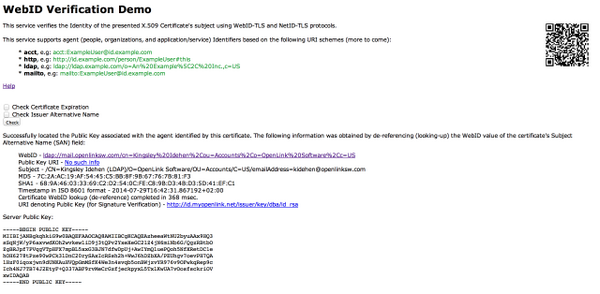
#LinkedData enabling #WoT construction via #LDAP #URIs & #NetIDTLS protocol. #TLS #PKI #X509 #RWW #Privacy #Identity
Cool #HTTP #URIs don't change i.e., Denotation stays the same while Connotation evolves, dynamically: #LinkedData
Web Docs r self-connoting (their #HTTP #URIs denote & connote). Not so when using the Web as connotation medium for other entity types.
Data as the new Electricity meme is generally groked. Understanding the role of #HTTP #URIs as its conduction mechanism is next. #LinkedData