 Andy Arthur - Threadinburgh
A Moorish Church in Leith: the thread about the many lives of the Hope Street Turkish Baths
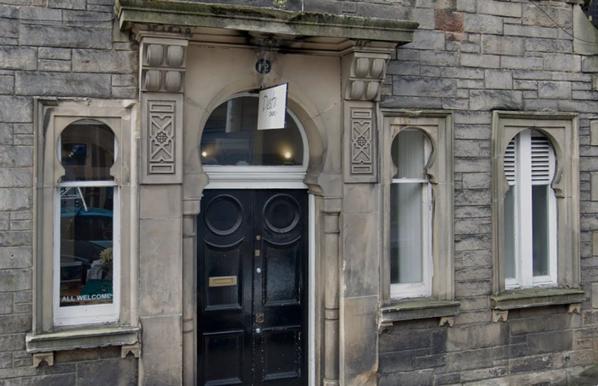
There’s a building just off the foot of Leith Walk that looks much like any other mid-to-late 19th century Scottish Baronial Revival tenement, but just a little bit less in the Scottish or Gothic tradition and with just a few more unusual architectural flourishes than usual. It’s a modern church now behind the façade – but that’s not what it was built as. Do you want to hazard a guess as to the original purpose?
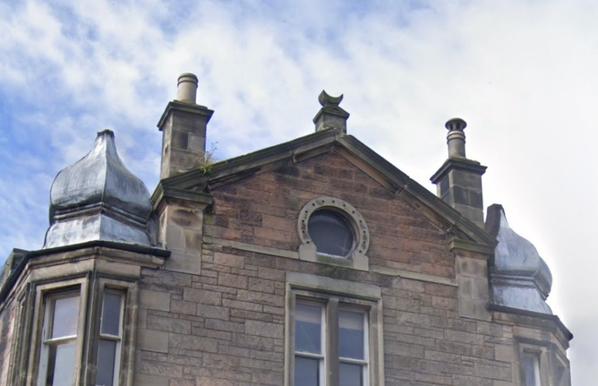
What was the mystery building? What are those details referencing?If like many people you were picking up a distinct Ottoman/ Turkish/ Moorish/ Islamic influence, then you’re on the right track. No it was not a mosque…
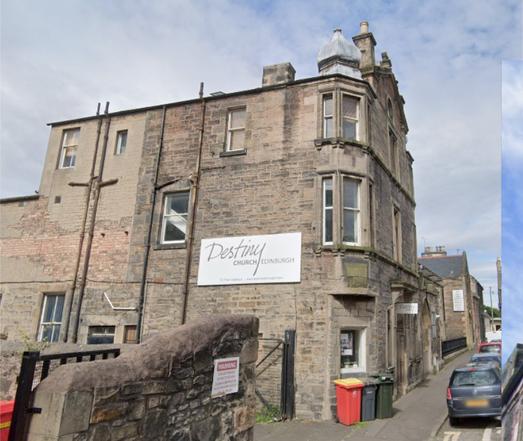
12 Casselbank Street was built at what was 12 Hope Street in 1885 (renamed in the 1960s to avoid confusion with a street in Edinburgh of the same name) as a Turkish Baths by George Beattie and Son. The proprietors were a John William Hodgson and a William Nixon. Casselbank refered to Walker Cassels, a merchant in Leith from whose estate it was feud. It was laid out as Hope Street which was probably a family connection. In reality it should have been named Casselsbank, as his name wasn’t Cassel.
1893 OS Town plan showing the Turkish Baths. Reproduced with the permission of the National Library of ScotlandTurkish Baths were copied from the hammam of the Islamic world; places of public bathing, particularly steam baths. Guests would first “bathe” in hot, dry air (not steam) to cause them to perspire. They would then move to a hotter room before a plunge into a cold pool and then washing in cold water. After washing and a massage from an assistant, they retired to a cooler room to relax. They were a popular pseudo-medical treatment, as well as a recreational activity.
The baths were built as a single storey, raised to 3 storeys a few years later in 1894, at which time Mr Nixon is noted as the “late proprietor” and newspaper adverts for the establishment dry up. They may have replaced an older establishment on Hope Street (but not at number 12, and not one I can find on the valuation rolls). The pediment was re-used and the onion-domes added either side. I think it’s a really clever mix of the Turkish influence with traditional Scottish masonry construction and the Baronial revival styling and that was so popular at the time.
Advert for the Leith Turkish Baths. “Cars” refers to tramway cars.I don’t have any pictures of the interior, but the relatively contemporary Stafford Street Turkish Baths in Edinburgh included this engraving of their interior in their Post Office directory advertising.
Stafford Street Turkish Bath, 1846And the washing room of the Moray Lodge Turkish Baths in Camden Hill, London:
Moray Lodge, Camden Hill, 1904In the 1920s, it was converted to another fashionable leisure activity, a cinema, nicknamed the plaster screen because of the projection screen fashioned from that material. It’s official name was the Central Kinema, a nod to it being within shouting distance of Leith Central station. The shareholders include J. W. Hodgson, the Turkish Baths proprietor, and he was one of the directors. and it opened almost exactly 99 years ago (when this was written on November 22nd 2019). On December 2nd 1920, when it opened, the programe was from 6PM continuous to 10:30PM, or from 3PM on Saturdays. The feature attraction was a A Man’s Fight Against Tremendous Odds starring Dustin Farnum, supported by a Gaumont serial Barabas and a “first class musical programme”. Capacity was 500 and tickets were 9d, 1/- and 1/6.
1919 American magazine advert for “A Man’s Fight”.There are lots of lovely photos of the interior here on the Scottish Cinemas archive, although all this ornate plasterwork is from its days as a cinema, not a bath house. You have to wonder if there is Victorian bathhouse tiling lurking behind it… The plaster screen is a rare survivor; they were usually demolished and replaced by a fabric one to install sound equipment behind, but the Central Kinema closed before it was converted for “Talkies”.
By 1934 the Central Kinema Co. Ltd. was in liquidation and the premises were being advertised for sale for an upset price of £2,200. It was soon taken over by the Edinburgh Pentecostal Church; the ready made amphitheatre suiting its needs. It was in appropriate company, next door to the Leith Trinity Free Church and along the street from the Leith Spurgeon Memorial Baptist Church. More recently, the Elim Pentecostal Church was been replaced by the Destiny Church; the Turkish Baths having spend the best part of its working life not as a bath house or even a cinema, but as a place of worship.
Note to readers: unfortunately in April 2026, a third-party plug-in more than exceeded its authority and broke many of the image links on this site. No images were lost but I will have to restore them page-by-page, which may take some time. In the meantime please bear with me while I go about rectifying this issue.
If you have found this site useful, informative or amusing then you can help contribute towards its running costs by supporting me on ko-fi. This includes my commitment to keeping it 100% advert and AI free for all time coming, and in helping to find further unusual stories to bring you by acquiring books and paying for research.
Or please do just share this post on social media or amongst friends and like-minded people, sites like this thrive on being shared.
Explore Threadinburgh by map:
Travelers' Map is loading...If you see this after your page is loaded completely, leafletJS files are missing.
These threads © 2017-2026, Andy Arthur.
NO AI TRAINING: Any use of the contents of this website to “train” generative artificial intelligence (AI) technologies to generate text is expressly prohibited. The author reserves all rights to license uses of this work for generative AI training and development of machine learning language models.
#Lochend #Logan #Restalrig #StMargaret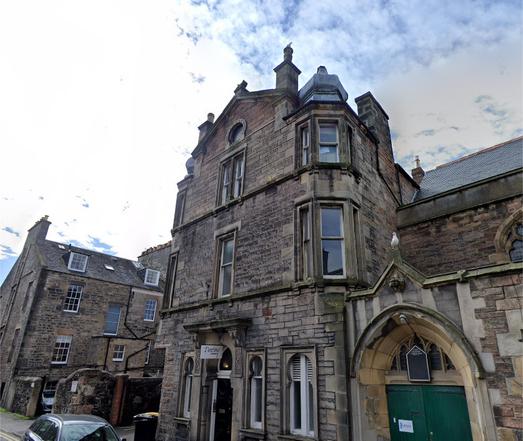
 History Cafe ☕ Ottoman Heritage
 Archiseek

 Arlington Baths Club
 Queer Lit Cats
 North West Bylines
 VicTurk