 Miguel Afonso Caetano
"Turing’s test remains intriguing, but there is a longstanding difficulty: the fallibility of the judge. A primitive 1960s chatbot, Eliza, responded like a parody of a therapist (“How does that make you feel?” “Why do you feel sad?” “Please go on.”). People lapped it up; it’s nice to feel listened to. A 1980s chatbot, MGonz, just fired off insults and was perfectly plausible, partly because insults are simple to deliver and mostly because they prompt rage rather than reflection in the human recipient. And Robert Epstein, an expert in the Turing Test, has written entertainingly about how he was fooled into a four-month correspondence with a sexy Russian lady who was, in fact, a 2006-era chatbot. None of these bots had a thousandth of the sophistication of a modern LLM, but they didn’t need it: when humans are sad, angry or amorous, we aren’t very sophisticated judges, either.
We are all going to find ourselves in strange variations of the Turing Test in years to come, and I wonder if we are up to it. And not just us, but those with power over us. As Cory Doctorow, author of Enshittification, is fond of observing: you won’t be replaced because an AI can do your job, you’ll be replaced because an AI salesman convinces your boss that it can. If my journey to the marathon start line is any guide, that salesman will have an easy job.
The capabilities of modern AI are impressive. But what determines whether we use it is not the capability, but the impressiveness. They are correlated but they are not the same thing."
https://www.ft.com/content/eb6f5398-6635-4938-b890-625e7c8d3af2?syn-25a6b1a6=1
#AI #GenerativeAI #Chatbots #LLMs #TuringTest #Enshittification

 Paul SomeoneElse
 C.
C. Greg Lloyd
 the roamer
 Noodlemaz
 malte
malte
 ScottMGS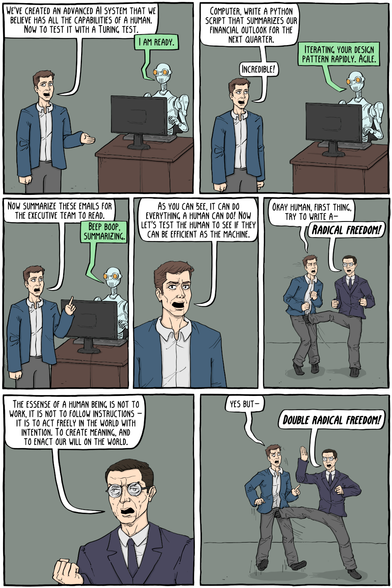
 Stefan Müller

 JdeBP
JdeBP