Relatively recently, I got interested in time-domain reflectometry, which is essentially just sending a pulse down a cable and measuring the amount of time for its reflection to return.
It's useful for testing long cables and finding where there's a break.
I bought a little device that plugs into my oscilloscope and provides a USB-powered low-frequency oscillator for doing this. (Total kit cost is <$400.)
It also provided a good "object lesson" by showing me that the signal traveled through some coaxial cable only at about 66% of c, reminding me about that last part of its definition as the speed of light *in a vacuum*.
That's only about 1.9 × 10^8 m/s.
According to a quote from "Computer Networks - A Systems Approach (5th Ed)", a signal through copper wire could propagate at 2.3 × 10^8 m/s and through optical fiber it's just 2.0 × 10^8 m/s.
https://en.wikipedia.org/wiki/Time-domain_reflectometer
#TimeDomainReflectometer
#TimeDomainReflectometry
#TDR
 13
13
 John Carlsen 🇺🇸🇳🇱🇪🇺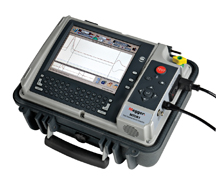
 Mees
Mees
