Hackaday [Unofficial]
TDR For Auto Diagnostics Done On The Cheap
https://fed.brid.gy/r/https://hackaday.com/2026/05/04/tdr-for-auto-diagnostics-done-on-the-cheap/
TDR For Auto Diagnostics Done On The Cheap
https://fed.brid.gy/r/https://hackaday.com/2026/05/04/tdr-for-auto-diagnostics-done-on-the-cheap/
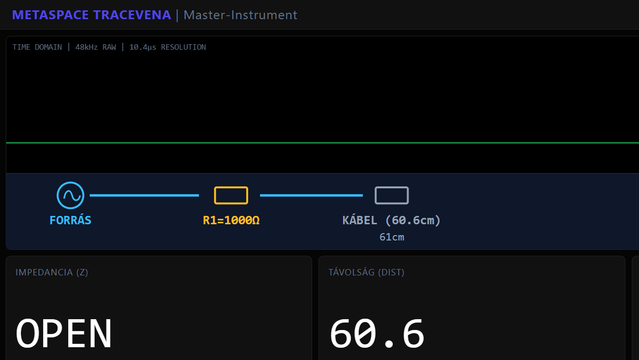
I never tried TDR (Time Domain Reflectometry) on the #nanovna_v2 before, but it turns out to be quite accurate! 😃
Once calibrated and configured with the right velocity factor (66% for RG-58), the length of the cable is seen as a major reflection from the non-terminated far end.
TDR analysis has always been a bit of magical, it’s like you’re able to look inside the cable and observe what’s going on in there.
At work we have really high bandwidth instruments, providing fantastic TDR resolution - but this little unit does quite well too 👍🏼🙂
I might be going on a field trip in a week where this could come in handy - stay tuned 👌🏻
#hamradio #timedomainreflectometer #nanovna #testandmeasurement #rfengineering #rfengineer #electronics #electronicsengineering
Relatively recently, I got interested in time-domain reflectometry, which is essentially just sending a pulse down a cable and measuring the amount of time for its reflection to return.
It's useful for testing long cables and finding where there's a break.
I bought a little device that plugs into my oscilloscope and provides a USB-powered low-frequency oscillator for doing this. (Total kit cost is <$400.)
It also provided a good "object lesson" by showing me that the signal traveled through some coaxial cable only at about 66% of c, reminding me about that last part of its definition as the speed of light *in a vacuum*.
That's only about 1.9 × 10^8 m/s.
According to a quote from "Computer Networks - A Systems Approach (5th Ed)", a signal through copper wire could propagate at 2.3 × 10^8 m/s and through optical fiber it's just 2.0 × 10^8 m/s.

 Søren Kjærsgaard
 John Carlsen 🇺🇸🇳🇱🇪🇺