The Best of FYFD 2024

Welcome to another year and another look back at FYFD’s most popular posts. (You can find previous editions, too, for 2023, 2022, 2021, 2020, 2019, 2018, 2017, 2016, 2015, and 2014. Whew, that’s a lot!) Here are some of 2024’s most popular topics:

  • The Taum Sauk Dam Failure and Its Legacy
  • Stretching Ant Rafts
  • Gigapixel Supernova
  • Feynman’s Sprinkler Solved
  • Calming the Waves
  • “Dew Point” Deposits Droplets
  • Drying Unaffected by Humidity
  • Trapped in a Taylor Column
  • Exciting a Flame in a Trough
  • Remembering Rivers Past
  • A Comet’s Tail
  • Light Pillars
  • Liquid Metal Printing
  • The Miscible Faraday Instability
  • A Triangular Prominence

This year’s topics are a good mix: fundamental research, civil engineering applications, geophysics, astrophysics, art, and one good old-fashioned brain teaser. Interested in what 2025 will hold? There are lots of ways to follow along so that you don’t miss a post.

And if you enjoy FYFD, please remember that it’s a reader-supported website. I don’t run ads, and it’s been years since my last sponsored post. You can help support the site by becoming a patronbuying some merch, or simply by sharing on social media. And if you find yourself struggling to remember to check the website, remember you can get FYFD in your inbox every two weeks with our newsletter. Happy New Year!

(Image credits: dam – Practical Engineering, ants – C. Chen et al., supernova – NOIRLab, sprinkler – K. Wang et al., wave tank – L-P. Euvé et al., “Dew Point” – L. Clark, paint – M. Huisman et al., iceberg – D. Fox, flame trough – S. Mould, sign – B. Willen, comet – S. Li, light pillars – N. Liao, chair – MIT News, Faraday instability – G. Louis et al., prominence – A. Vanoni)

#admin #ants #astrophysics #civilEngineering #comet #damFailure #drying #flowVisualization #fluidDynamics #fluidsAsArt #FYFD #instability #physics #plasma #rivers #rotatingFlow #science #selfExcitedOscillation #TaylorColumn #waveInterference

How Magnetic Fields Shape Core Flows

The Earth’s inner core is a hot, solid iron-rich alloy surrounded by a cooler, liquid outer core. The convection and rotation in this outer core creates our magnetic fields, but those magnetic fields can, in turn, affect the liquid metal flowing inside the Earth. Most of our models for these planetary flows are simplified — dropping this feedback where the flow-induced magnetic field affects the flow.

The simplification used, the Taylor-Proudman theorem, assumes that in a rotating flow, the flow won’t cross certain boundaries. (To see this in action, check out this Taylor column video.) The trouble is, our measurements of the Earth’s actual interior flows don’t obey the theorem. Instead, they show flows crossing that imaginary boundary.

To explore this problem, researchers built a “Little Earth Experiment” that placed a rotating tank (representing the Earth’s inner and outer core) filled with a transparent, magnetically-active fluid inside a giant magnetic. This setup allowed researchers to demonstrate that, in planetary-like flows, the magnetic field can create flow across the Taylor-Proudman boundary. (Image credit: C. Finley et al.; research credit: A. Pothérat et al.; via APS Physics)

#fluidDynamics #magnetohydrodynamics #physics #planetaryScience #rotatingFlow #science #TaylorColumn #TaylorProudmanTheorem

Taylor–Proudman theorem - Wikipedia

The world’s largest iceberg, A23a, is stuck. It’s not beached; there are a thousand meters or more of water beneath it. But thanks to a quirk of the Earth’s rotation, combined with underwater topology, A23a is stuck in place, spinning slowly for the foreseeable future. A23a is trapped in what’s known as a Taylor column, a rotating column of fluid that forms above submerged objects in a rotating flow. You can see the same dynamics in a simple tabletop tank.

Pirie Bank sticks up from the seafloor, which sets up a stationary column of rotating water that iceberg A23a is now stuck in.

When a tank (or planet) is rotating steadily, there’s little variation in flow with depth. With an obstacle at the deepest layer — in this case, an underwater rise known as the Pirie Bank — water cannot pass through that lowest layer. And that deflection extends to all the layers above. The water above Pirie Bank just stays there, as if the entire column is an independent object. Caught inside this region, A23a will remain imprisoned there. How long will that last? There’s no way to know for sure, but a scientific buoy in another nearby Taylor column has been hanging out there for 4 years and counting. (Image credit: A23a – D. Fox/BAS, diagram – IBSCO/NASA; via BBC News; submitted by Anne R.)

https://fyfluiddynamics.com/2024/08/trapped-in-a-taylor-column/

#fluidDynamics #geophysics #oceanography #physics #rotatingFlow #science #TaylorColumn

FYFD

Celebrating the physics of all that flows

FYFD

[The parentheses are my edits / additions. When reviewing the study & the quotes by Dr. Brearley, the statement about #melting #icebergs not contributing to #SeaLevelRise appears to be specific only to icebergs that melt in a #TaylorColumn. The author of the article does not make that clear, which could lead to misunderstanding. The study was specific. Therefore #A23a’s melt will only NOT contribute to rising sea levels IF it STAYS within the vortex for the duration of its #melt.]

#Climate

…[When] the largest iceberg in the world …[melts, it will not]… flood* the southern hemisphere. Melting icebergs & removal of floating ice shelves do not directly cause #SeaLevelRise*, Dr. Brearley said.

[*specifically due to melting in a #TaylorColumn; see pic & study link]

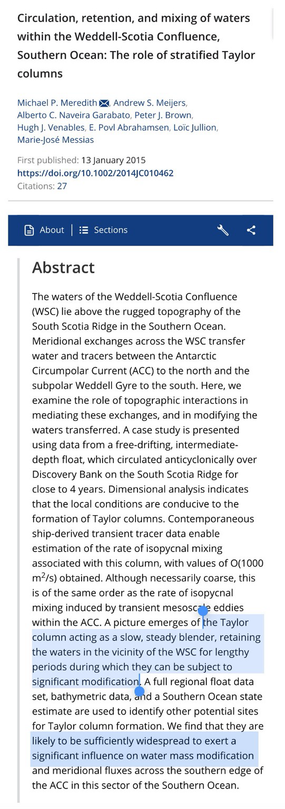
Brearley cited a 2015 study that observed a robotic float, in a fleet of instruments that drift in #ocean currents to measure water temp, trapped in a Taylor column for 4yrs NE of #A23a’s location.

https://agupubs.onlinelibrary.wiley.com/doi/10.1002/2014JC010462

“It’s basically just sitting there, spinning around & it will very slowly #melt — as long as it stays there. What we don’t know is how quickly it will… come out of this,” said Alex Brearley, an #oceanographer & head of Open #Oceans research grp at the British #Antarctic Survey.

#Iceberg #A23a is caught in a #TaylorColumn, a current that forms around seamounts. Standard flow diverges around the mount & creates a stagnant cylinder of fluids above it, slowly rotating the water counterclockwise.