EP 331: The Enchanted Pomegranate Branch and the Beauty (Kunos)
Listen Here
Watch Here
The Enchanted Pomegranate Branch and the Beauty
There was once a Padishah who, while being very bored, decided to take a trip with his Vezir. Before setting out, however, he called his Vezir and said: “So that our departure may be a secret, find a man that looks like me and set him on the throne.” The Vezir asked how he could be found. ” Let’s walk around the town for a few days and we shall find one,” said the Padishah. Disguising themselves, they put the plan into action.
Entering a pub for some refreshment, they saw a drunk who was the spitting image of the Padishah. So, they took the publican aside and told him to “let the man drink until he was drunker than a boiled owl, and when night came to throw him out into the street”. This was done, and at midnight the Padishah sent the Vezir to secretly bring the man to the palace. There the fellow was washed, put in the royal robes, and laid out on the Padishah’s own bed. Now everything was ready for the monarch and his Vezir to start their journey.
When the drunken fellow awoke the next morning he saw that he was in the King’s palace. “What did I do?” he asked himself. “Maybe I am dreaming, or perhaps I am dead and in heaven.” After these reflections he clapped his hands, and immediately servants brought him a washbasin and a cup of water. Having washed, he drank coffee, and lit his chibouque. “I must be Padishah,” he mused. As it was Friday the servants begged him to be pleased to say where the guest should be met. In the quarter where he used to live, was a djami or orator, so he decided that the conversation should be held there, and all hurried away to get ready.
A fortnight had elapsed since the drunkard had left his own home, and when his wife heard that the Padishah was coming to the local djami, she prepared a petition, which she handed to him as he was leaving the mosque after the conversation. The Padishah took the petition and read as follows: “Oh Padishah! I have a husband who does nothing but drink night and day. He has not been home now for fifteen days, nor sent me any money for provisions, so that we are dying of hunger.” The Padishah immediately gave orders that the woman’s dwelling should be pulled down and rebuilt on a better plan, and also that a monthly pension of five hundred gold pieces should be given to her. This was done.
The new Padishah had three enemies: the innkeeper who threw him out into the street when he was drunk, the butcher who had beaten him because he could not pay for the meat, and a restaurant owner who wouldn’t feed him. He gave orders that they should be beheaded, and this was done.
In the meantime the real Padishah and his Vezir had already travelled a considerable distance. One day, they came to a valley, where they decided to stop and rest for a while. In a stream that flowed through the valley they found an apple, which they ate. Now the Padishah recollected that when setting out he had taken an oath to do nothing that was forbidden while on his journey. This gave him uneasiness, since he had no means of knowing whether it was permitted to eat the apple or not. ” There is nothing for it,” said the Padishah, “but to go to the owner and ask permission now.”
As they went along they came across a farmer ploughing. Greeting him, they told him about the apple, and when the story was finished, the farmer showed them an orchard with apple-trees from which the apple they had eaten had fallen. He also pointed out the house of the owner of the orchard, and there the Padishah and his Vezir went immediately. They knocked on the door, which was opened by an old woman, and to her also they related the incident of the apple. The old woman, saying that the apple-trees belonged to her daughter, went to consult her about the matter. The daughter sent back a message that if the man would marry her, permission to eat the apple was granted. The Padishah considered the question and finally agreed to make the maiden his wife.
When she heard this the old woman said: “Then I must tell you that my daughter’s legs and arms are crooked, she is bald, and altogether so ugly that no man can bear the sight of her.” “Don’t worry,” replied the Padishah, “I won’t break my promise.” He told his Vezir to prepare a wedding for that very day, as the next morning they must be off again. They now went to a neighboring pub to prepare for the wedding.
As soon as the maiden was presented to him, the Padishah was wonderstruck. “My Sultana,” he exclaimed, “your mother said you were ugly; while, behold, you are the loveliest creature in the world!” The maiden said that her mother was accustomed to always speak of her that way.
The wedding took place, and the next day the Vezir reminded the Padishah that they must proceed. The monarch, however, replied that he had made up his mind to remain at the inn four or five more days. As a matter of fact, he remained forty days, and on the forty-first he said to his wife: “My Sultana, I cannot remain here any longer; I must go. If you should have a son, when he is grown up, bind this amulet to his arm, send him into such and such a country, and tell him to inquire for Osman and Hamza.” These were the names the Padishah and his Vezir had decided to use upon their travels.
They mounted their horses and rode away, not stopping until they reached home. After arriving at the palace, the first thing they did was to get rid of the fake Padishah. So at midnight, while he slept, they put him into a basket and set him down by the pub where they found him a few months ago. When the man woke up, he found himself lying in the street, “I must be dreaming,” he said, and closed his eyes again. Then he clapped his hands, whereupon the new publican appeared, asking: “Who is there?” The drunkard told him to stop joking or he would be hanged immediately.
“Open the door; I am the Padishah,” he called loudly. The landlord opened the door, and seeing the drunkard kicked him away. The latter in a towering rage exclaimed: “You rascal; I am the Padishah, and I will certainly hang you for this.” In reply the innkeeper took a stick and beat the self styled Padishah until he was in a lather, afterwards he was taken to the madhouse.
Meanwhile the Padishah said to his Vezir: “Oh, lala, we brought the man to the palace, and after he had served our purpose we cast him away. Go and see what has become of him.” So the Vezir went to the publican and learned that the drunk had gone mad and been taken to the asylum. Going to the lunatic asylum, the Vezir heard the man shouting that he was the Padishah. The Vezir told him not to say that he was the Padishah, or it would get worse. Reading the tea leaves, the man went to the owner of the pub and said: “Sir, I am a drunk and not the Padishah.” After this confession he was no longer insane, and so he was set free.
His first thought was to go home, but hardly had his wife set eyes on him than she cried: “Get out of my sight, you graceless fellow. Where have you been all this time? You have heard no doubt that the Padishah has built me a new house and granted me a pension, and so now you come to share it!” The woman would not have let him in, but the Vezir happened to be passing by and heard the angry fighting. Going up to her he said: “Let your husband in, or I will take everything from you.” Recognizing the Vezir, the woman’s courage failed her and she let her husband into the house.
Leaving this worthy couple in peace, we will now return to the owner of the orchard. In due time a son was born to her. When he grew up his mother, remembering the Padishah’s instructions, called her son to her. “Your father,” she said, “left you this amulet, saying that when you grow up, you were to go to his country and ask for Osman and Hamza.” Upon hearing this the youth took the amulet and prepared for his journey.
On the way he met the farmer, with whom he rested a little. During their conversation the farmer told the youth that Osman was his friend, and he advised him not to go alone. The boy agreed to take the farmer’s son with him, and the two set out again. By and by they came to a well, and being overcome with thirst the farmer’s son said to the youth: “I will let you down first, so that you may drink; afterwards you let me down.”
The Shahzada accordingly was lowered into the well, but when he had quenched his thirst and was ready to return to the top, the farmer’s son called down to him: “Swear you will say that I am the son of Osman and that you are the son of the farmer, and promise never to reveal the truth, or I will leave you down there.” He had no choice, so the Shahzada promised and was pulled up to the surface.
They went on and in a few weeks they arrived at the capital of the Padishah’s kingdom. They wandered about the town asking for Osman and Hamza, and when the Padishah heard, he ordered the boys to be brought before him. They were taken to the palace, and when the King asked which one was his son, the Shahzada pointed to the other and named himself as the son of the farmer. So the farm boy was taken into the palace as a prince, and the other given a job in the court.
Once, in a dream, the fake Prince saw a dervish who presented to him the Princess and gave him the chalice of love. From that time he was a changed man. He couldn’t eat nor drink, sleep nor rest, and he became pale and weak. Physicians and hodjas were called in one after another, but none of them did him any good; they did not understand his illness, and so could not find a remedy.
One day the false Prince said to the Padishah: “My father, physicians and hodjas cannot help me. My illness is a love for the princess.” The King was frightened at the youth’s strange words and feared for his reason. “You must not think of her; it is dangerous,” said the monarch; “her love would bring only death.”
But the young man continued to get thinner and paler. The Padishah asked him whether he wanted anything, but the answer was invariably the same: “The Princess.”
The King felt that his son would surely die if he said no and that he would be the cause of his death. So trusting that Allah would have mercy upon him, he was about to agree to his son’s travel, when the fake Prince said: “I do not want to go; let’s send the farmer’s son to get her for me.” The Padishah immediately sent for the farmer’s son, and told him to go in search of the Princess and to bring her to marry the Shahzada.
The next day the youth set off in search of the Princess. After some time he came to the seashore, where he saw a little fish floundering on the sand. The creature asked him to throw it back into the water, and he agreed; but first the fish offered him three of its scales, saying: “When you are in trouble, burn one of these scales.” Accepting them gratefully, the youth threw the fish back into the sea and went his way.
Coming to a great plain he met an ant, who begged for his help, as it was going to a wedding and would be too late to join its companions. The young man picked up the ant and carried it to its companions. Before leaving, the insect offered him a piece of its wing, saying: “When in trouble burn this piece of my wing.”
Dispirited and weary, the fake farmer’s son at length reached a thick forest, where he saw a small bird struggling with a large snake. The bird asked for help from the youth, who promptly cut the snake in two. In return the bird gave him three of her feathers, saying: “When in trouble burn one of these.”
Once more he went over mountains and sea until he came to a large city. He was now in the kingdom of the father of the Princess. Going directly to the palace, he begged in the name of Allah that the Padishah would give him his daughter in marriage.
“First you must accomplish three tasks,” said the Padishah, “and then you may speak to my daughter.” The monarch then took a ring, cast it into the sea, and told the Prince to bring it back again in three days or his life would be forfeit.
The Prince thought deeply, and recollecting the three fish-scales he burnt one of them. Immediately the little fish appeared and said: “What is your command, my Sultan?”
“The ring of the Princess has fallen into the sea; fetch it for me,” replied the Prince. The fish went after the ring, but could not find it; down it went a second time, without success; diving a third time, it went right down, down to the bottom of the seventh sea and brought up a fish. The Prince slit its stomach and found the ring inside. He gave it back to the Padishah, who handed it to his daughter.
In the neighbourhood of the palace was a cave, filled with a mixture of ash and millet. “Your second task,” said the Padishah, “is to separate the ash from the millet.” The Prince went to the cave and burnt the ant’s wing, whereupon all the ants in the world appeared and set about the work. The task was thus finished that very day, and in the evening the Padishah came and satisfied himself that not a grain had been overlooked.
“One task remains to be done,” said the Padishah, “and then I will take you to my daughter.” Calling a female slave to him, the King split her head open and said to the youth: “Thus shall your own head be split if you cannot restore her to life.” The youth left the palace wondering whether the bird’s feather would help him. He burnt one, and straightway the little bird appeared and awaited his commands. With a heavy heart the Prince related the difficult task that had been set before him. Now the bird belonged to the Peris, and flying up in the air out of sight it soon reappeared with a jug of water. “Here,” said the bird, “this is some water of Paradise which will restore the dead to life.” Taking it to the palace the Prince sprinkled some over the corpse, and the maiden arose immediately as though just awakened from sleep.
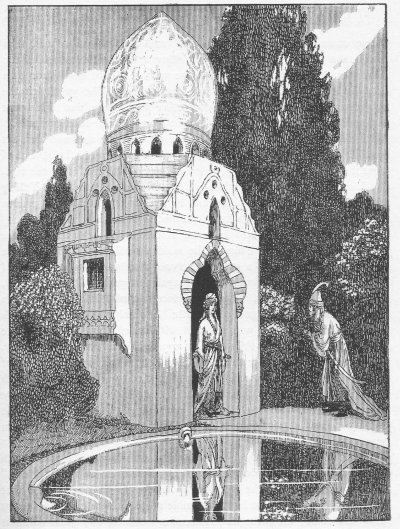
The Princess was informed of the youth’s exploits, and she got ready to meet him. The maiden hid in a small marble kiosk, before which was a golden reservoir, and water poured into it from four sides. In the court was a magnificent garden, filled with trees, flowers, and singing-birds. When the Prince saw all of this, it seemed as though he were at the gates of Paradise.
Suddenly the door of the kiosk opened, and the garden was wrapped in light. The Princess now appeared in all her radiant beauty. She approached the Prince to address him, but no sooner did she look at him than she fainted. She was carried to the kiosk and when she came to she said: “Oh, Prince, you are the son of Shah Suleiman, and you can help me. In the garden of the Reh-Dew a pomegranate branch sings; if you will bring it to me I am yours forever!”
The youth went far away to fulfil the Princess’s quest. For a month he wandered. “Oh, Allah, Creator of all things,” he prayed,” show me the right way.” Presently he reached the foot of a mountain. There he heard a terrible noise, as though the Judgment Day had come; the rocks and mountains trembled, and an evil darkness fell. As the youth bravely went toward the noise, it increased and became even more terrifying, all the while he was enveloped in a whirlwind of dust and smoke. He could not tell whether he was on the right road, but he knew that a six months’ journey should bring him to the garden of the Reh-Dew and that the awful noise was created by the talismans of the Dew.
Continuing on his way, a little garden came into view. On the gate were the shrieking talismans and also a guard. The Prince went to him and told him what he wanted. “Why were you not terrified by the great noise?” asked the astonished guard. “All the talismans were on alert because of you; they even scared me.” The Prince asked about the pomegranate branch. “It is hard to get,” said the guard gravely; “but if you aren’t a coward you might succeed. At the end of a three months’ journey you will arrive at another place similar to this, with other talismans; there you will find another garden, the guard of which is my mother. But do not go near her; wait until she comes to you. Give her my greeting, but do not tell her your business until she questions you.”
The youth now took the road pointed out to him, and after going for three months he heard an awful sound that seemed impossible to describe. This was the large garden of the Reh-Dew, and the noise came from his talismans. The youth hid himself behind a rock, and saw a human form which was that of an old woman about ninety years old. Her hair was snow-white, her eyelids red, her eyebrows like two arrows, her eyes gleamed fire, her fingernails were two yards long; and she leaned on a staff as she sniffed the air. She was the guardian of the garden. Coming up to the youth, she demanded to know what he was doing there. The Prince gave her a greeting from her son. “The little jerk!” she wheezed; “So you have met him, eh? Did my miserable son think I should have mercy on you that he sent you to me? I’ll soon end you.” So saying she seized the youth and shook him fiercely.
The Prince didn’t know what had happened; he saw only that he was on the back of something that had neither eyes nor ears, and was shrivelled up like a toad. This creature was running off with him, taking gigantic strides and springing over seas at a single bound. Suddenly the hideous thing set him down, and said: “Whatever you hear, whatever you see, be careful not to speak of it, or you are lost!” In a moment it was gone.
As in a dream the Prince now saw an endless garden, with streams and waterfalls, and trees, flowers, and fruit. All around was the sound of song birds as though the air itself were song. Looking around, the youth entered the garden, and heard a heartbreaking sound of weeping. Remembering the pomegranate branch he began to look for it. In the middle of the garden was a small conservatory, and in it hung a number of pomegranates. He plucked a branch, and at once a fearful cry was heard: “A mortal is killing us!” Seized with dread, the youth fled from the garden.
“Quick! Run!” shouted the nameless thing waiting at the gate. He jumped on its back, and with one bound he was on the other side of the sea. Now for the first time the youth looked at the pomegranate branch. He saw there were fifty pomegranates, each of which sang a different song, as though all the music of the world were brought together there. Next he met the old woman who was ninety years old.
“Take good care of the pomegranate branch,” said the old woman; “never let it out of your sight. If you can listen to it throughout your wedding day the pomegranates will love you; you need fear nothing, for they will protect you in any trouble.”
Taking leave of the mother, the Prince went to her son, who told him to listen to the old woman’s advice. Then the youth made his way to the Princess.
The maiden awaited him anxiously, for she loved the Prince so fondly that her days were filled with fear on his behalf, lest any misfortune befall him. The maiden hurried to meet the Prince, and the pomegranate branch chanted the union of their two hearts in such exquisite strains that they seemed to be lifted up from this earth to the Paradise of Allah. Their wedding lasted forty days and forty nights, and all the time they listened to the singing of the pomegranates. When the feast ended the Prince said: “Like yourself, I have a father and mother. We have already celebrated our marriage here; we will now go to my parents and celebrate it there also.” Accordingly they set out on the following day.
When they arrived, the youth went to the Padishah and reported that he had succeeded in bringing the Princess with him. The King praised him for his bravery and skill, and gave him a valuable present. Then he made preparations for the Princess’s marriage to the fake Shahzada. When the maiden saw that it was intended to marry her to the fake Prince, she struck him in the face. He ran to the Padishah to complain, and the monarch, suspecting there was more than meets the eye, went to the maiden and begged her to explain such conduct.
The Princess implored the Padishah not to allow the marriage to take place until the farmer’s son had been put to death. So the King ordered the youth to be brought before him, and he was beheaded in his presence. Immediately the Princess took Paradise water, sprinkled the body of the youth, and at once he arose.
“Now,” said the Princess, “you have died and risen again; so you are released from your oath, and can tell all that has befallen you.” On this the youth related how, after leaving his mother, he met with the farmer’s son. He spoke of the incident at the well, and of everything connected with his perilous quest for the Princess. He also established his identity by showing the amulet he had received from his mother.
Being convinced that the youth was truly his son, the Padishah embraced and kissed him repeatedly. The impostor was executed, and the Prince’s mother was brought to the palace in time for the wedding of her son with the Princess.
The End
Source: Forty-four Turkish fairy tales by Ignácz Kúnos
#Fairy #Magic #Marriage #podcast #publicDomain #TalkingAnimals Sandman Stories Presents
 codejester
 The Muse of Last Resort
 PregNuki Raccoon: Shitposting for 2 (at least!)
 Ysann
Ysann
 Anime of Japan

 Bello Bear